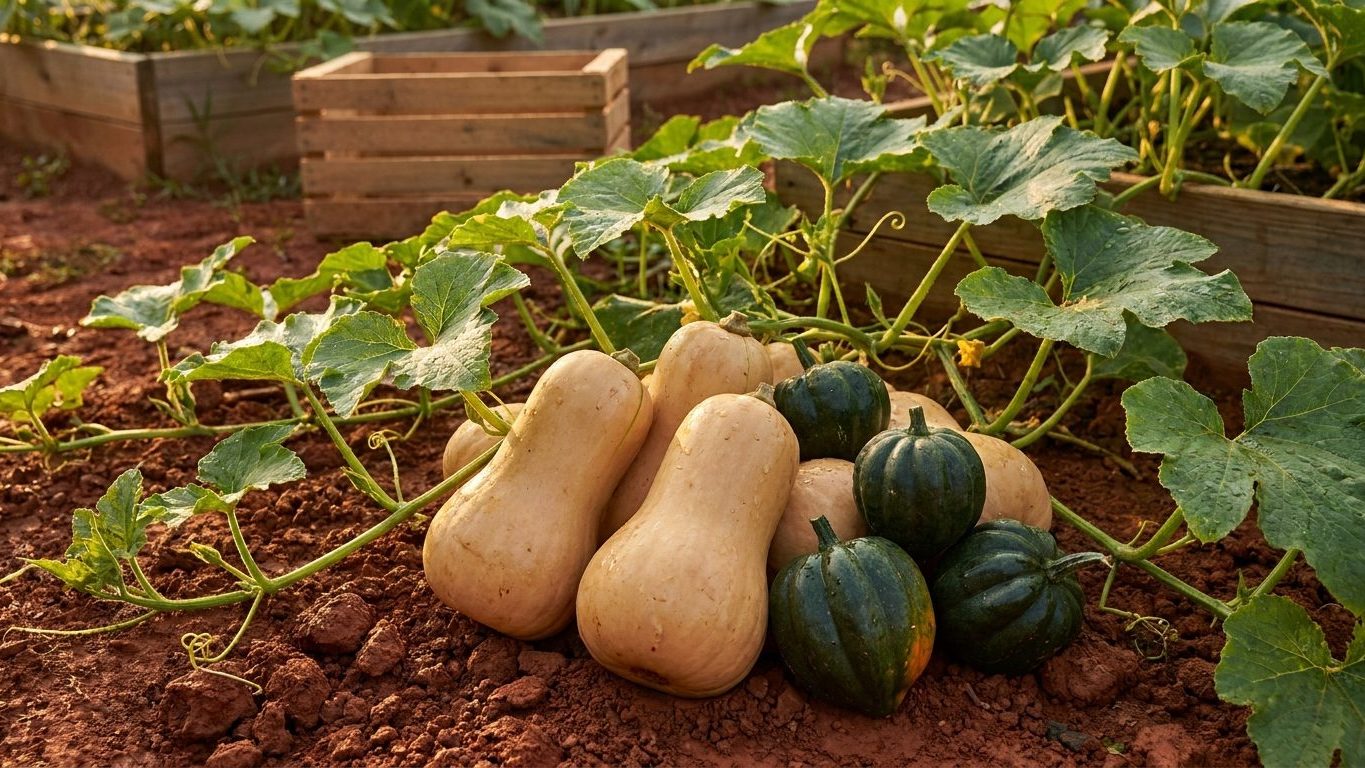

Short-season, cool-tolerant winter squash beat long-season, heat-hungry ones here. With zero days a year reaching 90°F and a frost-free window that runs, on average, from May 30 to October 17, Newfoundland and Labrador gardeners do best with Hokkaido-type and bush acorn squash rather than butternut or giant Hubbard.
The short answer for Newfoundland and Labrador
Start with the two numbers that actually decide this: 0.0 days above 90°F and a mean frost-free stretch of about 140 days (May 30 to October 17) at the St. John’s A reference station. Winter squash don’t just need days without frost. They need heat units to push a vine from flower to fruit to a rind hard enough for storage. A season with no real heat surge asks a lot of any squash bred for a hot Midwest or Mid-Atlantic summer.
That points the choice toward type rather than toward a single named variety. Squash bred for cool, short summers, the Hokkaido and Red Kuri lines of Cucurbita maxima, bush-habit acorn squash, and compact buttercup types, are built to set fruit and finish ripening without a heat spike. They were largely developed in northern Japan and Scandinavia for exactly this kind of climate: damp, cool, short. Butternut and other Cucurbita moschata types run the other way. They want sustained warmth through the whole season and tend to sulk, or simply run out of time, when nights stay cool and there’s no 90°F stretch to speed things along.
| Type | Season length needed | Heat requirement | Fit for NL |
|---|---|---|---|
| Hokkaido / Red Kuri (maxima) | Short | Low | Good |
| Bush acorn (pepo) | Short | Low | Good |
| Bush buttercup (maxima) | Moderate | Low-moderate | Fair, start indoors |
| Butternut (moschata) | Long | High | Poor |
| Giant Hubbard / large storage maxima | Long | Moderate-high | Poor |
Starting from a transplant rather than direct seed buys back two to three weeks against a season that never truly heats up, and black plastic mulch under the row does real work here, warming soil in a climate that gets no help from the air above it.
What will not work here
Butternut squash is the clearest case. It belongs to Cucurbita moschata, a group that wants sustained heat from planting to curing, and a season averaging zero days above 90°F simply doesn’t deliver that, no matter how many nominal frost-free days sit on the calendar. The vines can look fine through July and still hand you a pile of half-ripe fruit in October, because the plant was never given the heat units it was bred to expect.
Giant Hubbard and other large-fruited storage maxima run into the same wall from a different direction. They need a long unbroken run of warm weeks to bulk up fruit and thicken the rind for storage. In a place where the frost-free average is 140 days and that figure is a midpoint, not a promise, half the years will run shorter. A slow-finishing giant squash has no slack left to work with.
The curing problem
Winter squash needs a warm, fairly dry stretch after harvest to cure the rind before storage. That stage usually leans on the kind of heat this region doesn’t get. With no days reaching 90°F, and summer rainfall running close to 3.6 to 3.9 inches a month even in the driest month, outdoor curing on a porch or in a shed with poor air movement risks soft spots and rot before the squash ever gets to a root cellar. Curing indoors, with a fan and a dehumidifier if the basement runs damp, does the job the weather won’t.
The spacing problem
The same rainfall numbers argue against planting sprawling vine types at the tight spacing that works in a drier state. Around 11.4 inches of rain falls across June, July, and August here, and that moisture sits on cool foliage longer than it would in a hot, drying climate. Wide spacing and open rows matter more here than the seed packet’s minimum, because slow-drying leaves in a cool, damp summer are exactly what powdery mildew and other fungal problems look for.
What changes across Newfoundland and Labrador
The 6a hardiness zone figure in these facts belongs to one place: the St. John’s reference station, on the Canadian system built from seven climate variables, not the single-variable USDA scale used elsewhere on this site. It describes the Avalon Peninsula’s milder coastal pocket. It does not describe the province.
Newfoundland and Labrador stretches from that same relatively sheltered southeastern coast across a vast interior and up into Labrador’s north, and a single zone number was never going to cover that spread. Labrador’s interior and northern coast sit further still from the conditions the frost dates describe.
None of that means guessing. It means checking the actual zone for a specific municipality on Natural Resources Canada’s Plant Hardiness Site rather than assuming the province-wide figure quoted here applies to a particular yard. This page describes a reference point, useful for understanding the type of squash that suits a cool, short-summer province in general. It was never built to tell one reader in one town which zone they garden in.
Where to check this for your own county
Newfoundland and Labrador’s Department of Fisheries, Forestry and Agriculture keeps the resources built for growers in the province, at gov.nl.ca/ffa. That’s the right next stop, and it narrows the general provincial picture down toward a specific district’s conditions.
Two things are worth hunting for there. First, a local planting calendar, if one is published for the district in question, will reflect actual local frost patterns rather than the single reference-station average. Second, look for any varieties the department or a regional agricultural office has actually trialled nearby. A variety that’s been grown and reported on in a specific part of the province carries more weight than a general type recommendation built from climate normals alone.
That district-level source, when it exists, beats the provincial picture every time. This is the provincial-level answer, built to work across a wide range of conditions from the Avalon Peninsula to Labrador. A district calendar or a regional trial result is built for a narrower place, and narrower almost always means more accurate for the garden actually being planted.
Checking this against your own garden
No date outranks what a gardener can see and feel in their own soil. Three signs settle the question of whether a particular spring, and a particular yard, is running ahead of or behind the averages quoted here.
- Soil warmth by feel: squash seed germinates poorly in cold soil no matter what the calendar says. Soil that still feels cold and damp to the hand, even weeks after the average frost date, is telling the gardener to wait, transplant instead of direct-seed, or warm the bed with dark mulch first.
- The first flush of male flowers: squash plants typically produce male blooms before the female flowers that actually set fruit. An early, strong showing of male flowers signals the plant has enough accumulated warmth behind it to move toward fruiting; a slow, thin showing suggests the season is running cooler than average that year.
- The first true leaves: the rounded seed leaves that appear first don’t tell much. It’s the first serrated true leaves, and how quickly they follow, that show whether the plant is actually growing in the current conditions or sitting stalled in soil that hasn’t caught up yet.
Taken together, these three observations describe one particular plot’s microclimate better than any provincial average can, and they’re the difference between a season that matches the averages and one that quietly runs two or three weeks behind them.