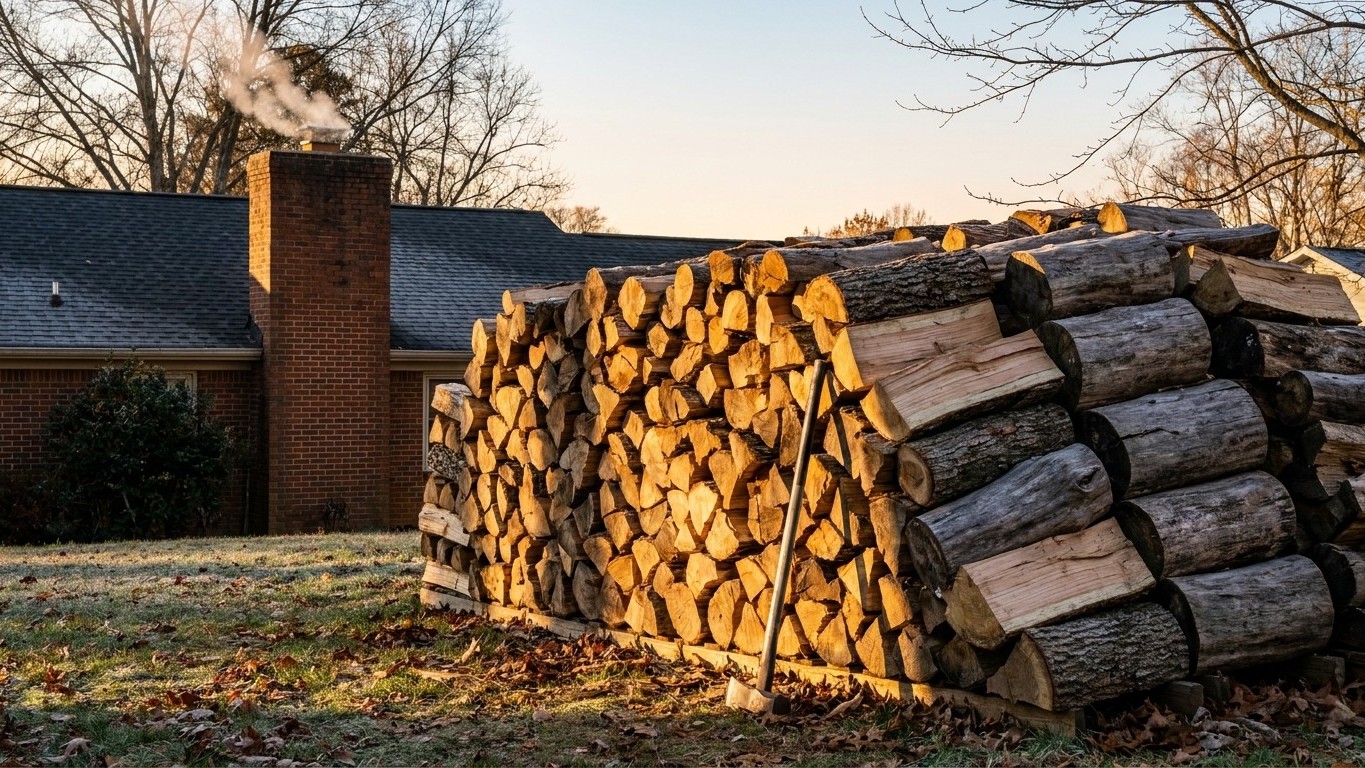

The mean low temperature in Charlotte during the coldest month sits at 31.8°F, according to NOAA’s 1991-2020 Climate Normals. That single number shapes almost every firewood decision you’ll make in North Carolina: how many cords to stack, which species earn their space in the woodshed, and how much drying time you actually have before the first real cold snap. This guide walks through what that figure means for your wood pile, species by species.
How cold it actually gets here

31.8°F isn’t the record low, and it isn’t some abstract yearly average. It’s the mean daily minimum for the coldest month at Charlotte, the reference station for this part of the state. That means on a typical night during peak winter, the mercury drops to around 32°F, not the single brutal night that makes the news, but the baseline you’re dealing with over and over for weeks.
That number puts North Carolina in a middle zone. It’s cold enough that a wood stove or insert does real work here, not just decoration. But it’s nowhere near the sustained sub-zero stretches that force households in the upper Midwest or northern New England to burn around the clock just to keep pipes from freezing. Here, a woodstove is often supplementing a furnace or heat pump rather than replacing one outright, especially in the Piedmont and coastal plain. In the mountains, where elevation pushes actual local temperatures colder than the Charlotte reference figure, wood heat leans more toward necessity.
What a 31.8°F average low means for your stove
A mean minimum just above freezing means you’re rarely fighting to keep a house from freezing solid. What you’re fighting is the cost and hassle of running a furnace non-stop for three or four months. Wood heat in this climate earns its keep by cutting into that furnace runtime on the cold mornings and evenings when the temperature sits in the 30s, not by being the only thing standing between you and hypothermia.
That distinction matters when you’re picking species and volume. A household in a genuinely brutal climate has to prioritize density above everything else, because every cubic foot of wood needs to carry maximum heat. A North Carolina household has more room to also weigh convenience, cost, and what’s actually sitting at the local firewood lot. Density still matters, especially on the handful of nights each winter when temperatures drop hard, but it’s not the only variable calling the shots.
Which woods are worth the effort here
Start from the one number that’s actually documented: a cord of well-seasoned hardwood carries about 20 million BTU, according to Michigan State University Extension. That’s an average across hardwood species, and it moves a lot depending on which species you’re burning and how dry it actually is. A cord, worth restating because it’s the most common way buyers get shorted, is a stack measuring 4 feet by 4 feet by 8 feet, or 128 cubic feet of stacked wood, not a loosely tossed pile that looks about that size.
Because a cord is a fixed volume, density is what decides how many pounds of actual wood fiber, and therefore how much heat, you’re getting in that box. Denser hardwoods pack more wood mass into the same 128 cubic feet, which pushes the heat output above that 20-million-BTU average. Lighter, less dense woods pack less mass into the same space, pulling the output down. That’s the entire logic behind choosing one species over another once seasoning is equal.
In North Carolina, that plays out as a split between the state’s dense native hardwoods, oak and hickory chief among them, and its lighter, faster-burning woods like pine and poplar. The dense woods are what you want stacked closest to the stove for the coldest nights and for an overnight burn you don’t want to tend at 2 a.m. The lighter woods have their place too: they light faster, they’re forgiving in the shoulder-season weeks of October and April when you just want to take the chill off, and they’re often what’s cheapest and easiest to find seasoned.
That last point deserves more weight than it usually gets. A dense species you can only find green, or can’t find at all, is worse than a lighter species you can actually get seasoned and stacked before winter. Local supply decides as much as the table below does.
| Wood category | Heat output vs. 20M BTU/cord average | Smoke | Sparks |
|---|---|---|---|
| Dense hardwoods (oak, hickory) | Above average | Low once fully seasoned | Low |
| Medium hardwoods (maple, ash) | Near average | Moderate | Low to moderate |
| Light/softer woods (pine, poplar) | Below average | Higher, especially if not fully dry | Higher, more prone to popping |
Use the dense end of that table for the nights that follow the 31.8°F pattern described above, and the lighter end for kindling, quick fires, and the weeks when you’re barely running the stove at all.
How much wood a winter takes
There’s no honest single number for how many cords a North Carolina winter takes, and anyone quoting you one without asking about your house is guessing. What actually decides the answer are three variables, and they interact enough that the same climate can produce wildly different cord counts from one house to the next.
- The cold itself: a winter that regularly bottoms out near that 31.8°F mean low burns less wood overall than a mountain property sitting well below that reference figure, even a few hundred feet of elevation change shifts the math.
- How well the house holds heat: insulation, air sealing, window quality, and even how open the floor plan is around the stove all decide how much of the heat you generate actually stays inside instead of leaking out.
- Wood’s role in the heating plan: a household burning wood as the sole heat source needs several times the volume of a household running wood alongside a furnace or heat pump on the coldest days only.
The mechanism that makes these variables move the needle so much is straightforward: a poorly insulated house in a hard winter can burn roughly double what a tight, well-sealed house uses in the exact same climate, because so much of the generated heat simply escapes before it does any work. That’s why a published “North Carolina households burn X cords a year” figure is close to meaningless. Two neighbors on the same street, both burning oak, both facing the same 31.8°F average low, can land on very different cord counts once you account for how their houses were built and sealed.
The practical move is to track your own first winter rather than trust a general figure. Note how many cords you go through, how cold it got, and how the house felt, then adjust the following year based on that, not on a number that assumes a house you don’t actually own.
Drying wood in this climate
Seasoning matters more than species choice everywhere, and North Carolina’s humid summers make the timeline slower than it would be in a drier climate. Green wood can carry over 60 percent moisture, according to Michigan State University Extension, and all of that water has to boil off before the wood gives you any usable heat. That boiling process eats the very energy you were trying to burn for warmth, which is why wet wood hisses, smokes, and underperforms no matter how dense the species.
The target, regardless of where you live, is 20 percent moisture or less. What gets wood there is airflow and time, not direct sun, so stacking split wood loosely enough that air moves freely through the pile matters more than where the pile sits. A shaded spot with good cross-breeze dries wood just as well as a sunny one, often better, since sun mainly dries the outside while trapping moisture inside unsplit rounds.
The spring-cutting mistake
Wood cut and split in spring for the coming winter is, in most cases, not going to be ready. A full summer of stacked drying time is the general minimum for reaching that 20-percent target, and North Carolina’s humid summer air stretches that clock compared to a drier climate. Red oak is a documented exception worth knowing specifically: MSU notes it dries more slowly than other hardwoods because of its cell structure, so wood cut this spring for red oak in particular needs even more lead time than other species cut the same week.
The fix is planning a full year ahead rather than a single season. Wood split and stacked in spring is a reasonable target for burning the following winter, not the one arriving in a few months. Anyone buying “seasoned” wood late in the year should ask when it was actually split, since a few months on a truck or in an unstacked pile isn’t the same as a full season of open-air drying.