
Vancouver’s coldest month averages a low of 33.5°F, according to Environment and Climate Change Canada’s 1981-2010 normals. That single figure shapes almost everything about firewood in British Columbia: how many cords a household burns, whether a dense hardwood is worth chasing down, and how long a stack needs to sit before it’s ready to burn. This guide works through what that number means for wood choice, quantity, and drying time.
How cold it actually gets here

Start with the number itself: 33.5°F. That’s the mean daily minimum for the coldest month at the Vancouver reference station, not the record low and not some scary once-a-decade snap. It’s the average low you’d expect on a typical night in January, year after year. For a coastal climate, that’s mild. It hovers right around freezing rather than diving into the teens or single digits the way winters do in the BC Interior, the Kootenays, or the Peace region.
What does that mean for someone stacking wood in the yard? It means a wood stove or fireplace insert in the Lower Mainland or on Vancouver Island is rarely fighting for its life against brutal cold. The furnace or heat pump is doing most of the real work on the coldest nights, and wood heat is filling in, taking the edge off, keeping a living room comfortable without the baseboard heater running nonstop. That’s a different job than what a wood stove does in Prince George or Cranbrook, where winter lows regularly sit far below freezing for weeks at a stretch.
This matters because it changes what “worth the effort” means when picking wood. In a genuinely brutal winter, the densest, hottest-burning hardwood available is close to a necessity, because the margin between enough heat and not enough gets thin. In a winter that bottoms out near 33.5°F, wood heat is closer to comfort and atmosphere than survival. That’s not a knock on it. A wood fire on a damp, 34-degree Vancouver evening does real, useful work: it dries out a room, it cuts the chill, it saves the furnace some cycles. But nobody in that climate needs to schedule their life around whether the woodpile holds out.
One caveat worth being blunt about: this figure comes from a single reference station. British Columbia is enormous and climatically split by mountain ranges, and a homeowner two hours inland or a few hundred feet higher in elevation is looking at a colder reality than 33.5°F suggests. If you’re burning wood in the Interior, in the Kootenays, or up toward the Cariboo and Peace regions, treat the coastal figure as a starting point and adjust upward, both on quantity and on how much density matters. The coastal number is the honest baseline; it isn’t a promise about what your particular valley does in February.
Which woods are worth the effort here
Once you know the winter is closer to mild than brutal, the wood question becomes less about survival and more about efficiency and practicality. That still starts with density, because a cord is a fixed volume, not a fixed weight. A cord is a stack measuring 4 feet by 4 feet by 8 feet, or 128 cubic feet total, and that measurement is exactly the same whether you’re stacking a light wood or a heavy one. What changes is how many pounds of actual wood fiber fit into that space, and pounds are where the heat comes from.
According to Michigan State University Extension, a cord of well-seasoned hardwood produces roughly 20 million BTU, which the extension service compares to about 145 gallons of #2 fuel oil or 215 gallons of LP gas. That 20 million figure is an average across seasoned hardwood generally, not a fixed number for any single species, and both the type of wood and how dry it is will push that figure up or down noticeably.
Red oak is the one species worth naming specifically here, and it comes with a warning attached rather than a recommendation to chase it down. MSU flags red oak as unusually slow to season because of its cell structure, meaning a load that looks split and stacked can still be holding more moisture than it appears. If red oak is what’s available seasoned and dry in a BC firewood yard, it’s a dense, long-burning wood suited to the coldest overnight stretches. If it’s only available green, it’s a poor choice for this winter specifically, because it needs more time than a typical hardwood to reach burnable moisture.
The broader principle matters more than any single species name: dense hardwoods, properly dried, are what you want for the coldest nights and for a fire you need to hold through several hours of sleep. Lighter, faster-burning wood has its own job, which is getting a fire started and carrying it through shoulder-season evenings when you don’t need or want a long, hot burn. What actually decides your woodpile, though, isn’t a chart. It’s what’s sold, split, and genuinely seasoned at the yards near you. A theoretically superior species you can only get green is a worse buy than a modest hardwood a local supplier has had stacked and covered for a year.
How much wood a winter takes
There’s no honest number for “cords per winter” that applies to a random BC household, and any source publishing one flat figure is glossing over the variables that actually decide it. Three things move that number more than anything else: how cold the winter actually runs, how well the house holds heat, and whether wood is the main heat source or just a supplement to a furnace or heat pump.
The cold figure from earlier sets the floor. A household near the coastal reference point, averaging lows around 33.5°F, is burning through a much gentler season than one in the Interior where lows regularly sit 20 or 30 degrees colder. Insulation and building envelope are the second variable, and they matter enormously; an older home with drafty windows, thin attic insulation, and no vapor barrier can lose heat two or three times faster than a comparably sized, well-sealed newer build in the exact same climate. The third variable is simple but often ignored: a household running wood as its sole heat source needs a fundamentally different quantity than one burning it a few evenings a week to supplement a heat pump that’s doing the real work.
Here’s the mechanism that makes those variables collide instead of just stacking neatly: a poorly insulated house sitting in a hard winter can burn close to double what a tight, well-sealed house uses in that same climate, even with an identical wood stove. That’s not a rounding error, it’s the difference between running out in February and having wood left over in April. So instead of hunting for a published average, a more useful approach is to track actual burning over one full season, note how many times the woodshed got refilled, and adjust from there based on how that winter compared to a typical one and whether any insulation or weatherization work happened in between.
Drying wood in this climate
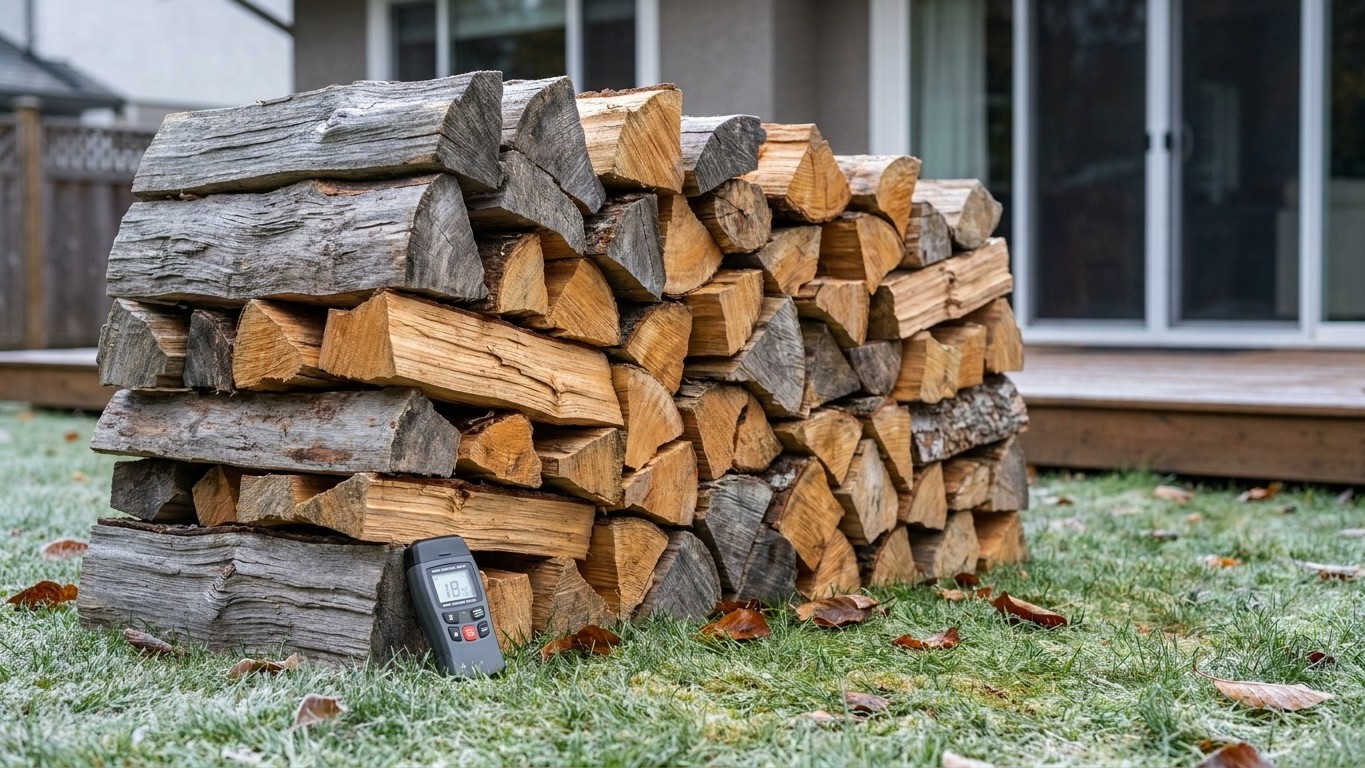
Seasoning matters more than species selection almost everywhere, and British Columbia’s damp climate makes that especially true. MSU Extension puts the target plainly: firewood should burn at 20 percent moisture or less, while green, freshly cut wood can sit above 60 percent. That extra water isn’t neutral. It has to boil off before the wood can release usable heat, and that boiling consumes energy that would otherwise be warming the room, which is exactly why green wood hisses, smokes, and burns cold.
Getting from green to 20 percent takes one full summer of proper stacking, split and arranged so air moves freely through the pile, not left as uncut rounds in a heap. In a humid coastal climate with a shorter effective drying season, that timeline can stretch longer than it would in a drier interior valley, because what actually pulls moisture out of wood is airflow and time, not direct sun. A pile baking in full sun but packed too tightly, with no airflow between rows, dries slower than a properly spaced stack sitting in partial shade.
Red oak deserves a second mention here specifically because of its slow-drying cell structure; a load that would season adequately in one summer for most hardwoods may need a second season for red oak to reach that same 20 percent target.
Tie this back to the cold figure from the start of this guide: wood split and stacked this spring is very often not ready to heat a home through this coming winter, no matter how the weather turns out. That gap between “cut recently” and “actually seasoned” is the single most common mistake among BC households buying or cutting their own firewood, and it’s also the easiest one to avoid simply by buying wood a full season ahead rather than scrambling for a supplier right as the first cold snap hits.