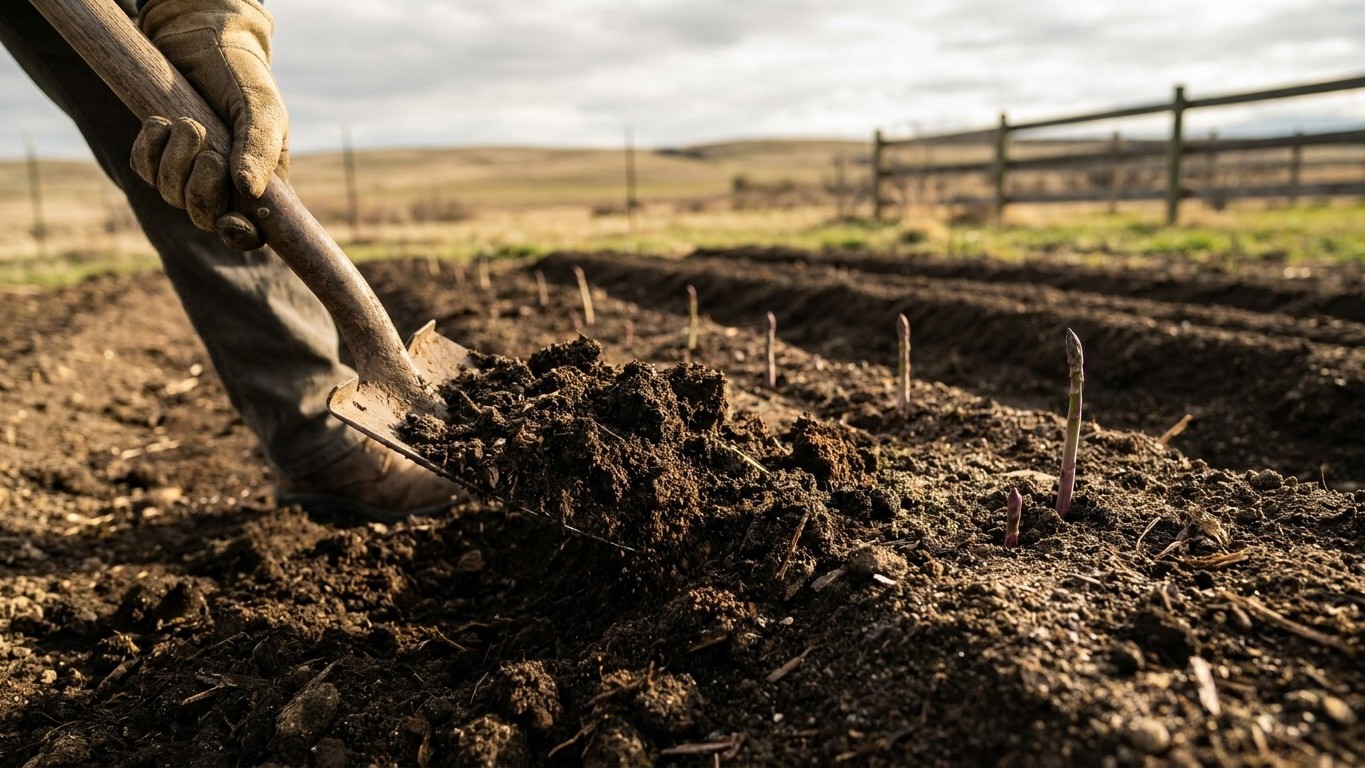

Asparagus rewards patience more than any other vegetable in the garden: plant it once, and it can keep producing for a decade or more. In California, the real question isn’t whether the climate suits asparagus, it does, but whether the ground you pick can handle a plant that isn’t going anywhere for fifteen years, and whether you’re prepared to be the one supplying nearly all its water each summer.
The short answer
an Asparagus Bed is not a seasonal commitment, so getting the timing right matters as much as getting the soil right; see this guide on When to Plant Asparagus Crowns in California before you dig. Crowns go into an 8-inch furrow, and once established the planting produces for 10 to 15 years, according to Utah State University Extension. That single fact changes how you should think about soil. A raised bed you amend every spring for tomatoes is a five-minute fix if the drainage is off. An asparagus bed you get wrong sits there, waterlogged at the crown, for the better part of two decades.
The only soil requirement the source gives is that it drains. It doesn’t ask for a particular pH, and it doesn’t specify a texture beyond “most soils will do provided they are well drained.” So the question for a California gardener is narrow: does the ground here tend to drain?
California’s representative state soil, the San Joaquin series, gives a partial answer. It’s an Alfisol, a forest soil of moderate fertility, and its surface horizon runs loam to silt: 51 percent sand, 18 percent clay, 32 percent silt, with organic matter around 0.8 percent and a surface pH near 6.1, slightly acid. USDA NRCS classifies it as moderately well drained. That’s a workable starting point for asparagus. Moderately well drained ground, with that much sand in the mix, isn’t the heavy, standing-water clay that would rot a crown over winter.
But the San Joaquin series is a map-scale average, not a diagnosis of your particular yard. California spans river bottoms, hillside decomposed granite, adobe clay flats, and any lot a builder has cut and filled. Those soils can behave nothing like the representative series, which raises the real question: Will California Soil Hold an Asparagus Bed for Fifteen Years? If your own ground stays soggy a day or two after a hard rain, or if water pools rather than soaking in within an hour, that’s the sign to act before you plant, not after. The fix is straightforward: build a raised bed or mounded row, work in organic matter to open up a clay soil, or choose a different spot on the property with better natural fall. What you don’t want to do is bury a crown in ground that holds water, then discover the problem in year four when the whole planting is already established.
Note what the source doesn’t say. It’s silent on any winter chilling requirement and silent on soil pH for asparagus specifically. Neither figure is published here, so don’t let a hardiness zone map or a general fertility rule stand in for information the source simply doesn’t give.
Will the summer here water it for you?
The Utah State University Extension guidance is specific about the water schedule: 1 to 2 inches every other week for the first two years, then 1 to 2 inches every three weeks once the planting is established. California’s climate does almost none of that work for you. NOAA’s 1991-2020 Climate Normals for the reference station put summer rainfall at about 0.1 inch total across June, July, and August, with June averaging 0.08 inch, July 0.04 inch, and August effectively 0.0 inch, the driest month of the year. In practice, an asparagus bed here runs on irrigation, not sky water, for the entire growing season.
- Years one and two: plan on supplying the full 1 to 2 inches every other week yourself, since essentially none of it will arrive as rain between June and August.
- Established beds, year three on: the schedule eases to 1 to 2 inches every three weeks, but that water still has to come from a hose, drip line, or sprinkler, not the clouds.
- Check the soil, not the calendar: a sandy surface like the state’s representative series lets water move through fast, which means the same rainfall or irrigation total can disappear sooner than it would on a heavier clay.
- Account for heat: days at or above 90F pull moisture out of the topsoil quickly, so a single deep watering does less in a heat spell than the same amount spread across cooler days.
- Verify locally: a rain gauge on your own property, not a regional average, is what actually tells you whether you’re under- or over-watering in a given month.
The bigger picture: coastal and Southern California gardening constraints are heat, drought, and water restrictions, not frost. That reality shapes the whole irrigation conversation. A bed that would coast through a wet Midwestern July on stored soil moisture needs an active watering plan here practically every week of summer.
When to put the crowns in
Crowns go into the ground in early spring, set into an 8-inch furrow, according to Utah State University Extension. In much of California, that timing question comes with an unusual wrinkle: coastal and Southern California don’t really have a frost date to plant around. NOAA’s 1991-2020 Climate Normals for the reference station show no computable freeze normal at all, and daily records back that up, zero days at or below 32F across 30 years of data, with a frost-free season listed at 365 days. Practically speaking, “early spring” in that part of the state is a soil-temperature and workability decision, not a frost-avoidance one.
That’s a coastal and Southern California picture specifically. Northern California, the Central Valley, and the Sierra foothills do freeze in an average year, and a gardener in those regions still needs to work around a last-frost window before setting crowns out. Since frost dates are always a long-run average, treat any date you find for your own area as an around figure, a mean, not a guarantee that the ground won’t dip colder in a particular year.
The furrow itself isn’t filled in all at once. Backfill gradually across the season, adding about two inches of soil every other month as the spears grow, rather than covering the crown completely on planting day. That gradual fill is part of what gives the roots room to establish before they’re carrying the full weight of soil above them.
Seed is the alternative route, though it adds time to an already long timeline. Whichever way you start the bed, from crowns or from seed, the harvest rule doesn’t change: no cutting in year one or two. The first spears you’re allowed to take come in year three, and even then the harvest window is short, about four weeks, before it stretches to six weeks the following year and eight weeks after that as the planting matures. The stopping point each season isn’t a date on the calendar either, it’s a visual cue: stop cutting once most of the spears coming up are thinner than a pencil, which signals the plant needs to put its energy back into building next year’s crown rather than into more spears for you.
On variety, the source names four options by sex only: Jersey Giant and Jersey Knight are all-male varieties, while UC 157 F1 and Purple Passion are male/female varieties. No flavor comparison, yield figure, or reason to prefer one over another is published by Utah State University Extension, so treat variety choice as a separate research question rather than something this source settles for you.
Checking this against your own county
Everything above comes from a statewide soil series and a single reference weather station, useful for spotting the general pattern, not a substitute for what’s happening on your particular lot. California’s own land-grant extension network, University of California Agriculture and Natural Resources, keeps county-level guidance and can answer questions a national dataset can’t, like how a specific valley microclimate behaves or what local growers have found works in heavier native soils.
Before committing a fifteen-year bed to a spot in your yard, it’s worth a call or a visit to UC ANR for anything specific to your county, especially if your soil looks nothing like loam to silt, or if you’re gardening somewhere in the Central Valley or Sierra foothills where frost is a real yearly event rather than a rarity.
Common questions
How long until I can actually harvest asparagus?
Not until year three, regardless of whether you start from crowns or seed. The first harvest runs about four weeks, extending to six weeks the following year and eight weeks after that, according to Utah State University Extension.
Does California’s soil need special amendment for asparagus?
The source doesn’t publish a pH requirement for asparagus, so there’s no target number to amend toward. What matters is drainage: if your ground holds standing water, work in organic matter or build a raised bed before planting, since the bed will be there for a decade or more.
Do I need to worry about chilling hours for asparagus in California?
That figure isn’t published in this source. Don’t substitute a hardiness zone number or a chilling-hours estimate for information that simply isn’t given here.
How do I know When to Stop Cutting spears each spring?
Watch the spears, not the calendar. Stop harvesting once most of what’s coming up is thinner than a pencil, a sign the plant needs to redirect its energy into building the crown for next year.