
Collards go into Oklahoma soil twice a year with real success: a spring planting timed to the last frost, and a fall planting that often outperforms it, since collards actually sweeten after a light freeze. Whether you treat the crop as an autumn harvest or a standing bed you pick from all winter depends on where in the state you garden, not on the calendar page.
When the soil is warm enough in Oklahoma

The frost date gets asked about first, so start there. For the Oklahoma City reference station, NOAA’s 1991-2020 Climate Normals put the last spring freeze in the window of March 28 to April 10, based on the 32°F freeze-probability band. That’s a 30-70% probability spread, not a guarantee stamped on the calendar. Half the years fall inside it, half don’t, and a garden ten miles outside the city, especially at higher elevation or in a low frost pocket, commonly sees frost linger one to two weeks longer than the airport reading shows.
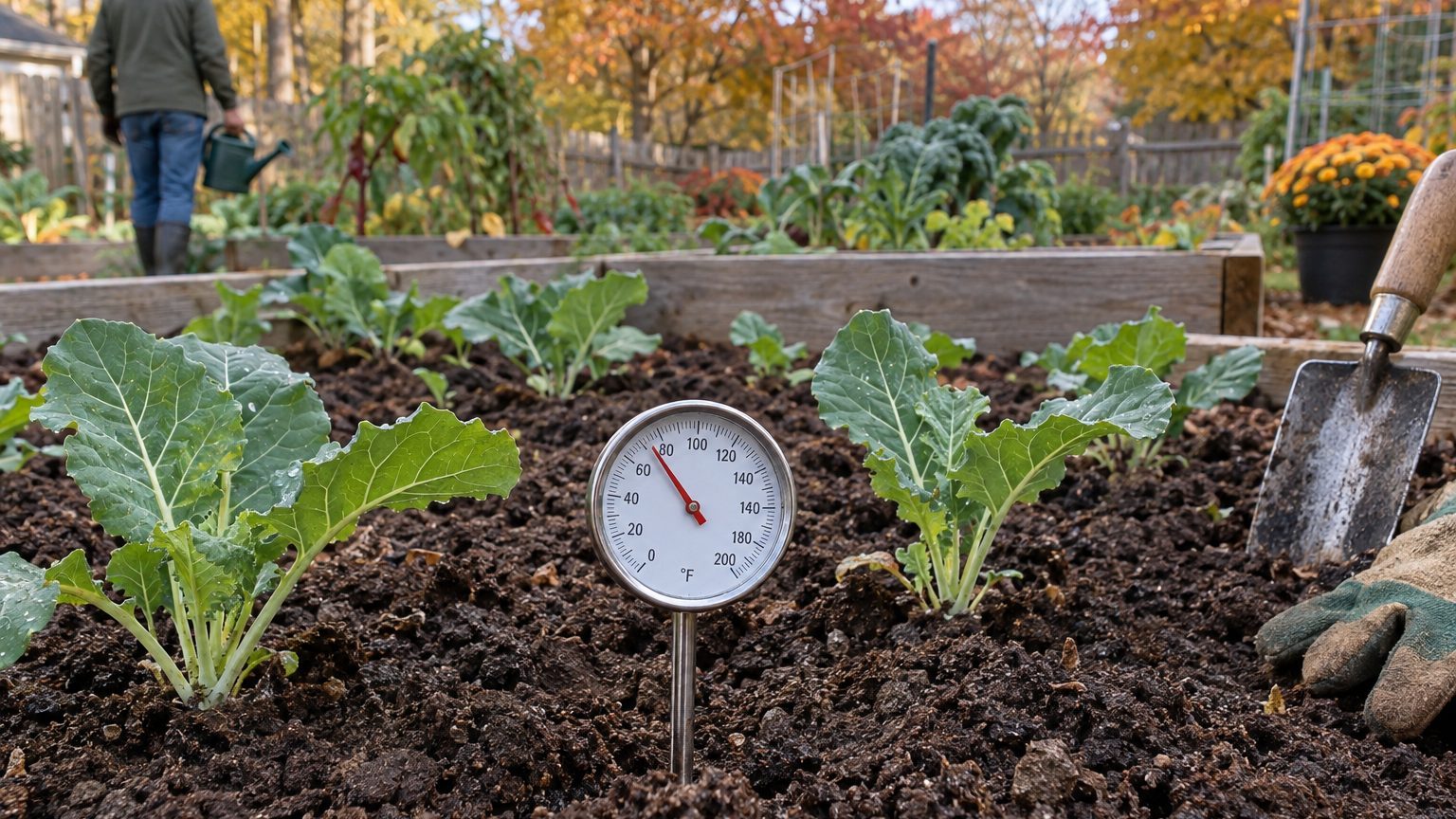
Frost is only a proxy anyway. Collards germinate and transplant well once soil temperature holds in a workable range, and soil warms on its own schedule after air temperatures stabilize, not the moment the frost risk clears. Pushing seed into cold, wet ground the week frost risk drops usually means slow, uneven germination rather than a head start. A soil thermometer pushed two inches down tells you more than the date on a seed packet.
Spring-sown collards can be direct-seeded or set out as transplants once that soil warms, and either method works in this territory. Transplants give a jump on the season if a gardener wants leaves before the real heat arrives; direct seeding skips the transplant shock but asks for a slightly later start. Neither method changes the frost math above.
Checking your own garden, not the airport’s
Because the NOAA figures come from one weather station, treat them as the city’s number, not the county’s. Gardeners in rural counties or at elevation should shift their working date later and confirm it against a personal frost log if they keep one, or against the nearest cooperative weather observer if they don’t.
Whatever collards share a bed with matters too. They’re brassicas, in the same family as cabbage, kale, mustard, turnip, and rutabaga, and they carry the same soil-borne troubles those crops do. A bed that hosted any of those crops in the last two or three seasons hasn’t given collards a clean start, and that rotation timing belongs on this site’s crop rotation guide rather than repeated here.
How long the season lasts here
Stack the two NOAA windows together and the frost-free stretch in the Oklahoma City area runs from the end of the last spring freeze window (March 28 to April 10) to the start of the first fall freeze window, which NOAA puts at October 29 to November 8. That leaves roughly six and a half to seven months of frost-free growing, depending on where in each window a given year lands.
That’s a genuinely long window by national standards, and it changes what’s worth planning. A season this long allows a second sowing of collards in mid-to-late summer for a fall crop, on top of whatever went in during spring. It also means transplanting is worth the effort even for a spring-only planting, since there’s enough season left afterward to justify starting seedlings indoors rather than waiting on direct seeding.
The practical split is this: a short growing window forces a gardener into one planting and one harvest push, full stop. A window like Oklahoma’s frees up a second decision point in July or August, when the spring collards are winding down and there’s still enough season left for a fresh sowing to reach usable size before the fall freeze risk climbs. That second sowing is also the one most likely to carry into a standing winter harvest, covered below.
Timing that second planting correctly, so it doesn’t bolt in leftover summer heat and doesn’t run out of season before the first hard freeze, is exactly what this site’s succession sowing guide walks through, and it’s worth reading before picking a July planting date rather than guessing at it.
One caution carries over from the spring numbers: both fall and spring frost dates here come from the same single reference station, so a rural or elevated garden should again expect the safe planting window to run narrower than the raw subtraction suggests, particularly on the fall end where an early freeze can arrive ahead of the airport’s reading.
Heat and water in Oklahoma

Oklahoma summers are long and the state is well known nationally for extended heat, which matters more to collards than most people expect, since the crop turns bitter and slow to recover when it’s pushed through peak heat with a spring planting still in the ground. That’s the real argument for treating the fall sowing as the main event rather than an afterthought: it grows through the cooling shoulder of the year instead of the hottest stretch.
What decides the bigger question, whether a bed becomes a standing winter crop or strictly an autumn one that ends at the first hard freeze, isn’t summer heat at all. It’s the winter low. NOAA’s Climate Normals put the mean daily minimum of Oklahoma’s coldest month at the Oklahoma City reference station at 27.0°F. That’s a mild average minimum, well above the range that kills collard plants outright, and it means gardens near that reference point can reasonably plan on picking leaf by leaf from November into March rather than clearing the bed at the first freeze.
That’s not the whole state, though. The USDA Plant Hardiness Zone Map places Oklahoma across a 6a-8a range, and the Panhandle and higher-elevation counties running toward the colder end of that range see winter lows the Oklahoma City figure doesn’t capture. A gardener in one of those colder zones should plan collards as a fall crop that finishes at the hard freeze, not a standing one, and should confirm which end of that hardiness range their own county sits closest to before betting a winter’s worth of harvest on it.
Rainfall figures for the summer stretch aren’t part of the verified data behind this page, so no specific number belongs here. What’s worth saying without a number attached: a hot, humid stretch anywhere in this territory favors fungal leaf disease over drought stress, and a gardener seeing spotting or a powdery coating on collard leaves in August is looking at a moisture-and-heat problem, not a watering shortfall to fix with more water.
Which collards suit Oklahoma
The honest answer to “which variety” is a type, not a name, and that’s a deliberate choice rather than a dodge. Trial results on days to maturity, bolt resistance, and disease tolerance are run county by county by land-grant extension programs precisely because a variety that thrives in the Panhandle’s drier, colder pocket can underperform in the humid southeast corner of the state, and no single page can responsibly stand in for that local trial data.
What this territory’s own numbers do point toward, by type:
- A shorter-season type earns its place where a gardener is fitting a second, fall sowing into the window described above, since it reaches harvestable size before the freeze risk climbs in late October.
- A type known for standing up to heat, with room for airflow between plants and a mulched root zone, suits the spring planting that has to push through summer before a fall sowing takes over.
- A disease-tolerant type is the first criterion in any humid stretch of the state, since heat paired with damp air is what invites the leaf spotting and mildew described above, more than any single planting mistake.
None of that substitutes for a local recommendation. Oklahoma State University’s Cooperative Extension Service, at extension.okstate.edu, publishes the variety trial results specific to Oklahoma growing conditions, county by county, and that’s the source that turns “a heat-tolerant type” into an actual seed packet worth buying.
The same rotation caution applies to variety choice as it does to bed placement: whatever collard type gets picked, it’s still a brassica, and a rotation plan that swaps it in for last year’s cabbage or mustard bed hasn’t broken the disease cycle those crops share. Check the extension service’s current trial list before buying seed, and check the bed’s last three years of crops before putting the seed in the ground.