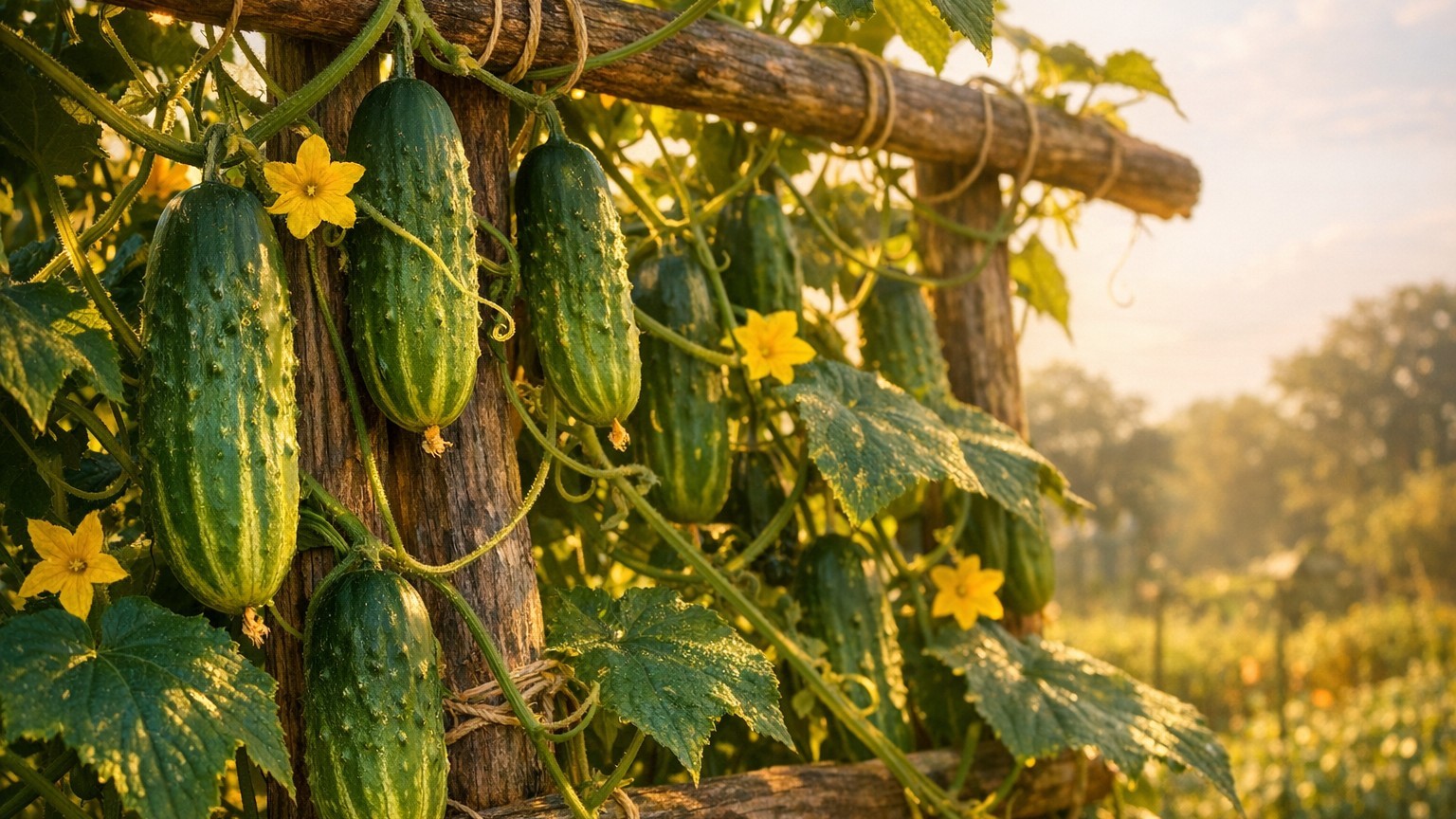

North Carolina’s long frost-free stretch means almost any cucumber type has time to mature here. The real filter is summer heat and humidity, not the calendar. That favors trellised vining slicers and pickling types bred with disease resistance over ground-grown bush varieties, and it rewards gardeners who plant twice rather than once. The details below explain why, using the numbers specific to this state.
The short answer for North Carolina
Grow vining cucumbers on a trellis, choose types marketed with resistance to powdery mildew and downy mildew, and plan for two plantings rather than one. That’s the decision, and it comes straight from this state’s own numbers rather than a generic Southeast recommendation.
Start with the season length. The Piedmont reference station (Charlotte) sees a last spring frost between March 23 and April 5, and a first fall frost between October 30 and November 8. That’s a frost-free window stretching close to seven months. Cucumbers of any maturity type, pickling, slicing, or burpless, have plenty of room to finish inside that window. Season length is not what limits a North Carolina cucumber patch. Heat and moisture do.
Charlotte averages 35.0 days a year at 90°F or hotter. That’s over a month of high-stress heat spread across a growing season, and cucumbers respond to that kind of load with stalled fruit set, dropped male flowers, and bitter skins if the plant is thirsty at the same time. Vining types trained upward catch more airflow than bush types sprawled on warm soil, which matters when the air itself is holding onto humidity for weeks at a stretch.
That humidity is the second half of the equation. Summer rainfall averages about 12.1 inches across June, July, and August, but it doesn’t arrive evenly: June brings 3.99 inches, July drops to 3.74, and August climbs back to 4.35. July is both the driest month and, typically, one of the hottest, which is exactly the combination that stresses a cucumber vine and stresses the soil around it. A vining habit on a trellis dries faster after a thunderstorm than a bush spread flat on the ground, and that faster drying is what keeps fungal disease pressure down in a state this humid.
None of this is a recommendation for one named variety. Cucumber varieties that perform well in Wake County are not necessarily the ones that perform well in Buncombe County. What it can say, backed by the numbers above, is that trellised, disease-resistant vining types have the physical advantage in this state’s climate, and that a mid-summer second sowing timed to mature before the late-October frost window makes better use of the season than one long spring-to-fall planting alone.
What will not work here

Bush-type cucumbers left to sprawl on bare soil are the most common failure point in a North Carolina garden, and it’s a humidity problem, not a heat problem. Leaves lying flat against warm, damp ground stay wet longer after rain or dew, and that’s the exact condition powdery and downy mildew need to take hold. In a state where summer humidity lingers for weeks, ground-grown bush cucumbers without airflow are fighting a battle they usually lose by August.
Weekly watering schedules fail here too, and the rainfall numbers explain why. July averages only 3.74 inches of rain, arriving in a state that also averages 35 days a year above 90°F. Rain that falls as a single summer thunderstorm tends to run off rather than soak in, especially on compacted or sandy soil, so a gardener watering once a week during a hot, dry July stretch is often underwatering without realizing it. Cucumbers are over 90 percent water by weight, and inconsistent moisture during fruit development is what produces the curled, bitter, or hollow fruit that gets blamed on the variety when the real cause is the watering gap.
Tight spacing is a humid-climate mistake
Spacing cucumber plants close together, a habit that causes fewer problems in drier western states, backfires in North Carolina’s humidity. Crowded vines trap moist air between leaves, and that trapped moisture is exactly what fungal spores need to spread from one plant to the next. Wider spacing, or a trellis system that lifts foliage into open air, does more to prevent disease here than any spray applied after symptoms appear.
Season length is genuinely not the constraint that trips people up in this state. With roughly seven frost-free months between the spring and fall frost windows cited above, even long-maturing cucumber types have time to finish. Gardeners who fail here usually fail on watering rhythm, spacing, or airflow, not on running out of days.
What changes across North Carolina
North Carolina is not one garden, and the hardiness zone range makes that plain: the state spans USDA zones 5b through 8b, one of the widest spreads of any state on the map. That’s the difference between a mountain garden that sees hard winter cold and a coastal garden that barely does.
The frost dates used above, March 23 to April 5 for last spring frost and October 30 to November 8 for first fall frost, come from the Charlotte reference station, which sits in the Piedmont. The Blue Ridge Mountains to the west run several weeks later in spring, meaning frost risk lingers well past early April at higher elevations, and the growing season there closes earlier in the fall too. A gardener working at altitude in the mountains should expect a noticeably shorter window than the Piedmont figures suggest, and should lean harder into transplants and cloches to get a head start rather than direct-seeding on the Piedmont’s calendar.
The coastal plain runs the opposite direction. Frost typically arrives later in fall and clears earlier in spring than the Piedmont reference point, stretching the usable cucumber season and making a true second planting for a fall harvest more reliable there than it is in the mountains.
Because the zone range spans five full USDA zones, there is no single frost date or season length that describes North Carolina as a whole. A gardener’s actual zone matters more than any state-wide figure, and it’s worth checking the current USDA Plant Hardiness Zone Map directly rather than estimating from a regional description.
Where to check this for your own county
North Carolina covers many counties and climates. It does not, and cannot, describe Mecklenburg County, Buncombe County, or Dare County specifically, and that gap matters more for cucumbers than for almost any other vegetable, given how much the state’s humidity and frost timing shift from the mountains to the coast.
The place to close that gap is NC State Extension, the land-grant university’s cooperative extension service. Every county in the state has a local extension office tied to that system, and those offices publish a planting calendar built on local frost data rather than the Piedmont reference station, and a list of cucumber varieties actually trialled in that county’s soil and climate.
Look specifically for the local frost-free window for your county, since it may run weeks longer or shorter than the Piedmont figures cited above depending on elevation and distance from the coast. Also look for variety trial results or recommended cultivar lists for cucumbers, since those lists reflect real performance against local disease pressure, something a state-wide article can describe in general terms but can’t verify plant by plant. If your county office runs a home garden hotline or a Master Gardener program, that’s often the fastest way to get a variety recommendation matched to your specific soil and microclimate rather than to the state average.
Checking this against your own garden
Every date and average here is a normal, built from thirty years of weather records at one reference station. Your own garden will confirm or contradict it, and that confirmation matters more than any date printed here.
Start with soil warmth, checked by hand rather than a thermometer. Cucumber seed sits and rots in cold soil rather than germinating, so if the ground still feels cool and damp to the touch in early April, even though the calendar says the frost-free window has opened, it’s worth waiting rather than planting on schedule. A garden in full shade in the morning or on low ground where cold air pools will lag behind the state’s frost dates regardless of what the calendar says.
Second, watch for the first male flowers. Cucumber plants typically produce male flowers before female ones, and a burst of male blooms with no fruit-bearing female flowers yet is normal, not a sign of trouble. It tells you the plant is building toward fruit set, and gives a rough read on how far along your specific plants are compared to a neighbor’s.
Third, track how fast the first true leaves appear after the seed leaves. Slow true-leaf growth in what should be warm soil often points to a cooler microclimate than the county average, maybe from a north-facing slope, heavy clay that stays cold longer, or shade from a nearby structure. That’s a signal worth noting for next year’s planting date more than any single figure in a climate normal.