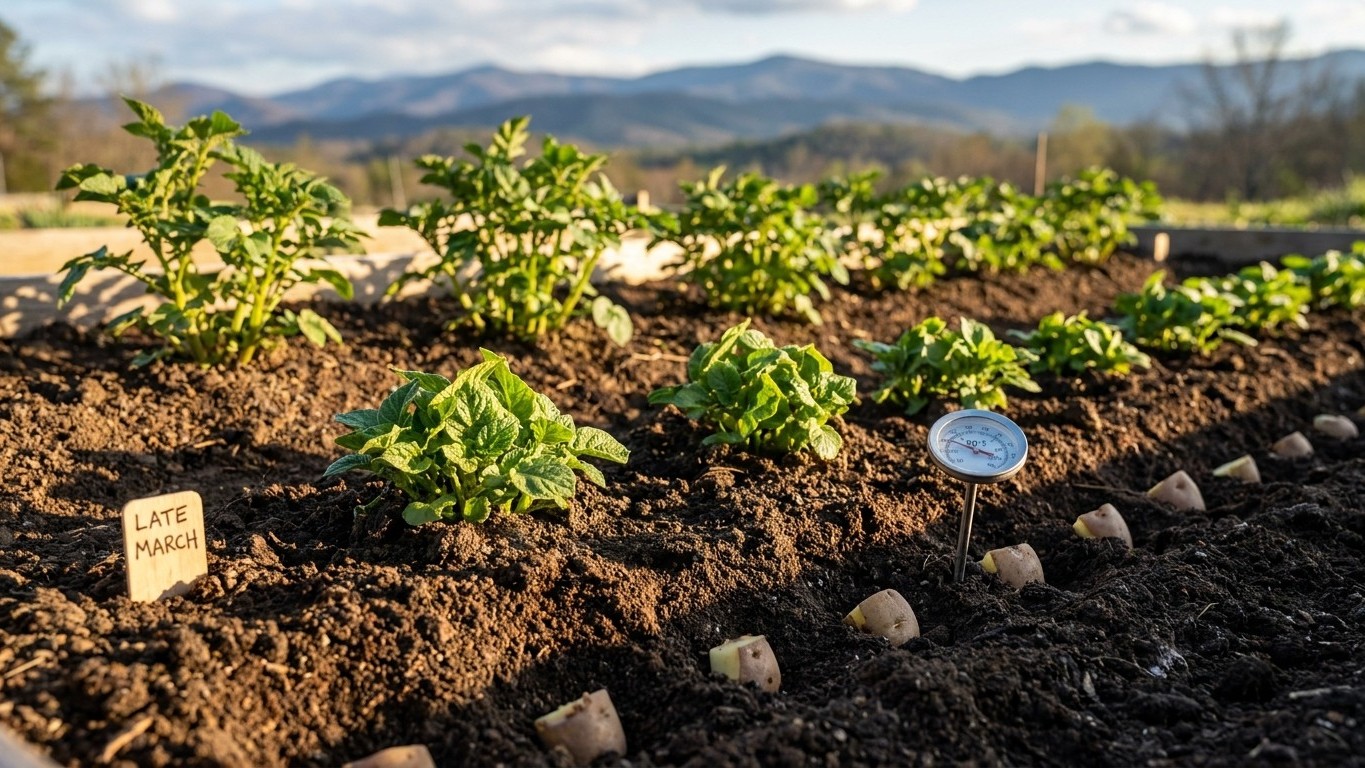

North Carolina’s growing window for potatoes is short and hot, which means the “right” variety is really a season class, not a brand name. Early-season potatoes are the safest bet statewide because they size their tubers before soil temperatures climb into the range that shuts tuber growth down, a threshold documented by Utah State University Extension and the University of Maine Cooperative Extension. Mid-season varieties work in the mountains; late-season types are a gamble almost everywhere else in the state.
The short answer
Plant early-season potatoes if you garden anywhere in the Piedmont, the coastal plain, or the lower foothills of North Carolina. That’s the practical reading of the frost data for Charlotte, where NOAA NCEI’s 1991-2020 Climate Normals put the last spring frost between March 23 and April 5. Potatoes go in the ground as soon as the soil hits 50 degrees Fahrenheit, which lands 14 to 21 days before that last frost date, according to Utah State University Extension’s potato fact sheet and University of Maine Cooperative Extension Bulletin #2077. Count backward from early April and the planting window in the Piedmont opens in mid-to-late March, sometimes earlier on the coastal plain where frost eases up sooner, and later in the Blue Ridge where spring arrives weeks behind Charlotte.
That narrow window is the whole reason season class matters more than variety name. An early-season potato reaches its tuber-bulking stage and finishes filling out before the soil climbs into the danger zone. A late-season variety is still trying to size tubers when North Carolina’s early summer heat arrives, and by the time soil temperatures push past 90 degrees, according to both extension sources, tuber set and fill are inhibited outright. No amount of irrigation reverses that. So the honest answer to “which variety suits North Carolina” is: whichever early-season variety you can source as certified seed, planted as early as the soil allows.
Mid-season varieties aren’t off the table everywhere. Gardeners at higher elevations in the mountain counties, where the frost calendar runs weeks later than Charlotte’s and summer heat is milder, have more room to let a mid-season crop finish before the ceiling becomes a problem. But in the Piedmont and points east, mid-season and late-season potatoes are pushing their luck against a heat calendar that doesn’t care how good the seed catalog description sounded.
None of this is about flavor, skin color, or whether a potato is “waxy” or “floury,” a distinction neither Utah State nor Maine’s extension bulletin uses. What both sources do publish is season class and end use, meaning whether a variety is suited to baking, to boiling, or to general kitchen use. That’s the information worth building a planting plan around, because it’s the information that’s actually verified.
What actually decides it
The soil-temperature planting trigger
Potato planting isn’t scheduled by the calendar date, it’s scheduled by soil temperature. Both Utah State University Extension and the University of Maine Cooperative Extension describe the same trigger: potatoes go into the ground once the soil reaches 50 degrees Fahrenheit, and that point typically falls 14 to 21 days ahead of the last frost date for a given location. In the Piedmont, using Charlotte’s NOAA-derived last-frost range of March 23 to April 5 as the reference, that pushes the practical planting window into the second half of March for most years. A gardener on the coastal plain, where frost breaks earlier, can often move that window up. A gardener in the mountains, where spring lags Charlotte by several weeks, has to wait longer, and that delay is exactly what buys mid-season varieties enough runway to finish before summer heat sets in.
The heat ceiling that ends the season for the crop
The second mechanism is the one that decides whether a longer-season variety was ever a realistic choice. Once soil temperatures climb above 90 degrees Fahrenheit, tuber set and fill are inhibited, a finding both extension sources treat as a hard ceiling rather than a soft slowdown. Watering more doesn’t undo it. Shade cloth doesn’t reverse it. The tubers simply stop sizing until the soil cools again, and by the time it does, the plant may already be senescing. This is the mechanism a gardener anywhere in the U.S. can apply without needing this page to name their county: count how many days your local soil realistically sits above that threshold in early-to-mid summer. Where that count is high, plant early and dig a spring crop. Where it’s low or the season starts later (as it does at elevation), a mid-season variety has room to work.
Why certified seed changes the outcome before either mechanism matters
Uncertified seed potatoes carry viruses that stunt tuber development regardless of how well the timing and heat math work out. Certified seed is the starting condition that makes the rest of the reasoning meaningful; skip it and an early-season variety planted at the perfect soil temperature can still underperform because the seed piece was compromised before it went in the ground.
How to do it
- Choose an early-season potato variety as the default statewide selection, reserving mid-season varieties for higher-elevation mountain gardens where spring arrives later and summer heat is milder.
- Buy certified seed potatoes rather than saving grocery-store or uncertified tubers, since certified stock is checked for the viruses that limit tuber development.
- Track soil temperature directly with a soil thermometer rather than relying on the calendar date, watching for the point where it reaches 50 degrees Fahrenheit.
- Count backward from your local last-frost date, using the 14-to-21-day window ahead of that date as the guide for when 50-degree soil typically arrives, adjusting earlier for coastal plain locations and later for mountain locations relative to the Piedmont’s Charlotte-based range.
- Cut and plant seed potatoes once soil temperature confirms the window is open, rather than planting on a fixed date regardless of conditions.
- Monitor soil temperature again as the season progresses, watching for the approach toward 90 degrees Fahrenheit, since that’s the point tuber set and fill stall out.
- Dig the crop as it matures rather than leaving it in the ground once soil temperatures push toward that ceiling, since delaying the harvest doesn’t recover growth lost to heat.
What goes wrong
- Planting by calendar date instead of soil temperature. A fixed “plant in April” rule ignores year-to-year swings in how fast soil warms. The remedy is a soil thermometer, checked directly, waiting for the 50-degree mark rather than a date on a seed packet.
- Choosing a late-season variety because it’s marketed for storage or flavor. In most of North Carolina, the growing window closes with heat before a late-season variety finishes bulking. The remedy is defaulting to early-season stock unless gardening at mountain elevation where the season runs longer and cooler.
- Planting uncertified or saved seed potatoes. Virus carried in uncertified tubers limits tuber development no matter how well the timing is managed. The remedy is sourcing certified seed potatoes each planting.
- Trying to push a crop through summer heat with extra irrigation. Once soil crosses above 90 degrees Fahrenheit, tuber set and fill are inhibited regardless of water supply. The remedy is treating that threshold as an end point, not a stress to be managed around, and planning the harvest before soil regularly reaches it.
- Applying a statewide frost date without adjusting for region. A gardener in the coastal plain or the Blue Ridge who uses Charlotte’s Piedmont frost window unadjusted will plant too late or too early. The remedy is treating the Charlotte figure as a Piedmont reference point, moving the window earlier east of it and later at higher elevations to the west.
Common questions
Do early-season potatoes taste worse than late-season ones?
Neither Utah State University Extension nor the University of Maine Cooperative Extension frames season class as a flavor ranking. Season class describes how quickly a variety reaches maturity and end use describes whether it’s suited to baking or boiling, not taste quality.
Can I grow a mid-season variety on the coastal plain if I plant it early enough?
The coastal plain’s earlier frost break gives a slightly wider planting window than the Piedmont, but the region also tends to reach damaging soil heat sooner in the year, which narrows the margin a mid-season variety needs to finish. That specific coastal-plain heat timing isn’t published in the facts used for this page, so treat it as a regional risk to weigh rather than a settled figure.
Is a second, later planting worth trying after the spring crop is dug?
That depends on how long the local soil stays above the 90-degree threshold before cooling again in fall, a figure this page doesn’t have for individual North Carolina counties. Where that hot stretch is short, a fall crop timed to the region’s own soil-cooling pattern can work; where it isn’t, the spring crop is the more reliable one.
Why does certified seed matter more than variety choice?
Because a virus-carrying seed piece limits tuber development regardless of how well the planting timing and heat exposure are managed. Certified seed removes that variable before season class or heat ceiling even come into play.