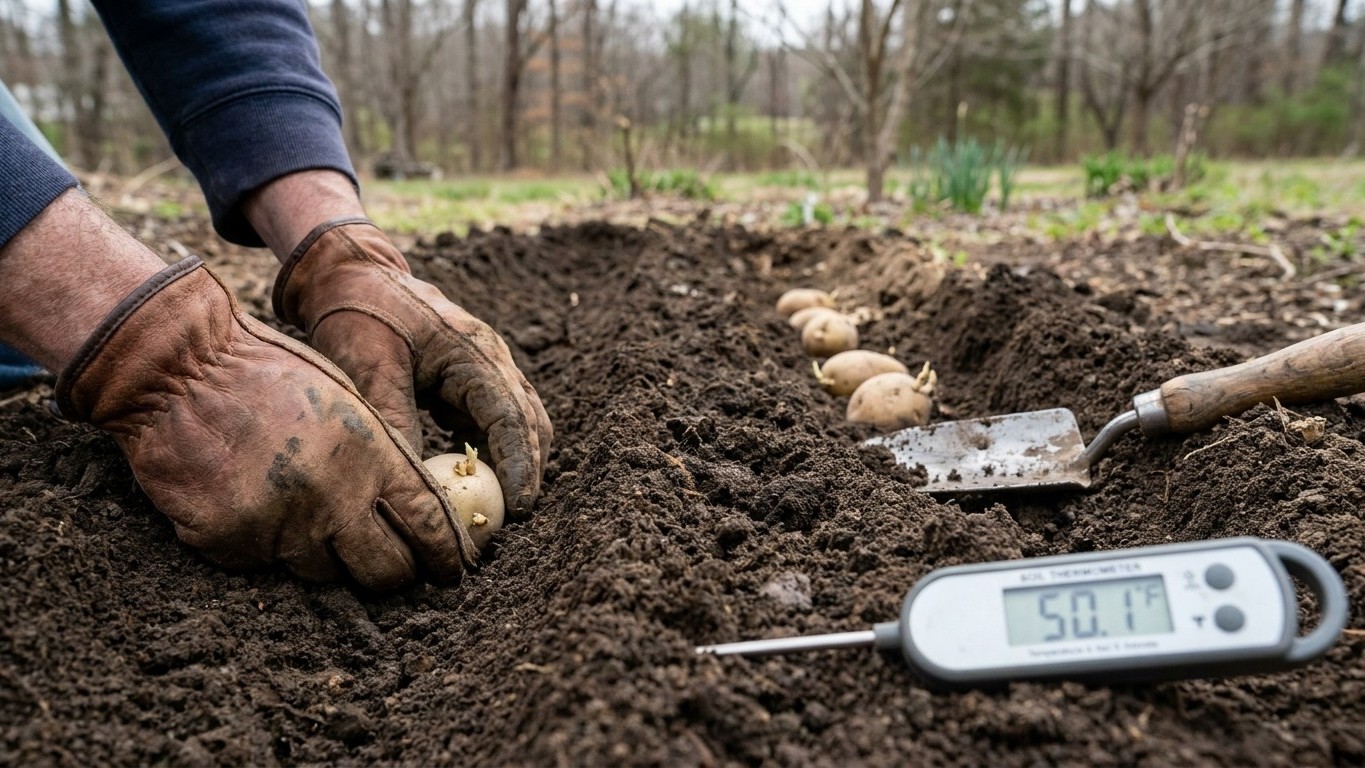

Fourteen to twenty-one days before your last frost date is the answer, and for Charlotte, the Piedmont’s reference station, that last frost falls somewhere between March 23 and April 5, according to NOAA’s 1991-2020 climate normals. Count backward from that window and seed potatoes go into Piedmont soil in early-to-mid March. Mountains run weeks later. The coastal plain runs earlier.
The short answer
Start with the number itself. NOAA’s National Centers for Environmental Information track the 32°F freeze probability at Charlotte across three decades of data, and the band where that risk drops from 70% to 30% runs from March 23 to April 5. That’s not a guess dressed up as science; it’s a measured freeze-risk window for one specific station, and it’s the number this whole planting calendar hangs on.
Potatoes don’t wait for the frost date itself. Utah State University Extension and the University of Maine Cooperative Extension both describe the same rule: seed potatoes go into the ground once soil temperature reaches 50°F, and that point typically arrives 14 to 21 days ahead of the last spring frost. Run that math against Charlotte’s window and the planting stretch lands somewhere between the first week of March and the third week of March, depending on where inside that March 23-April 5 band a given spring happens to fall.
That’s the Piedmont. It is not North Carolina as a single block. The Blue Ridge counties to the west sit at higher elevation and colder air pools in those valleys, so frost lingers weeks past the Charlotte date; growers there push planting later, not earlier. The coastal plain runs the opposite direction. Warmer air moves in from the Atlantic and soil warms sooner, so a gardener in that region can often work ground while Piedmont soil is still too cold to plant into.
This is why “When to Plant Potatoes in North Carolina” doesn’t have one date. It has a mechanism, a soil thermometer, and a reference window that shifts by region. Charlotte’s numbers anchor the Piedmont answer. They are not a substitute for checking your own soil, especially if you garden west of the foothills or east toward the sound.
What actually decides it
Two thresholds run this whole calendar, and neither of them is the calendar itself.
Soil temperature, not the calendar date
Seed potatoes go into the ground when soil hits 50°F, full stop. That’s the trigger both Utah State Extension and the University of Maine’s Bulletin #2077 point to, and it explains why the 14-to-21-day window before last frost isn’t arbitrary. Soil that has climbed to 50°F is warm enough for sprouting without being so warm that rot organisms in cool, wet ground get the upper hand. Plant before the soil gets there and seed pieces sit cold and wet, which is where they fail. Plant after, and the crop loses growing days it can’t get back once summer heat arrives.
The heat ceiling that ends the season
The other threshold sits at the far end of the season, and it’s the one gardeners tend to discover the hard way. Once soil temperature climbs above 90°F, tuber set and tuber fill stop. The plant doesn’t just slow down, it shuts that process off, and no amount of watering brings it back. This is the mechanism that should drive the whole North Carolina calendar, more than the spring frost date does. In a state where soil routinely crosses 90°F well before Independence Day in the lower and mid-elevation regions, the entire strategy is to get a crop planted early enough to size up and finish before that ceiling hits, not to try to nurse a summer potato patch through July and August.
Why the frost-window math still matters
The last-frost date isn’t really about protecting potato foliage from a light freeze; it’s the anchor point for counting backward to the 50°F soil moment. Move that anchor west into the mountains and the whole window shifts later. Move it east toward the coastal plain and it shifts earlier. The mechanism is identical everywhere; the calendar date it produces is not.
How to do it
- Find your local last-frost reference. If you garden in or near the Piedmont, use Charlotte’s March 23-April 5 window as your starting anchor; adjust later for mountain or coastal-plain conditions.
- Count back 14 to 21 days from that window to identify your target planting stretch.
- Check soil temperature directly with a soil thermometer rather than relying on the date alone; wait until it reads 50°F before planting.
- Buy certified seed potatoes rather than grocery-store tubers or last season’s leftovers. Certified seed is grown and inspected to be free of the viruses that build up in uncertified stock and quietly reduce yield year after year.
- Cut larger seed potatoes into pieces with at least one or two eyes each, and let cut pieces dry and callus for a day or two before planting to reduce rot risk in cool soil.
- Plant seed pieces a few inches deep in soil that has already reached that 50°F mark.
- Hill soil up around stems as plants grow, which protects developing tubers from light and from surface heat.
- Track your local heat pattern and plan the harvest of an early or mid-season variety before soil temperatures climb past 90°F, rather than planting late and hoping the crop outruns the heat.
What goes wrong
- Planting by the calendar date instead of soil temperature. A gardener marks “last week of March” on the calendar and plants regardless of conditions. Cold, wet soil that hasn’t reached 50°F rots seed pieces before they sprout. Check the soil directly and wait for the number, not the date.
- Using uncertified seed potatoes. Tubers saved from last year’s harvest or picked up at a grocery store often carry viruses that don’t show obvious symptoms the first season but chip away at yield over time. Buy certified seed potatoes from a supplier that states the certification plainly.
- Ignoring the 90°F heat ceiling. A gardener plants late, the crop is still filling tubers when soil crosses that threshold, and growth simply stops. Watering more doesn’t restart it. The fix is earlier planting timed to the 14-to-21-day window, so the bulk of tuber sizing happens before soil heat shuts the process down.
- Applying the Piedmont window statewide. Someone gardening in the mountains plants on the Charlotte schedule and loses the crop to a late frost that Charlotte never sees; someone on the coastal plain waits for the Piedmont window and loses weeks of usable early-season soil. The frost date is a reference for one station, not a statewide fact.
- Choosing a variety without matching its season class to the region’s heat timeline. Planting a late-season type in a spot where soil crosses 90°F early in summer leaves the crop caught mid-fill when the heat ceiling hits. Matching an early or mid-season class to a shorter cool window before that threshold gives the crop a better chance to finish.
Common questions
Does the last-frost date protect potato plants from cold damage?
The date functions here as the anchor point for counting backward to the 50°F soil temperature, not as a direct frost-tolerance threshold for the plants themselves; the sources used here don’t publish a separate frost-damage temperature for potato foliage.
Can I plant potatoes earlier than the 14-to-21-day window if soil warms up fast?
The rule tracks soil temperature, not a fixed number of days. If soil legitimately reaches 50°F earlier than the typical window suggests, that’s the signal to plant, according to the mechanism described by Utah State University Extension and the University of Maine Cooperative Extension.
Is a late-season potato variety ever a good choice in North Carolina?
It depends entirely on how much cool soil time exists before the local 90°F ceiling arrives. In regions where that threshold hits early in summer, an early or mid-season class gives the crop more realistic odds of finishing tuber fill before growth stops.
What’s the practical difference between certified and uncertified seed potatoes?
Certified seed has been inspected to be free of the viruses that build up in saved or store-bought tubers. Those viruses often don’t cause visible symptoms right away, but they reduce yield over successive seasons, which is why both extension sources treat certified seed as a baseline, not an optional upgrade.