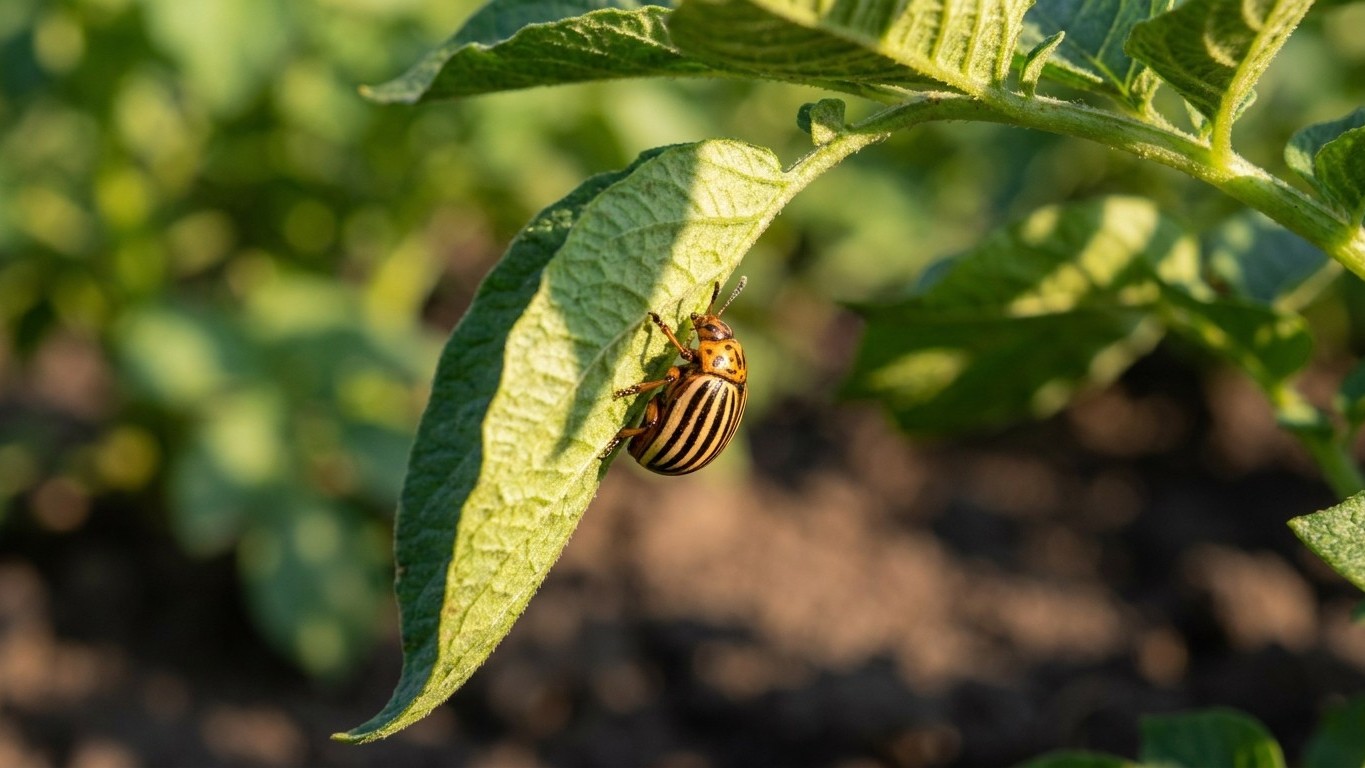

North Carolina’s potato plants face a short, specific list: flea beetles, Japanese beetles, and thrips are the ones NC State Extension documents feeding on this crop in the state. Everything else that shows up in the same records, cabbage worms, corn earworm, tree pests, targets other plants entirely. What actually shows up in a given garden, and how early, tracks closely with how the season’s timing lines up against the region’s frost-free window.
Which pests attack potato in North Carolina
NC State Extension documents nine pests active in North Carolina landscapes and gardens: cabbage looper, corn earworm, fall webworm, flea beetles, hemlock woolly adelgid, imported cabbageworm, Japanese beetle, striped cucumber beetle, and thrips. Not all of them have anything to do with a potato bed, and sorting that out matters before anyone reaches for a treatment.
Cabbage looper and imported cabbageworm are brassica feeders. They target cabbage, broccoli, and kale, and a caterpillar chewing on those leaves has nothing to do with the potato row next to them. Corn earworm goes after corn silks and tomato fruit, not potato foliage. Fall webworm builds its silk nests in tree branches, sometimes in the same yard as a vegetable garden, but it never touches a potato plant. Hemlock woolly adelgid is a conifer pest, specific to hemlock trees, and finding it near a garden says nothing about what’s happening at ground level. Striped cucumber beetle sticks to cucurbits, cucumbers, squash, melons, and mostly ignores solanaceous crops like potato.
That leaves three species with a real connection to potato: flea beetles, Japanese beetle, and thrips. All three are documented by NC State Extension as active in the state, and all three are generalist feeders capable of moving onto potato foliage when conditions favor them. Flea beetles are the most consistent early-season threat because they attack tender new growth right as it emerges. Japanese beetle is a broad host-range feeder that will skeletonize potato leaves along with dozens of other plants it visits. Thrips feed by scraping leaf surfaces and sucking plant juices, leaving a stippled or silvered look on foliage.
Three species is a short list, and that’s simply what NC State Extension documents for this crop in this state. There’s no benefit in padding it out with pests that belong to a different part of the garden.
When each one shows up, and what it does first
Timing on potato pests tracks the region’s growing season, not a fixed date on the calendar. In the Piedmont around Charlotte, the last spring frost typically falls between March 23 and April 5, and that window shifts: several weeks later in the Blue Ridge mountains to the west, and earlier along the coastal plain. Whatever a gardener plants around, the pest activity that follows tracks the plant’s growth stage more than the month printed on a calendar.
Flea beetles are usually the first sign of trouble. They target the youngest, most tender leaves as plants push through the soil and unfurl their first true leaves, right in the weeks following the region’s frost-free window. The first thing a gardener notices isn’t the insect itself, since flea beetles are tiny and jump away when disturbed, but a scatter of small, round holes across the leaf surface, sometimes described as a shotgun pattern. Damage tends to concentrate on the newest growth rather than older, tougher leaves.
Japanese beetle arrives later, once plants have built out a fuller canopy. Adults feed in groups, and the first visible sign is usually skeletonized leaf tissue, where the softer material between veins has been eaten away, leaving a lace-like skeleton behind. Unlike flea beetle damage, which stays scattered and small, Japanese beetle feeding tends to cluster on a handful of leaves at a time as the beetles work through a plant.
Thrips show up more quietly. Rather than chewing visible holes, they rasp at the leaf surface and feed on the fluids that come out, producing a silvery or bronzed sheen along leaf veins, sometimes paired with curling or slightly distorted new growth. Because the damage looks more like discoloration than a feeding wound, thrips are often the last of the three to get correctly identified, and gardeners sometimes assume a nutrient problem before they consider an insect.
Telling the damage apart from everything else
Potato foliage takes a beating from more than insects, and the wrong diagnosis usually means the wrong response. The single most useful habit here is checking the underside of the leaf and the base of the plant before assuming a pest is responsible, since several look-alikes show up in exactly the same spot on the plant.
| Symptom | Possible cause | What separates it |
|---|---|---|
| Small round holes across young leaves | Flea beetles vs. early blight lesions | Flea beetle holes are clean punctures with no surrounding discoloration; blight lesions have a dark, often ringed border |
| Lacy, skeletonized leaf tissue | Japanese beetle vs. hail or mechanical damage | Beetle feeding leaves veins intact and follows a chewed pattern; hail damage is torn and irregular, often across many plants at once regardless of leaf age |
| Silvery or bronzed sheen on leaves | Thrips vs. nutrient deficiency | Thrips damage tracks along leaf veins and often comes with fine black specks (droppings); deficiency symptoms usually show as uniform yellowing between veins, not a rasped texture |
| Wilting or curling leaves | Insect feeding vs. drought stress | Insect damage leaves visible holes or surface texture change; drought wilting affects the whole plant evenly and improves within a day of watering |
None of this replaces a look from someone trained to confirm it. When two possibilities remain on the table after checking the plant closely, the right move is a photo and a call to the local extension office rather than a guess acted on with a treatment.
What actually works here, and what is a waste of time
On a short growing season, timing does more work than any single treatment. A physical barrier put in place before flea beetles find the newest leaves beats almost any response applied after the damage is already visible, because once holes appear the feeding generation has usually already moved through. Floating row cover laid down at planting and kept on until plants are established closes off that early window entirely, since flea beetles need direct access to tender leaves to do damage.
Handpicking works reasonably well against Japanese beetle in a home garden, particularly early in an infestation, since beetles cluster and are easy to knock into a container of soapy water in the cool part of the morning when they’re sluggish. Trying to wait them out rarely helps, since beetles keep arriving from surrounding vegetation as long as the plant stays attractive.
Thrips are harder to manage with physical methods alone because they’re small enough to move through most row cover gaps and reproduce quickly in warm weather. Keeping weeds down around the potato bed removes some of the alternate hosts thrips use to build up numbers before moving onto the crop itself.
What tends to waste time is spraying on a fixed schedule instead of checking the plants first. Because none of these three pests is present at the same intensity every season, a calendar-based treatment plan often means either treating for a pest that never showed up, or missing the actual window when the pest was doing its damage. Any decision about a specific product, including whether one is even needed, belongs with the extension service, since only they can confirm what’s registered for use in North Carolina.
Where to check this for your own county
Everything documented above comes from NC State Extension, and it describes what’s been recorded across the state, not what’s necessarily present in one particular garden. Pest pressure inside North Carolina varies enough that a county in the coastal plain can see a completely different pattern than a county in the mountains, even in the same growing season.
The most useful next step is contacting the county extension office directly. They can confirm whether flea beetles, Japanese beetle, or thrips have been reported locally this season, and they can look at a photo or a sample before anyone commits to a treatment plan. That local check matters more than anything a state-wide list can offer, since the list only says a pest is documented somewhere in North Carolina, not that it’s active on a specific street.
Anyone planning next season’s planting date around the frost-free window should also confirm it locally rather than relying on the Piedmont figure alone, since the mountains run several weeks later and the coastal plain runs earlier. The county office can supply that local adjustment, along with any updates on pest activity reported nearby that season.
Common questions
Do Japanese beetles actually damage potato plants, or do they prefer other crops?
Japanese beetle is a broad host-range feeder, and NC State Extension documents it as active in North Carolina. It will feed on potato foliage along with a wide range of other garden plants, though it doesn’t limit itself to potato the way flea beetles tend to target young solanaceous growth.
Are cabbage loopers a threat to a potato bed planted next to cabbage?
No. Cabbage looper feeds on brassica crops like cabbage, broccoli, and kale. It isn’t associated with potato feeding, so caterpillar damage on the cabbage side of a garden doesn’t indicate a threat to the potato plants nearby.
What’s the first sign that thrips, not a nutrient problem, are affecting potato leaves?
Thrips damage tends to follow the leaf veins with a silvery or bronzed, rasped texture, often paired with fine black specks from their droppings. Nutrient deficiencies usually show as more uniform yellowing between veins without that surface texture change.
Should planting be timed around the frost-free window to avoid flea beetle damage?
Planting too early into cold, wet soil creates its own problems, but flea beetles specifically target tender new growth, which appears whenever the plant emerges. Row cover put in place at planting protects that vulnerable stage regardless of the exact calendar date chosen.