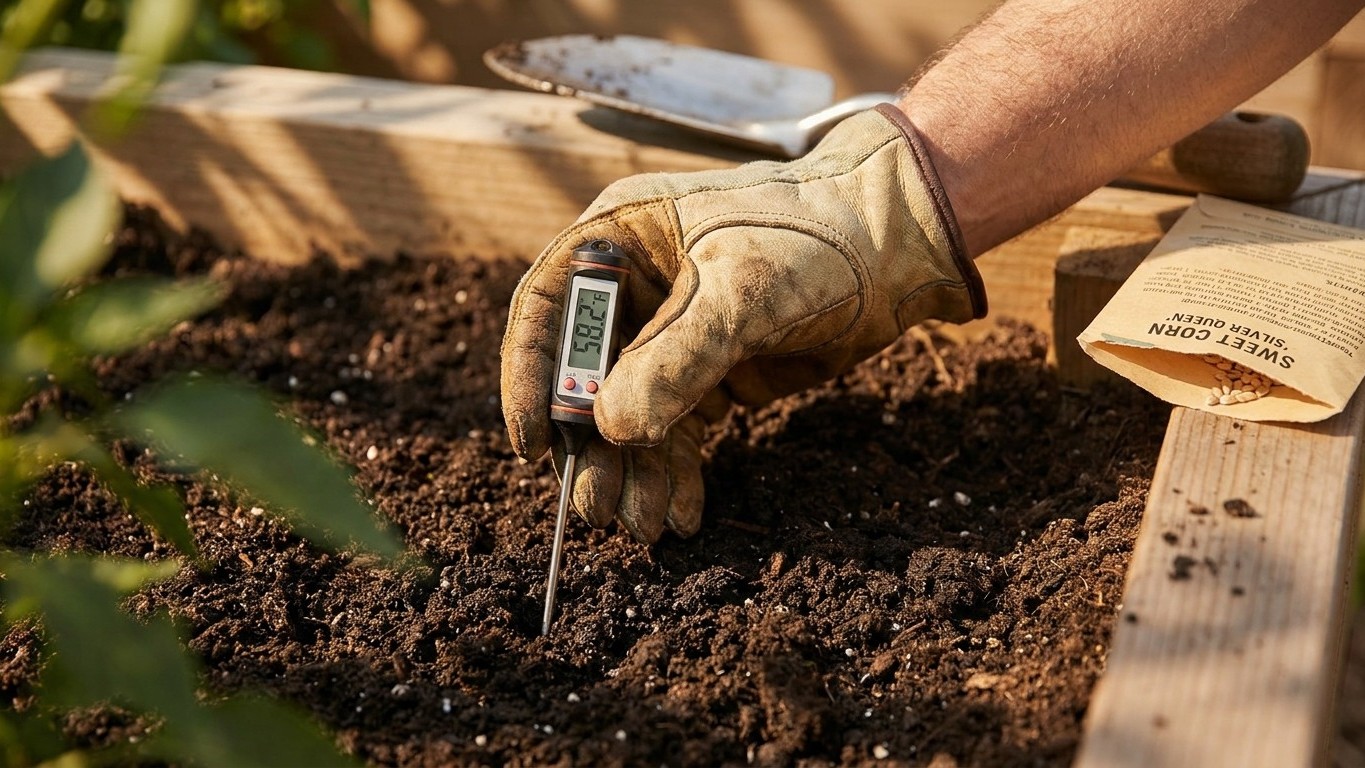

Sweet corn goes into North Carolina Piedmont soil once the ground itself, not just the air, has warmed past 60°F, which lands well after the last spring frost of March 23 to April 5. From there, a 60- to 90-day variety has plenty of room to mature before the first fall frost arrives October 30 to November 8.
The short answer
Here’s the part gardeners skip: the last-frost date and the soil-temperature date are not the same thing, and mixing them up is the single most common reason sweet corn seed rots in the ground. The Piedmont’s last spring frost falls somewhere between March 23 and April 5, based on 1991-2020 NOAA climate normals for the Charlotte reference station. That date tells you when the air stops freezing. It says nothing about the soil six inches down, which warms on its own schedule and typically lags the air by weeks. Sweet corn seed needs that soil above 60°F to germinate reliably, per Utah State University Extension guidance on growing sweet corn. Sow into cold, wet dirt and the seed just sits there, rotting slowly, while the calendar convinces you everything’s fine.
So the practical move is to let the ground, not the frost date, make the call. That usually pushes planting into mid-to-late spring in the Piedmont, later than the date on a seed packet’s zone map might suggest. A simple soil thermometer, pushed a few inches into a sunny bed, settles the question faster than any calendar guess.
Once soil clears that threshold, the second question is whether there’s enough season left. Sweet corn needs 60 to 90 days from planting to harvest, again per Utah State’s timeline. Even counting the worst-case scenario, planting after the last possible frost date of April 5 and harvesting before the earliest possible fall frost of October 30, that’s roughly 208 days of frost-free window. Stretch it to the earliest spring frost (March 23) and the latest fall frost (November 8), and the window opens to around 230 days. Either way, a 90-day variety fits with room to spare, and a 60-day variety fits with margin left over for a second planting.
| Milestone | Date range |
|---|---|
| Last spring frost | March 23 to April 5 |
| First fall frost | October 30 to November 8 |
| Frost-free window | roughly 208 to 230 days |
| Sweet corn maturity need | 60 to 90 days from planting |
The Piedmont isn’t the whole state, though. The Blue Ridge Mountains to the west run several weeks later in both spring and fall, shortening that window. The coastal plain trends earlier, opening it up further. Gardeners outside the Charlotte-area reference should adjust their expectations in that direction rather than assume the Piedmont numbers travel unchanged.
Does a late variety fit here?
The math above says both ends of the maturity spectrum, a quick 60-day corn and a longer 90-day corn, have enough calendar days to work with in this territory. But “enough days on paper” and “a smart choice for this climate” aren’t always the same thing, especially once summer heat enters the picture.
A 60-day variety
This is the low-risk pick for the Piedmont. Planted once soil clears 60°F, even a cautious mid-to-late spring sowing, a 60-day corn reaches harvest well before the earliest fall frost date of October 30. There’s slack built in for a slow, cool stretch of weather or a delayed start. It’s also the variety that tolerates a second, later planting for gardeners who want a staggered harvest instead of one big flush of ears at once.
A 90-day variety
The season length technically accommodates a 90-day corn too, since even the shorter 208-day frost-free estimate leaves well over 100 days of cushion after maturity. But timing gets tighter in practice. A soil-driven planting in mid-to-late spring, followed by 90 days to maturity, lands tasseling and ear-fill squarely in the hottest stretch of summer. The Charlotte reference station averages 35 days a year at 90°F or above, a heat load that stresses pollination and pushes water demand up sharply right when the plant needs it most. The variety doesn’t run out of calendar days here. It runs into the year’s hottest weeks at its most vulnerable stage, and that’s a real risk worth planning irrigation around rather than ignoring.
What goes wrong here
- Soil sown too cold. Planting right at the last-frost date, before the ground itself has caught up, leaves seed sitting in soil below 60°F. It rots instead of sprouting. The fix is simple: check soil temperature directly with a thermometer rather than trusting the frost date alone, and wait until it holds above 60°F.
- A maturity length that doesn’t fit the real planting date. The 60-to-90-day window only works if planting actually happens early enough. Delaying a 90-day variety past a reasonable spring start, whether from a cold snap, a busy week, or wet soil, can push harvest uncomfortably close to the October 30 to November 8 fall frost range. Matching maturity length to the actual sowing date, not the ideal one, avoids the squeeze.
- Sweetness lost to cross-pollination. This has nothing to do with frost dates or soil temperature. Standard sweet (su), sugary-enhanced (se), and supersweet (sh2) corn types lose their intended flavor and texture if their tassels shed pollen at the same time nearby. Utah State University Extension gives no isolation distance for this, so don’t rely on a fixed number of feet or rows as a fix. The real safeguard is timing: stagger plantings so the types don’t tassel together, or plant only one type per season. Growing sweet corn in blocks of three or more rows, rather than a single thin row, also improves pollination for the crop itself, though that’s a matter of shape, not a date to plant by.
Common questions
Can I plant sweet corn right when the last frost passes?
Not reliably. The last-frost date only marks when the air stops freezing. Soil temperature lags behind and needs to clear 60°F on its own before sweet corn seed germinates well, so planting at the frost date often means cold, slow-rotting soil instead of a head start.
Does the Piedmont have enough season for a 90-day sweet corn?
By the calendar, yes, since the frost-free window runs roughly 208 to 230 days depending on where in that range spring and fall frosts fall. The bigger consideration is that a 90-day variety planted once soil warms tends to tassel during the hottest stretch of summer, when the reference station averages 35 days a year at 90°F or higher, which can stress pollination.
How do I stop two types of sweet corn from ruining each other’s flavor?
Keep su, se, and sh2 types from shedding pollen at the same time. No isolation distance is published for this; the fix is timing plantings apart or sticking to a single type in a given season, along with growing each block as three or more rows rather than a single thin line.
What if I garden in the mountains or on the coast instead of the Piedmont?
Adjust the dates rather than copying them directly. The Blue Ridge Mountains run several weeks later for both spring and fall frosts, shrinking the growing window, while the coastal plain trends earlier on both ends, opening it up. The Piedmont figures here are specific to the Charlotte-area reference station.