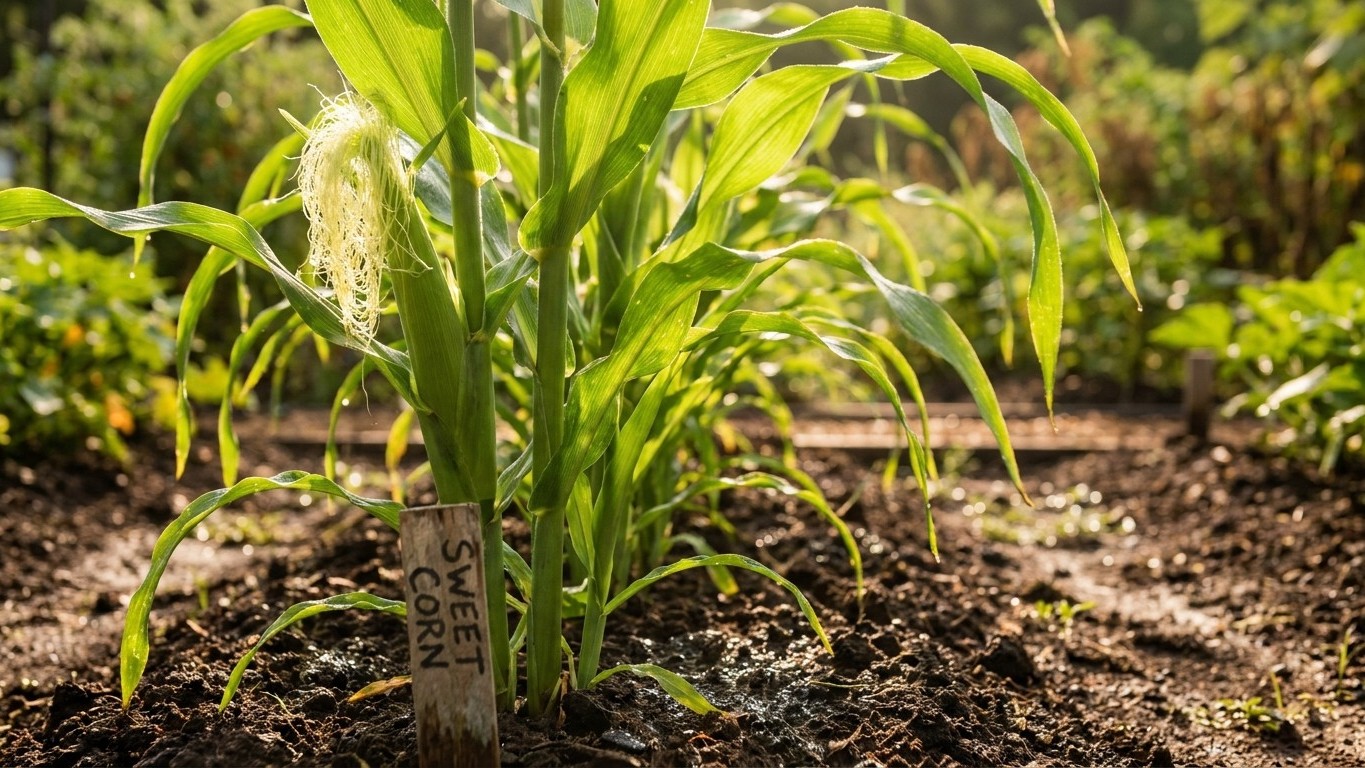

Sweet corn ripens without trouble in the Charlotte area of North Carolina. The growing season runs long enough, and stays warm enough, for a 60 to 90 day crop to finish well before the first fall frost shows up. The real question isn’t whether it ripens, it’s getting the planting date and the neighboring varieties right so the ears come out sweet instead of starchy and tough.
The short answer
The last spring frost in the Charlotte area falls somewhere between March 23 and April 5, based on NOAA’s 1991-2020 climate normals for the region. That date marks when the air stops threatening frost damage. It doesn’t mean the ground is ready for corn. Soil warms slower than air, and sweet corn seed only germinates well once the top few inches hold steady heat above 60 F, a mark that arrives weeks after the last frost has already passed, not on the same calendar day. Seed dropped into soil still sitting in the 50s tends to just sit there, and can rot before it ever sprouts, since sweet corn’s sugar content makes it more prone to seed rot in cold, wet ground than field corn ever is.
Once the ground finally catches up to that 60 F mark, most of the growing year is still ahead of it. The first fall frost doesn’t show up until October 30 to November 8, according to the same NOAA climate record. Stretch that out and the frost-free window covers close to seven months. Sweet corn needs somewhere between 60 and 90 days from planting to ripe ears, according to Utah State University Extension. Even if soil warm-up eats a month off the front end of that window, the corn still has four or five months of open season left to finish, with plenty of room to spare.
That surplus is what makes the Charlotte area forgiving ground for corn. This isn’t a climate where a grower has to gamble on the fastest variety just to beat the frost. The bigger variable most seasons is heat, not season length. Charlotte averages 35 days a year at 90 F or above, per NOAA’s climate normals, and that kind of heat load drives up water demand and can stress pollination if tasseling lands during the hottest stretch of summer. Timing a planting to dodge the worst of that heat matters more here than worrying whether the season runs long enough.
One caveat worth keeping in mind: these frost dates come from a reference station in the Piedmont. Head west into the Blue Ridge foothills and both frost dates shift later, pushing the safe planting window back in spring. Move east toward the coastal plain and the season opens earlier instead. The math above holds for the Piedmont core. Adjust it by a few weeks in either direction depending on where the garden actually sits.
Does a late variety fit here?
A 60-day variety
A 60-day sweet corn, planted once soil finally holds steady above 60 F (that point comes a few weeks after the spring frost window closes, not on the frost date itself), ripens by early-to-mid summer. That leaves an enormous cushion before the first fall frost in late October or early November. There’s room here to run a second or even third planting a few weeks apart, stretching the harvest instead of picking everything at once. A short-season variety is never the risky choice in this climate; it’s simply the one that lets a gardener plant later in spring and still finish with time left over.
A 90-day variety
A 90-day variety fits too, and comfortably. Planted in that same post-frost, soil-warmed window, it ripens roughly a month behind the 60-day type, landing in mid-to-late summer with the fall frost still months away. Unlike shorter-season parts of the country, where a slow variety can run out of season before it ripens, the Charlotte area’s stretch from last frost to first frost is generous enough that a 90-day corn isn’t a gamble. The bigger consideration for the late type is heat, not frost. A planting timed so its tasseling stage lands during the hottest weeks of summer, when the area is most likely logging one of its 35 annual days at 90 F or higher, can see weaker pollination and patchier ears than one timed a couple of weeks earlier or later. Planting in blocks of three or more rows, rather than one long single row, helps pollen reach more silks regardless of which maturity length is chosen, since wind-pollinated corn needs a cluster of plants around it, not a line.
What goes wrong here
- Soil sown too cold. Planting by the calendar instead of by the ground itself is the most common miss. Seed going into soil still under 60 F germinates unevenly or rots outright before it sprouts. The fix is a soil thermometer, not a date circled on the wall calendar: wait until the top few inches hold steady warmth above that 60 F line, which typically means waiting several weeks past the last frost, not planting the week frost risk ends.
- A variety too late for the local season. In the Piedmont itself this is rare, given how wide the window runs between frosts. It shows up more in the Blue Ridge foothills to the west, where both the last spring frost and the first fall frost arrive on a different schedule and the safe window is shorter. A gardener at higher elevation who plants a 90-day variety on a Piedmont timeline risks running out of season; checking local frost dates rather than assuming the Charlotte numbers apply everywhere in the state fixes that.
- Sweetness lost because two types tasseled at the same time. This one has nothing to do with climate. Su, se, and sh2 sweet corn types cross-pollinate if their tassels shed pollen during the same window, and the result is starchier, less sweet kernels on both plantings. The fix is timing, not distance: stagger planting dates so the types don’t tassel together, or grow only one type at a time in a given season. Utah State University Extension’s guidance gives no isolation distance between types, so the working rule is to keep their tasseling windows apart, while still planting each variety in its own block of three or more rows for good pollination within that block.
Common questions
When does soil actually reach 60 F for planting in the Charlotte area?
An exact calendar date isn’t published in the climate record cited here, only that it lands well after the last spring frost of March 23 to April 5. The reliable method is checking soil temperature directly with a thermometer rather than counting days from the frost date.
How do I know when the corn is actually ripe?
Look for three signs together, not just one: silks that have turned dry and brown, husks that are still moist and green rather than papery, and juice that runs milky rather than clear or doughy when a kernel is punctured. That’s a separate clock from the planting-to-harvest window; once silks first appear, ears are typically ready in another 17 to 24 days, a different count from the 60 to 90 days measured from planting.
Can I grow two different sweet corn varieties in the same garden?
Yes, as long as their tasseling windows don’t overlap. Stagger the planting dates, or pick two varieties that naturally mature at different speeds, so su, se, and sh2 types aren’t shedding pollen at the same time. Keep each variety in its own block of three or more rows so pollination within that block still works well.
Does location within North Carolina change any of this?
It does. The frost dates and heat-day figures here reference the Piedmont around Charlotte. The Blue Ridge foothills to the west run a later spring frost and a shorter season overall, while the coastal plain to the east warms earlier. A garden in either of those regions should shift its planting window accordingly rather than use the Piedmont dates directly.