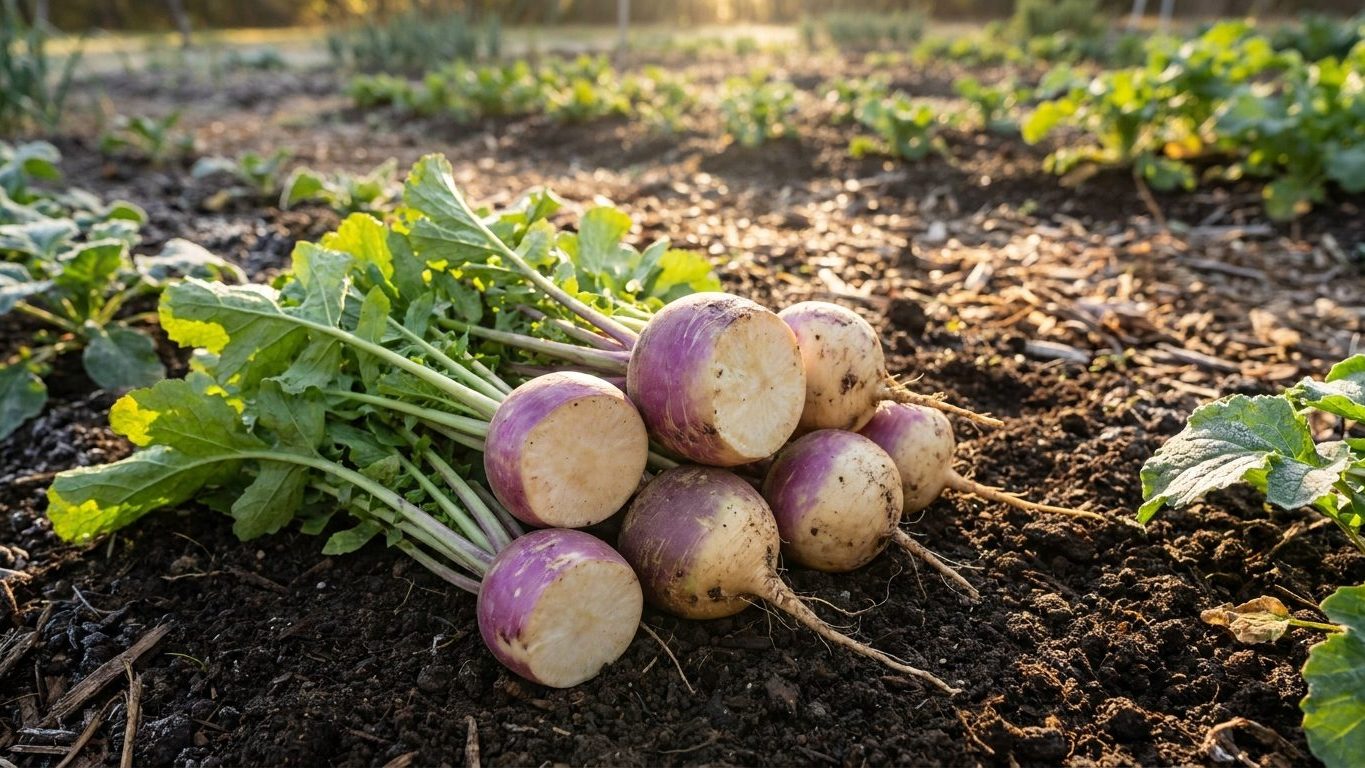

In North Carolina, turnips and rutabaga work best as a fall crop: sown in late summer, harvested from the first frosts into winter. A spring sowing is possible, but it has to finish before summer heat arrives. The dates below come from Charlotte, in the Piedmont, so mountain and coastal gardeners will need to shift them.
When the soil is warm enough in North Carolina
The date everyone asks about is the last spring frost. At Charlotte, the NOAA NCEI U.S. Climate Normals 1991-2020 put it between March 23 and April 5, based on the 30 to 70 percent probability band for a 32 F freeze. That is a probability, not a promise, and a late cold snap can still arrive after the window closes.
Treat that date as a proxy rather than a start signal. Turnips and rutabaga are waiting on the soil, and soil lags the air. It warms after frost risk ends, not at the same moment, and a bed that was frozen in February can still be cold and sodden in the last week of March. A cheap soil thermometer pushed a couple of inches into the bed tells you more than any calendar. Sow when the ground is workable, crumbles in your hand instead of smearing, and has clearly started to warm.
Why the spring window is the minor one
Both crops are cool-season brassicas. A spring sowing has to size up its roots before summer heat arrives, and roots that mature in hot weather turn woody, pithy and sharp. The usual spring choice is a quick-maturing turnip type, sown as soon as the soil allows. Rutabaga, which takes noticeably longer to fill out, is poorly suited to a spring start in most of the state.
The fall sowing is where the crop pays off. Work backward from the first fall frost, which at Charlotte falls between October 30 and November 8 on the same NOAA probability basis. Take the days-to-maturity printed on your seed packet, add a margin for the slower growth of shortening days, and that gives your sowing date. Rutabaga needs the longer lead, so it goes in first.
Charlotte is a Piedmont reference, and the state is not uniform. The Blue Ridge mountains to the west run several weeks later in spring, and the coastal plain runs earlier. For the varieties trialed where you live, check with North Carolina State Extension, because a type that thrives at Charlotte’s elevation may sulk in Asheville’s. The general picture of the crop is in Growing Turnips and Rutabaga: An Autumn Crop, Sweetened by Frost.
How long the season lasts here
Count the days between the two frost dates and the numbers get concrete. Pairing the early ends of each band, March 23 to October 30 gives 221 days. Pairing the late ends, April 5 to November 8 gives 217 days. So the frost-free stretch at Charlotte runs about 217 to 221 days.
| Pairing | Last spring frost | First fall frost | Days between |
|---|---|---|---|
| Early ends of both bands | March 23 | October 30 | 221 |
| Late ends of both bands | April 5 | November 8 | 217 |
What a long window allows
A window that long gives you room for two sowings of the same crop. A quick turnip can go in during early spring, come out before the heat, and the bed can then wait for a fall planting of turnips or the slower rutabaga. Between those, you can stagger small sowings every couple of weeks in late summer so the harvest does not arrive all in one weekend. The autumn crop overview covers the logic, and the succession sowing guide on this site lays out the spacing between plantings.
The window also settles the transplanting question. In a short northern season, starting roots indoors can buy a few precious weeks, and it might be worth the trouble. Here it rarely is. Turnips and rutabaga resent root disturbance, and a transplant with a bent or damaged taproot tends to fork. With a season this generous, direct sowing wins. If you do transplant, check the root before you set it: a crooked or broken tip is a reason to discard the seedling.
Remember that these figures describe Charlotte. A mountain site loses weeks in spring and probably some in fall, which can squeeze the spring sowing out altogether. A coastal garden starts earlier but also meets summer heat sooner, so the cool-season gap there opens and closes differently.
Heat and water in North Carolina
This page does not carry a count of days above 90 F or a figure for summer rainfall in North Carolina. Rather than guess, it sticks to what the verified data supports. Those two numbers would help explain why summer is the dead season for this crop, but they do not govern the harvest. For a fall brassica, the two facts that matter are cold ones.
What the winter numbers say
The mean daily minimum of the coldest month at Charlotte is 31.8 F (NOAA NCEI Climate Normals 1991-2020). That is an average night just under freezing. The practical meaning is that winter here alternates between mild stretches and frosty nights, and the soil rarely locks up for weeks. Roots left in the ground under a thick mulch of straw or shredded leaves can often stay put and be pulled as needed, a luxury gardeners in colder places do not have. The USDA Plant Hardiness Zone Map (2023) puts the state across zones 5b to 8b, so that advice weakens as you climb toward the mountains, where lifting roots before a hard freeze makes more sense.
The same number caps how much sweetening you will get. Frost converts starch to sugar in these roots, and the cold needed is repeated light freezing, not extreme cold. With the first fall frost arriving between October 30 and November 8 and winter nights hovering near 32 F, the Piedmont gets a modest, real dose of that sweetness, but not the long deep chill of a northern garden. A cold mountain autumn does better here.
A warm, humid season brings its own troubles. Turnips and rutabaga are brassicas, which means they share their pests and diseases with cabbage, kale and mustard. Flea beetles, aphids, root maggots, black rot and downy mildew all work across the family, and clubroot persists in soil for years. A gardener who rotates turnips into a cabbage bed has rotated nothing. Follow the crop rotation guide in this silo and keep the family out of the same ground for several seasons.
If you store roots, inspect each one. Look at the shoulders, the crown and the tip. A soft patch, a weeping spot or a moldy crown ends the question, and that root goes to the compost, not the kitchen. A firm, sound appearance is not proof of safety, and this page does not offer a keeping time. For readers curious how the same crop plays in very different summers, Growing Turnips and Rutabaga in Oklahoma and Growing Turnips and Rutabaga in British Columbia offer contrasts.
Which turnips and rutabaga suit North Carolina
Choose by type, not by name, and this page names no variety on purpose. The cultivars trialed in a given county are the only recommendation that means anything, and this page does not have that data. Inventing a name would be worse than leaving it out.
Match the type to the conditions
The state’s own facts point the way:
| Local condition | What to favor |
|---|---|
| Long frost-free window (about 217 to 221 days at Charlotte) | Room for a quick spring turnip and a separate fall sowing, including slower rutabaga |
| Hot summers that cut the spring window short | Early-maturing turnip types for spring; space plants for airflow and mulch to shade the root zone |
| Humid weather that favors leaf and root disease | Disease resistance listed on the seed packet, treated as the first criterion |
| Mild winters near 32 F at night | Types that hold well in the ground, with mulch, for pulling through the cold months |
Disease resistance comes first because humidity is the one factor you cannot change. Airflow matters in the same way: thin seedlings to the spacing on the packet, since crowded foliage stays wet and invites mildew. A shaded, mulched root zone keeps soil cooler during the warm early weeks of a fall sowing.
Mountain gardeners, whose winters are colder, should lean toward quicker types that finish before hard freezes, or plan on lifting. Coastal gardeners, who start earlier, can lean on the spring sowing.
For local recommendations, North Carolina State Extension and its county offices know which types have been grown, tested and survived in your soil. Ask for their vegetable planting calendar for your county as well, since it will correct any statewide pattern against local frost. A phone call to the office beats any list a website can print.
Common questions
Can I grow turnips in North Carolina in spring?
Yes, with a quick-maturing type sown as soon as the soil is workable. At Charlotte, the last spring frost falls between March 23 and April 5 on a probability basis. The crop has to finish before summer heat turns the roots woody.
Do I need to dig roots before winter?
Not always. At Charlotte, the coldest month averages a daily minimum of 31.8 F, so roots can often stay under mulch. Colder mountain sites, within a state spanning USDA zones 5b to 8b, may need to lift them before a hard freeze.
Can I plant them where cabbage grew last year?
No. Turnips and rutabaga are brassicas, like cabbage, kale and mustard, and they share the same pests and diseases. Rotate to a bed that has been free of the whole family for several seasons.
How do I find varieties that work in my county?
Contact North Carolina State Extension or your county office. They know which types have been trialed locally, which a statewide page cannot tell you.