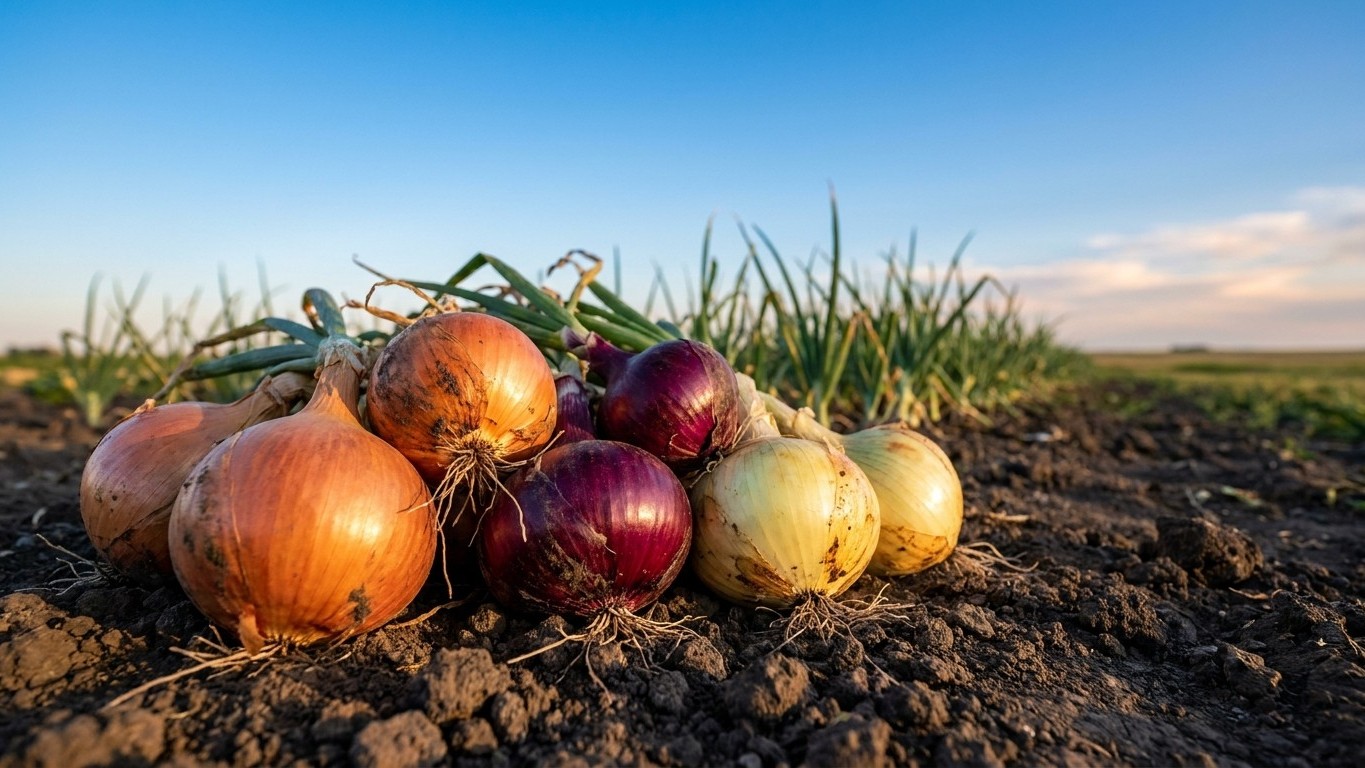

Lift onions when most of the tops have flopped over and yellowed, and check with your local county extension office for timing in your area. Pull them on a dry day, then cure them in a warm, airy spot until the necks are tight and the skins are papery. Only then do they go into storage. A pungent, long-day onion handled this way can feed a household into March. A sweet one will be soft or sprouting well before that.
Keeping them, and for how long
Curing decides how well an onion keeps. A bulb straight from the ground still has a fat, moist neck, and that open neck is how rot gets in. Spread the bulbs in a single layer on a screen, rack or slatted crate. Put them somewhere warm, shaded and breezy, such as a covered porch or an open garage where rain can’t blow in. Leave the tops on. The bulbs are ready when the neck is thin and dry and the outer skins rustle like paper. Go by touch rather than the calendar, because a damp fall stretches the job.
What temperature and humidity do onions need in storage?
Clemson Cooperative Extension’s Home & Garden Information Center states it plainly: “Ideal conditions are between 45 °F and 55 °F, and 50 to 60 percent humidity.” The numbers to write on the back of your hand are 45 °F to 55 °F with 50 to 60 percent humidity.
Dry matters as much as cool. Carrots, beets and other roots want damp air, and onions want the opposite. A cellar that keeps carrots crisp will push onions toward mold and sprouting. One space rarely holds both well, so plan two spots.
Treat any storage duration as a ceiling reached only when everything goes right. A well-grown, fully cured, pungent bulb in the range above may last into March. Thick-necked, nicked or bruised bulbs go sooner, and so does any bulb stored warm. Sort at harvest and put the damaged ones in the kitchen first. Bulbs with tunnels or soft spots from feeding insects belong in that pile too (see What Eats Onion in North Dakota, and When for what causes that damage). Check the stored bulbs every couple of weeks and remove any that feel soft, because one rotting bulb can spoil its neighbors.
Why do pungent onions keep longer than sweet ones?
University of Missouri Extension (publication G6355) says it directly: “As a rule, ‘sweet’ onions do not store as well as the more pungent types.” The reason is chemical. An onion’s bite comes from volatile sulfur compounds, and those same compounds help protect the bulb while it sits in storage. A sweet variety carries fewer of them. That makes it nicer raw and a poor candidate for winter. Eat sweet onions within the first weeks after curing, and don’t count on one to last.
Day length lines up with this trade-off. Onions start to bulb because of the length of the day, not the warmth. Fargo sits at 46.93 degrees north and gets 15 h 41 of daylight on the longest day. A short-day variety begins bulbing at about 12 hours, so up north it bulbs early and stays small. A long-day variety waits for 14 to 16 hours, and Fargo clears that bar easily. Short-day types run sweeter and long-day types keep longer, which is why northern gardens produce onions that last into March while southern gardens produce onions to eat soon.
That 15 h 41 belongs to Fargo. A garden near the Canadian border gets a little more summer daylight, and one in the far south of the state a little less, so check your own latitude if you live near either edge. Either way, long-day varieties are the right family for keeping, and The Best Onion Varieties for North Dakota sorts them out. For planting dates and the rest of the season, start with Onions in North Dakota.
Where in the house that actually is
A range on a fact sheet doesn’t tell you which door to open. The target of 45 °F to 55 °F is cooler than any living space and warmer than a refrigerator, which leaves fewer candidates than you might expect.
Can you keep whole onions in the refrigerator?
Not cured bulbs. A domestic fridge runs colder than 45 °F, and the air in the crisper drawer is humid, which is the wrong pairing for an onion. Use the fridge for onions you’ve already cut, sealed in a container so the smell stays put. A heated room has the opposite problem. A kitchen counter or a pantry shelf beside the furnace sits above 55 °F, and bulbs there soften and sprout early. A garage swings with the weather. It can be warm in September, then drop well below freezing in January, and a bulb that freezes and thaws turns to mush.
| Spot | Temperature against 45 °F to 55 °F | Air | Verdict |
|---|---|---|---|
| Refrigerator | Too cold | Humid | Cut onions only |
| Heated kitchen or pantry | Too warm | Usually dry | Short-term use |
| Garage | Swings from warm to freezing | Varies | Risky in winter |
| Unheated interior room or closet | Often close | Usually dry | Best candidate |
| Basement or cellar | Often close | Often damp | Only if it reads dry |
Which room comes closest, and what should you check?
In most northern homes the winner is a spare room or closet off the heated living space, with the vent closed or the radiator turned down. A north-facing closet works, and so does a basement corner away from the furnace, water heater and laundry. Basements tend to be cool enough but damp, especially in spring when the ground thaws, so a cellar earns its place only if it reads dry.
Readings settle the question. Run a thermometer and a hygrometer in the spot for a week before you load it, checking morning and evening, or use a min-max thermometer to catch the swings. Skipping that test can cost the whole bin by February, and the cheap gauges are the least expensive part of the whole crop.
Containers matter too. Use mesh bags, slatted crates or shallow baskets so air moves around every bulb, and keep the piles shallow. Plastic bags trap moisture and invite rot. Keep the onions on their own shelf, away from potatoes and root crops, which add moisture to the air around them. If a reading comes in cool but the humidity sits above 60 percent, a small fan moving air across the shelf will often help.
Common questions
How do I know when onions are ready to lift?
Watch the tops. When most of them have fallen over and started to yellow, the bulbs have stopped growing and are ready. Pull them on a dry day, and don’t wait through a hard freeze. Don’t bend the tops over by hand to speed things along, since that can leave a wet neck that rots in storage.
Should I wash onions before curing them?
No. Brush off loose, dry soil with your hand and leave the rest. Water on the skins and necks slows curing and invites rot. Trim the dry tops down to a short stub only after the neck is tight.
Can I store sweet onions through the winter?
Expect them to fall short. Sweet onions have fewer of the sulfur compounds that protect a bulb in storage, so they soften and sprout long before pungent types do. Cure them, use them first, and save the long-keeping shelf for pungent, long-day varieties.
Can onions and carrots share the same cellar?
They compete. Onions keep best at 50 to 60 percent humidity, while carrots and other roots need damp air to stay firm. Put the onions in a drier spot, such as an interior closet, and give the roots the cellar.