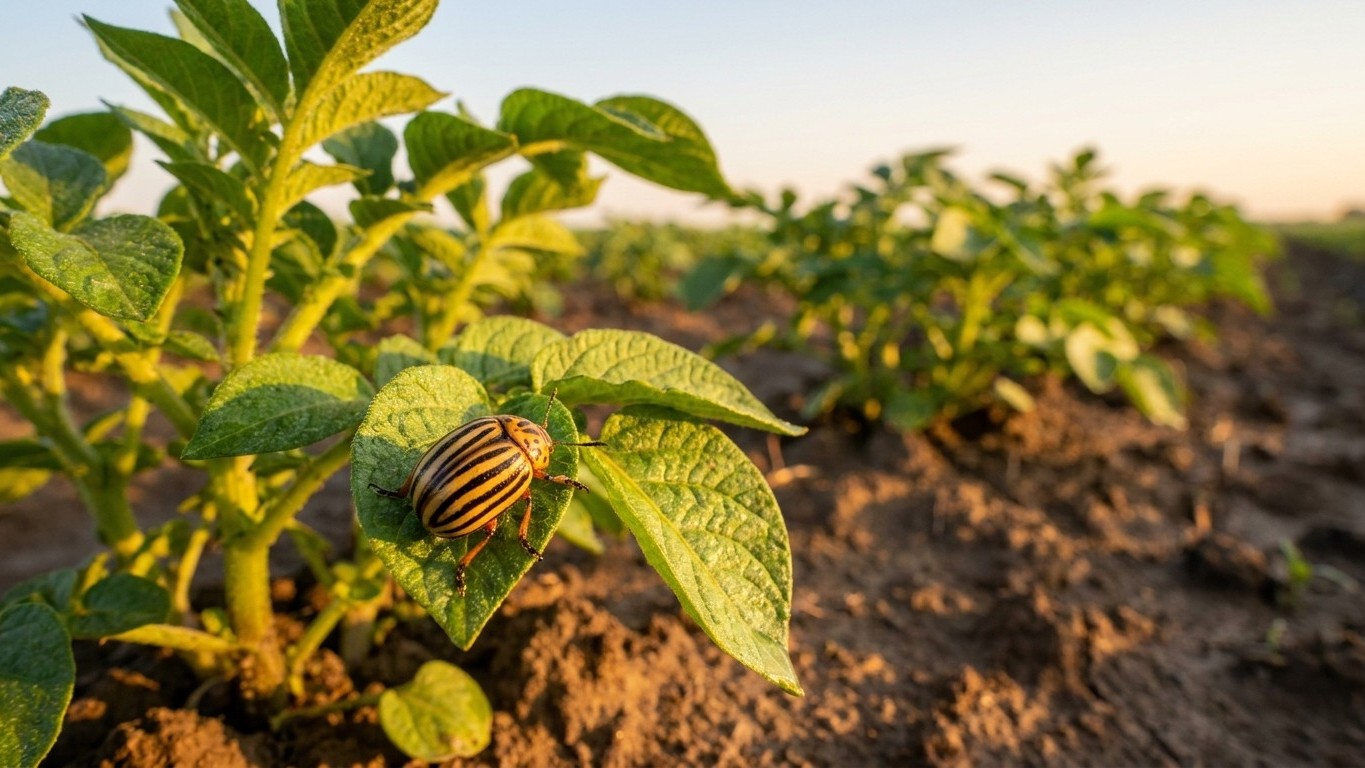

Four insects and one mollusk make the documented list for potato in this territory, according to the UAF Cooperative Extension, the closest source that actually publishes pest data for a subarctic growing region like this one. Aphids, cutworms, root maggots, and slugs feed on potato plants; a fifth name on that list, spruce beetle, has nothing to do with a garden bed. Timing here follows the region’s frost window more than it follows a calendar month.
Which pests attack potato in Northwest Territories
The UAF Cooperative Extension documents five species for this northern region: aphids, cutworms, root maggots, slugs, and spruce beetle. That list is short by design. It is not a comprehensive garden-pest inventory, it is what one extension service has actually recorded for a subarctic climate close enough to Northwest Territories to be the best available reference point, since the territory itself does not maintain its own separate published pest list for home gardens.
Spruce beetle does not belong on a potato page and it should not be on this one either, except to rule it out. It is a bark beetle that attacks the trunk of mature spruce trees, boring into the wood beneath the bark. It has no mouthparts built for foliage, no interest in tubers, and no documented association with any vegetable crop. A gardener who spots bark damage on a nearby tree and blames it for chewed potato leaves is chasing the wrong insect entirely.
That leaves four species that actually feed on potato: aphids, cutworms, root maggots, and slugs. Each one targets a different part of the plant, which matters more than the insect’s name when you’re standing in the row trying to figure out what happened overnight.
What each one actually does to the plant
Aphids cluster on the underside of leaves and along stems, piercing plant tissue to feed on sap. They rarely kill a mature potato plant outright, but a heavy colony weakens growth and can spread virus between plants, which matters more for anyone saving their own seed potatoes than for a single season’s harvest.
Cutworms operate at ground level. The larvae hide in soil during the day and cut young stems at the base overnight, a habit that can wipe out a newly emerged row before a gardener even sees the moth that laid the eggs.
Root maggots tunnel into roots and developing tubers below the surface, leaving damage that often goes unnoticed until harvest, when a knife or fork reveals tunnels that look nothing like normal skin.
Slugs feed at the soil surface and above it, rasping ragged holes in leaves and sometimes gouging into tubers close to the surface, work they do mostly after dark and in damp weather.
When each one shows up, and what it does first
Northwest Territories gardeners work with an average last spring frost of May 25, recorded at the Yellowknife A station. That date is a mean, not a safe planting guarantee: in one year out of two, the last frost actually falls later than May 25. Anyone planting seed potatoes right at that average date is gambling on the better half of the odds, not a sure thing, and gardens north of Yellowknife or at higher elevation typically lag even further behind it.
Cutworms are usually the first problem a gardener notices, because their damage appears fast, right at emergence. A seedling that looked fine the evening before is found severed at the soil line the next morning, often with no plant material dragged away, just a clean cut and a toppled stem. This happens early in the season, close to when plants first push through the soil after the frost-free window opens.
Root maggots follow a similar early pattern below ground, though their damage stays invisible until roots or young tubers are dug up or disturbed. A plant that looks stunted or wilts without an obvious above-ground cause, despite adequate moisture, is worth checking below the soil line rather than assumed to be a watering problem.
Aphids build up more gradually as the season progresses and foliage fills out, favoring the undersides of leaves where colonies can go unnoticed until numbers are already high. Sticky residue on leaves, or ants tending the colony for the honeydew aphids excrete, are usually the first visible clue rather than the insects themselves.
Slugs track weather more than calendar. They become active during stretches of cool, damp conditions, which in this region can happen at multiple points across a short growing season rather than on a predictable date. Fresh slime trails across leaves or soil, especially near ground level, tend to show up before the chewing damage becomes obvious in daylight.
Telling the damage apart from everything else
Not every damaged leaf or stunted plant is an insect problem, and misreading the cause wastes time and sometimes damages the plant further. The decision that actually matters here is checking the ground and the stem base before assuming an insect is responsible. A short season leaves little room to guess wrong and wait out a mistake.
| Symptom | Likely cause | What tells them apart |
|---|---|---|
| Stem cut clean at soil line, seedling toppled | Cutworm | Dig an inch of soil near the base; a curled gray-brown larva is usually still there |
| Ragged holes in leaves, slime trails visible | Slugs | Slime trails and night-time feeding; drought stress and nutrient deficiency never leave slime |
| Sticky residue, curling leaves, ants present | Aphids | Check leaf undersides for visible clusters; uniform pale yellowing without stickiness points to nutrient deficiency instead |
| Tunnels inside roots or tubers at harvest | Root maggot | Larvae or tunnels are visible when cut open; scab disease produces rough, corky patches with no tunnel and no larva |
Wilting that affects the whole plant evenly, rather than a single severed stem, points more toward drought stress or a disease issue than toward any of the four insects above. Mechanical damage from hail, hoeing too close to the row, or animal traffic also mimics insect feeding, but it tends to show torn or bruised tissue rather than the clean cuts, slime, or tunnels described above. When the cause stays unclear after checking the base of the stem and digging around the root zone, that is exactly the point to bring a sample or a photo to a local extension office rather than guess further.
What actually works here, and what is a waste of time
A short frost-free season changes the priority list. Timing and physical barriers matter more than any treatment applied after damage is already visible. Placing a physical barrier or collar around each stem before seedlings emerge is the single decision that prevents most cutworm losses; doing it after the first severed stem appears is already too late for that plant.
Crop rotation, keeping potatoes off the same ground where root maggots or their pupae overwintered the previous season, reduces pressure without any product at all. Fall cleanup of plant debris removes overwintering sites for several of these pests at once, which matters more in a short season where there’s little time to recover from a slow start. Hand-picking slugs after dark, when they’re active, also works better here than any daytime search, since a damp northern garden gives slugs plenty of cover during the day.
What tends to waste effort is spraying broadly once damage is already obvious, or treating for one insect based on a guess rather than a confirmed identification. A short growing season doesn’t leave room to treat the wrong pest and start over. It’s also worth saying plainly once: planting uncertified seed potatoes invites virus problems that no amount of pest control after the fact will fix, since aphids that transmit virus don’t create the underlying infection, they just spread what’s already there in the seed piece.
This site does not recommend specific products or active ingredients, since what’s approved for use varies and only a local extension office keeps that current.
Where to check this for your own county
Pest pressure inside a single territory is never uniform. A garden near open water, a sheltered yard in town, and a plot at higher elevation or further north can all report different pests in the same season, even though they sit under the same territory-wide documentation. What’s published for the region tells you what’s possible, not what’s actually in your own soil this year.
Since Northwest Territories does not maintain its own separate published home-garden pest list, the UAF Cooperative Extension remains the closest documented reference for this subarctic growing region, and it’s worth using their identification resources as a starting point before assuming a local diagnosis is settled. From there, the most useful next step is contacting the agriculture or extension office serving your own community or district, since they can speak to conditions specific to that garden rather than to the territory as a whole.
Bring a sample if possible, whether that’s a cut tuber, a photo of the damaged stem, or the insect itself in a sealed container. A local office confirms far more accurately from a physical sample than from a description over the phone, and confirmation matters more than speed when a short growing season doesn’t leave room to treat the wrong problem twice.
Common questions
Does spruce beetle ever damage potato plants?
No. Spruce beetle attacks mature spruce trees by boring into the bark and trunk. It has no documented connection to potato foliage or tubers, and its presence on a nearby tree is unrelated to damage in a vegetable garden.
Is May 25 a safe date to plant potatoes without frost risk?
No. May 25 is the average last spring frost recorded at the Yellowknife A station, meaning frost falls later than that date roughly half the time. Gardens further north or at higher elevation typically run behind even that average.
Why do slugs seem worse some years than others?
Slugs respond to moisture and cool conditions more than to a fixed calendar date, so a stretch of damp, cool weather at any point in the season can trigger a burst of activity that a drier season would not produce.
Does buying certified seed potatoes actually matter for pest problems?
Yes. Uncertified seed potatoes can carry virus that no pest treatment corrects after planting, and aphids that feed on an infected plant simply spread a problem that was already present in the seed piece rather than creating it.