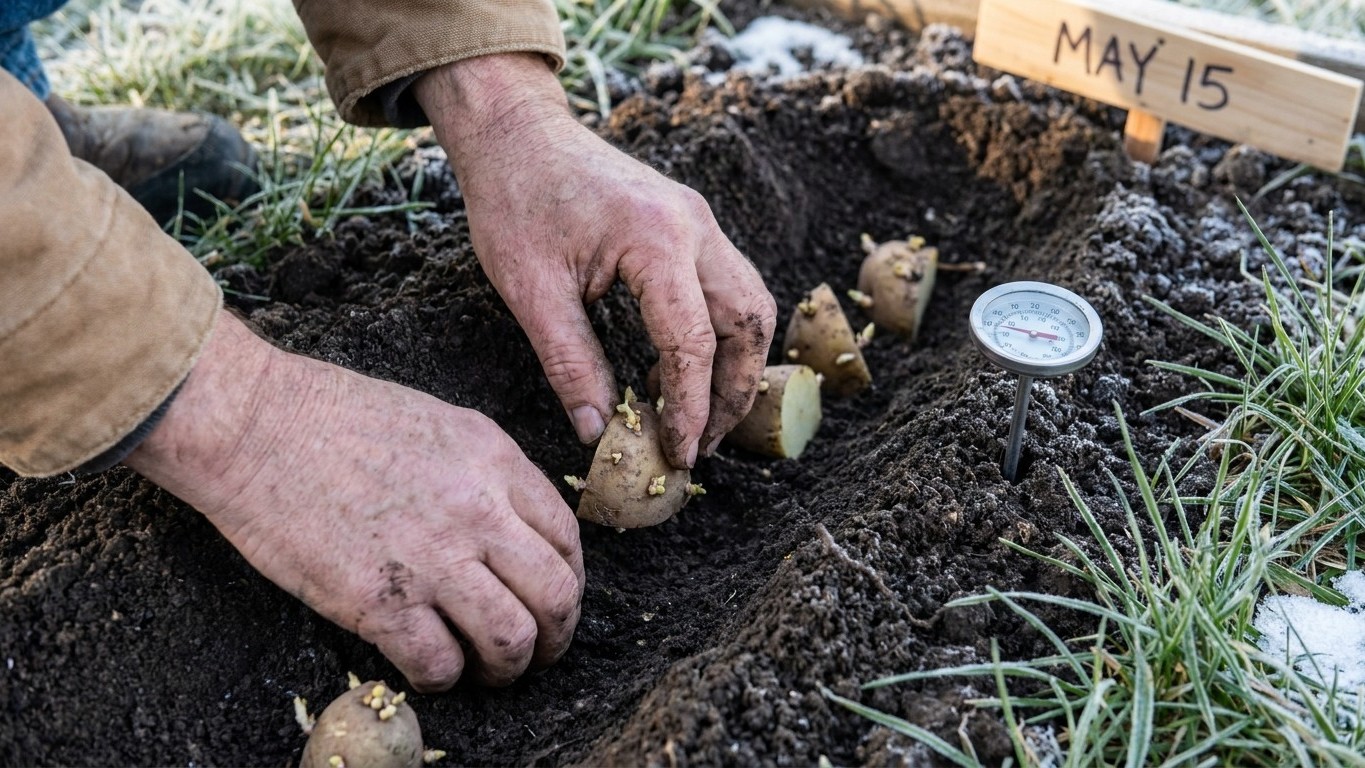

The short answer: count back 14 to 21 days from May 25, the average last spring frost at Yellowknife, and you land somewhere in early-to-mid May for getting potato seed pieces into ground that has warmed to 50°F. But that May 25 figure is a mean, not a promise, and the territory’s short, cool growing season changes how that math plays out compared to almost anywhere else potatoes get planted in North America.
The short answer
Environment and Climate Change Canada’s Climate Normals for 1981-2010 put the average last spring frost at the Yellowknife A climate station (climate ID 2204100) at May 25. Utah State University Extension and the University of Maine Cooperative Extension both describe the planting rule the same way: potatoes go in the ground as soon as soil temperature reaches 50°F, which typically falls 14 to 21 days ahead of the last frost date for a given location. Run that arithmetic against Yellowknife’s May 25 average and you get a planting window opening somewhere around the first to third week of May, depending on how quickly the soil warms that particular spring.
That’s the number. Here’s the catch nobody should skip past: a mean frost date is the midpoint of a spread, not a guarantee. Half of the years on record at Yellowknife saw frost arrive after May 25. If you plant potatoes assuming the average date is a safe date, you’re accepting even odds of a late frost hitting emerged foliage. Potato tops tolerate a light frost better than many garden vegetables, since new growth can push up again from the seed piece below ground, but a hard freeze after emergence still sets the plant back.
The other piece that matters: Yellowknife A is one weather station representing one location in a territory that stretches from the boreal forest around Fort Smith to the tundra edge near Inuvik and beyond. A territory this size does not share one climate. Communities north or at higher elevation than Yellowknife run behind it, sometimes by weeks, on both the last spring frost and the first fall frost. The May 25 figure is the reference point for the Yellowknife area specifically, not a blanket date for every garden in the Northwest Territories.
What that means practically is that the 14-to-21-day countback is a formula, not a fixed calendar square. Gardeners closer to Yellowknife’s climate can use the countback from May 25 with reasonable confidence. Gardeners further north need to shift their own planting window later, because their local last frost date sits later in the calendar than Yellowknife’s, even though no official figure for those locations is published here.
What actually decides it
Two separate thresholds govern a potato crop, and they pull in opposite directions. Understanding both lets you reason through a planting decision even for a location this page never names.
The 50°F soil floor
Potato seed pieces are planted once soil temperature reaches 50°F, according to Utah State University Extension. Below that, seed pieces sit in cold, often wet soil and rot before they can sprout, rather than waiting patiently for warmth. Soil temperature, not air temperature and not the calendar, is the real trigger. A sunny week can bring air temperatures into the 60s while soil four inches down is still in the low 40s, especially where snowmelt has just finished and the ground is saturated. That’s why the 14-to-21-day countback from the last frost date is a rule of thumb built on the typical lag between warming air and warming soil, not a substitute for actually checking the soil.
The 90°F heat ceiling
At the other end of the season, both Utah State University Extension and the University of Maine Cooperative Extension identify soil temperatures above 90°F as the point where tuber set and tuber fill are inhibited. Once soil crosses that line, the plant may still look green and healthy above ground, but the tubers below stop sizing up, and watering more does not reverse it. This is the mechanism that decides whether a warm-climate garden needs to treat potatoes as a spring-only crop dug before summer heat peaks, or whether the season stays cool enough throughout to let a full-season variety keep filling tubers into late summer.
In the Northwest Territories, this second threshold rarely becomes the binding constraint. Summers here are short and generally cool enough that soil temperatures climbing past 90°F is not the typical failure mode. The limiting factor runs the other direction: a frost window that opens late in spring and can close again early in fall, compressing the number of frost-free days available for the plant to bulk up tubers at all. That’s a different problem from the heat-driven tuber shutdown described in the sources, and it’s worth knowing which one you’re actually up against before choosing a variety or a planting date.
Season class matters more than a fixed date
Because the frost-free window is the scarce resource here, the season class of the variety, early, mid-season, or late, as both extensions describe it, carries more weight than it might in a longer-season state. An early-season variety reaches usable size in less total growing time than a late-season one, which matters when the gap between a mid-May planting and an early fall frost is not generous.
How to do it
- Check soil temperature directly. Push a soil thermometer four inches deep in the bed where potatoes will go, checking on a few consecutive mornings rather than relying on one reading, since soil temperature can swing with weather.
- Wait for a consistent 50°F reading. Once the soil holds at or above that mark, per Utah State University Extension’s guidance, the bed is ready, regardless of what the calendar says.
- Source certified seed potatoes. Buy certified seed rather than potatoes from a grocery store or an uncertified bin. Uncertified seed stock can carry viruses that stunt the plant and reduce yield without any obvious sign until the crop disappoints.
- Cut and cure seed pieces if needed. Larger seed potatoes are cut into pieces with at least one eye each, then left to callus for a day or two in a cool, airy spot before planting, which reduces rot risk once they’re in the ground.
- Plant at the recommended depth and spacing. Set seed pieces in trenches roughly 3 to 4 inches deep, cut side down, eyes up, spacing them out along the row.
- Hill soil around the stems as they grow. As shoots emerge and gain height, mound soil up around the base of the plant, which protects developing tubers from sunlight and gives the plant more rooting depth for tuber formation.
- Monitor for late frost after emergence. Given that the May 25 average is a midpoint and not a safe date, keep frost cloth or loose mulch on hand to cover emerged foliage if a late cold snap is forecast.
- Track the season toward harvest based on variety class. Watch the foliage rather than a fixed day count: early-season varieties will show signs of maturing sooner than mid-season or late types, and that observation should guide harvest timing more than a number on the calendar.
What goes wrong
- Planting by the calendar instead of the soil. A gardener plants on a fixed date because “that’s when everyone plants,” only to find the seed pieces rotting in cold, wet ground. The remedy is simple: check soil temperature with a thermometer and wait for 50°F, not for a date on a page.
- Treating the average frost date as a safe date. Because May 25 is a mean, betting the whole crop on frost being done by then ignores that roughly half of past years saw frost land later. The remedy is to keep row cover or mulch ready through late May and into early June, and check forecasts closely once plants have emerged.
- Using uncertified seed to save money. Seed potatoes saved from last year’s grocery haul, or bought from an uncertified source, can carry viral disease that shows up as weak growth and poor yield with no clear cause. The remedy is buying certified seed potatoes every season, even though it costs more upfront.
- Applying a heat-avoidance strategy that doesn’t fit here. A gardener who has read general potato advice built around hot-summer states may rush to dig potatoes early to beat soil temperatures past 90°F, a threshold the Northwest Territories rarely reaches. The remedy is recognizing that the local limiting factor is the short frost-free window, not summer heat, so a full growing season through to natural maturity usually serves the crop better than an artificially early harvest.
- Assuming one frost date applies territory-wide. A gardener outside the Yellowknife area plants on the May 25 countback and finds frost still active weeks later, because their community’s climate runs behind Yellowknife’s. The remedy is treating the Yellowknife figure as a reference point for that area specifically, and shifting planting later for locations known to have a later local frost pattern, even without an official published date for that spot.
Common questions
Is May 25 the date I should plant potatoes in the Northwest Territories?
No. May 25 is Yellowknife’s average last spring frost from Environment and Climate Change Canada’s 1981-2010 Climate Normals. Potatoes are planted 14 to 21 days before that date, once soil reaches 50°F, so the actual planting window for the Yellowknife area typically falls earlier in May, not on the frost date itself.
What if my community is farther north than Yellowknife?
Locations further north or at higher elevation than Yellowknife generally see their last frost later in the calendar, since Yellowknife A is a single reference station, not a territory-wide figure. No official frost date for other communities is published here, so the safest approach is to check local soil temperature directly rather than assume the Yellowknife countback applies.
Do I need to worry about soil getting too hot for potatoes in the Northwest Territories?
Rarely. Utah State University Extension and the University of Maine Cooperative Extension both note that soil above 90°F inhibits tuber set and fill, but Northwest Territories summers are short and generally cool enough that this ceiling is not the typical constraint here. The bigger limiting factor is a compressed frost-free window on both ends of the season.
Should I choose an early, mid-season, or late variety?
Given how compressed the frost-free window is in this territory, an early-season variety, as classified by these extension sources, generally fits better than a late-season one, since it needs less total time to reach usable size before fall frost returns. Neither source publishes a specific day count for any season class, so plan around the class label and watch the foliage rather than counting toward a fixed number.