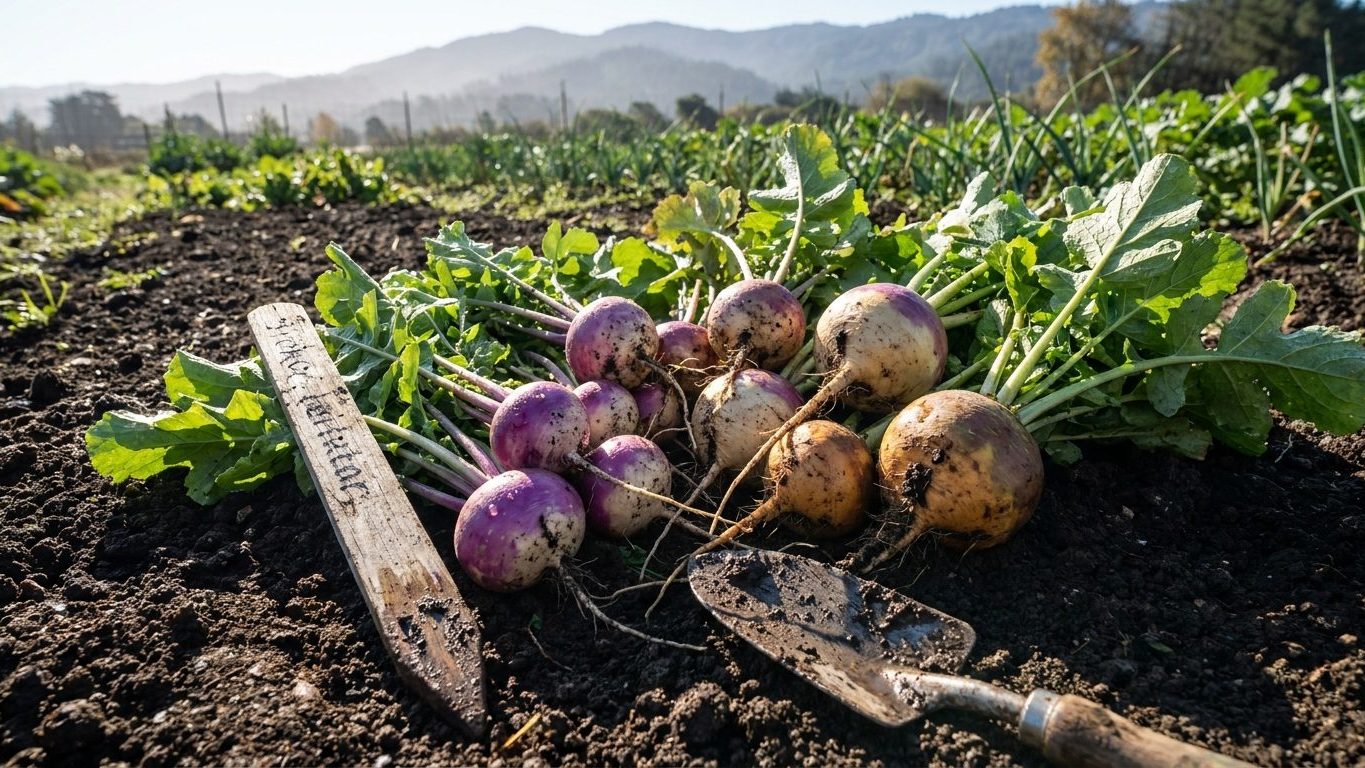

Northwest Territories gardeners get one real shot at turnips and almost none at rutabaga. Fast salad turnips maturing in under 60 days are the safe bet; full-size storage turnips work with careful timing; rutabaga only pencils out if you start early indoors and accept the risk. The territory’s growing season is simply too short and too cold for anything slower.
The short answer for Northwest Territories
Choose by days-to-maturity first, variety name second. That’s the whole strategy here. Yellowknife’s climate normals put the average last spring frost at May 25 and the average first fall frost at September 18, which gives a frost-to-frost window of roughly 116 days in a typical year. That sounds workable until you remember these are averages, not guarantees, and soil in a zone 1b climate takes its time waking up in spring.
Fast turnips built for baby-root or salad harvest, the kind bred to size up in five to six weeks, fit that window with room to spare. A gardener can direct-sow one round after the frost risk clears, harvest by midsummer, and often squeeze in a second sowing before the fall cold returns. These are the varieties that actually reward a Northwest Territories garden: quick out of the ground, quick to size, forgiving if the season runs a week or two short.
Full-size white or purple-top turnips grown for storage need more like 50 to 60 days and still work, but they leave less margin. Plant them the moment soil can be worked, not on a calendar date, and watch the fall end of the calendar closely.
Rutabaga is the harder call. Classic storage rutabaga runs 90 to 100 days from seed, which asks for nearly the entire average frost-free window with zero allowance for a late spring or an early fall. That’s not impossible in a warm year, but it’s not a plan a gardener should build a season around. The realistic path is starting rutabaga seed indoors three to four weeks before the last frost date and transplanting out, effectively borrowing a month the outdoor calendar doesn’t have. Without that head start, rutabaga in the Northwest Territories is a gamble more often lost than won.
So the type decision comes down to this: turnips, yes, favoring the fastest maturing types; rutabaga, only with an indoor head start, and even then treated as a bonus crop rather than a certainty.
What will not work here

Long-season rutabaga sown directly outdoors after the last frost is the clearest failure point. At 90 to 100 days to maturity, it needs almost the full average frost-free stretch with nothing held in reserve, and the moment a spring runs cold or a fall arrives early, the crop is caught mid-swell with roots still small. This isn’t a marginal risk, it’s the default outcome in a season this tight.
Anything bred for a long, warm finish also struggles, not because the Northwest Territories gets too hot but because it never gets hot enough for long enough. Varieties selected in warmer growing regions for slow, steady bulking in sustained heat simply run out of daylight-driven warmth before they finish here.
Overwintering roots in the ground is another non-starter. The mean daily minimum of the coldest month at the Yellowknife reference station sits at -29.5°C (about -21°F), a temperature that kills stored roots and any exposed crown well before spring. Gardeners used to leaving a few roots in the soil under mulch in milder climates need to unlearn that habit here: nothing survives that cold undisturbed in open ground, and every turnip or rutabaga needs to be lifted and stored indoors before hard freeze sets in.
Treating the average frost dates as fixed deadlines is a subtler failure, but a common one. Because May 25 and September 18 are means, not guaranteed safe dates, roughly half of all years bring a frost later than May 25 or earlier than September 18. A gardener who sows rutabaga on May 25 assuming the frost risk is over, then loses two weeks to a late cold snap, has just converted an already-tight 90-day crop into one that can’t finish before the average fall frost arrives. The short season doesn’t forgive that kind of miscalculation, and there’s no quick recovery move once the roots are behind schedule.
Close spacing crowds roots into small, woody shapes in any climate, but it compounds particularly badly here: a turnip that’s already racing a short season doesn’t have the extra weeks to recover from a slow, crowded start the way it might in a longer-season garden further south.
What changes across Northwest Territories
The Northwest Territories is not one garden, and treating it that way is the fastest way to plant the wrong variety. The figures in this article come from the Yellowknife A climate station, and Yellowknife’s hardiness zone under Canada’s system is 1b, already one of the coldest classifications used anywhere in the country. That’s the reference point, not the floor.
Canada’s plant hardiness system builds its zones from seven climate variables, not one, so a single number like 1b captures more than just winter cold: it reflects the frost-free period, summer heat accumulation, snow cover, and wind exposure together. A territory spanning from the southern Dehcho and South Slave regions near the 60th parallel up to Arctic coastal communities hundreds of miles north covers ground that no single zone number can represent fairly. Southern communities generally see a longer, slightly milder growing season than Yellowknife’s normals suggest; far northern and coastal communities see a shorter one, sometimes considerably so.
This matters directly for variety choice. A gardener in a milder southern pocket of the territory might get away with a 60-day storage turnip sown on the average schedule. A gardener further north, where the frost-free window compresses further, needs to lean even harder toward the fastest 35-to-40-day turnip varieties and should treat rutabaga as essentially off the table without a serious head start indoors.
There’s no way to give a single safe recommendation for “the Northwest Territories” as a whole, because the territory itself doesn’t have a single climate. The right move is checking the Canada’s Plant Hardiness Site map for the specific community in question, rather than assuming Yellowknife’s zone 1b applies uniformly across a territory this large.
Where to check this for your own county
The Northwest Territories doesn’t use counties, but the same logic applies at the community and regional level: a territorial average is a starting point, not a final answer. The Government of the Northwest Territories’ Department of Industry, Tourism and Investment maintains an agriculture service that gardeners should treat as the next stop after this page, available at iti.gov.nt.ca/en/services/agriculture.
What to look for there is specific, not general. First, any regional planting guidance or growing-season data broken out by community rather than territory-wide, since a Fort Smith garden and an Inuvik garden are not working with the same number of frost-free days even though both sit inside the Northwest Territories. Second, any record of turnip or rutabaga varieties actually trialled locally, whether through community gardens, agricultural programs, or extension demonstration plots. A variety that has already been grown successfully two towns over carries more weight than any generic recommendation, including this one.
This page works from territory-wide climate normals recorded at one reference station. That’s useful for understanding the general shape of the growing season, the relative shortness of it, and the type of turnip that suits it, but it can’t replace a recommendation tuned to a specific community’s soil, elevation, and microclimate. A local extension contact, a community garden coordinator, or a regional agricultural office will always beat a territorial average, because they’re working from what has actually grown, not just from what the climate normals suggest should grow. Treat this article as the broad strokes and the local source as the fine print.
Checking this against your own garden
No planting calendar beats what’s actually happening in the soil, and that’s especially true in a territory where average dates carry this much uncertainty. Three signs matter more than any date on this page.
Soil feel comes first. Turnip and rutabaga seed germinates poorly in soil that’s still cold and clumping wet from spring melt. Reach in and squeeze a handful: if it packs into a hard, cold ball, the soil hasn’t warmed enough yet regardless of what the calendar says. Loose, crumbly soil that falls apart in the hand is the real green light, and in a short-season climate like this one, waiting those extra few days for the right soil condition rarely costs more than it saves.
First true leaves are the second signal. Turnip seedlings push up rounded seed leaves first, then a set of true, textured leaves that actually look like miniature turnip foliage. The speed at which those true leaves appear tells a gardener whether their particular spot is running warmer or cooler than the territorial average, information no climate normal can provide for an individual yard.
Third, watch the root shoulder, the point where the swelling root pushes up and becomes visible at the soil surface. Once that shoulder is roughly the width of a quarter, harvest windows open for baby turnips, and gardeners can start checking size every few days rather than guessing from a maturity date on a seed packet. Given how tight the Northwest Territories season runs, that visual check is often more useful than counting days from the sowing date, because it reflects what actually happened in that garden rather than what the average year predicted.