
In Nova Scotia, sow autumn spinach between late July and mid-August. That window comes from counting back 50 to 75 days from a harvest date set roughly two weeks ahead of the average first fall frost, which lands around October 18 at the Halifax Stanfield reference station. Sow too early and warm soil can block germination; sow too late and frost stops the crop before it fills in. The right week inside that range depends on how your own garden runs that particular summer.
The short answer
On the longest day of the year, Halifax gets 15 hours and 25 minutes of daylight. For most vegetables that would be good news. For spinach, it is the opposite. Spinach bolts under long days as well as under warm temperatures, so that stretch of near-15-hour daylight around the June solstice is exactly what pushes an early-summer crop to flower and turn bitter, no matter how mild the air feels.
Here is the part that surprises a lot of gardeners: Nova Scotia averages 0.0 days a year at 90 F or above. There is essentially no heat load in this climate, at least not in the sense of repeated hot afternoons. So when spinach fails in June, it usually is not because the plant got cooked. It bolted because the days got long, and day length works on its own clock, independent of the thermometer.
That distinction matters for how you plan the calendar. A grower who assumes “our summers are cool, so I can leave the spring crop in longer” is reasoning from the wrong variable. The days lengthen at the same rate here as anywhere else at this latitude, and spinach reads that signal regardless of whether the air is 65 F or 85 F. A cool Nova Scotia summer does not buy extra weeks in spring.
The autumn sowing runs on different logic. By late July, day length is already retreating from its peak, and by the time seedlings emerge in August, the days are shortening fast enough that bolting from day length stops being the threat. What replaces it are two separate obstacles at opposite ends of the sowing window: soil that is still too warm to germinate the seed reliably in high summer, and the first fall frost that eventually ends growth in October. Heat load, in the 90-degree sense, barely enters the picture in a province that averages zero such days a year. The two things that actually govern the Nova Scotia calendar are day length in spring and soil temperature paired with frost timing in fall.
How long the spring window really is
Working out the usable spring window means starting from a fixed frost date and working forward, then stopping the clock the moment day length takes over.
- Start with the sowing rule. Spinach seed goes in the ground 2 to 3 weeks before the last expected spring frost, while soil is still cool.
- Anchor that to Halifax’s average last frost. At the Halifax Stanfield station, the average last spring frost falls on May 7. That is a mean date, not a guarantee: in roughly half the years on record, frost arrives later than that, sometimes well into May.
- Sowing lands in mid-to-late April. Counting 2 to 3 weeks back from May 7 puts a typical spring sowing date somewhere between about April 16 and April 23, accepting the risk that a late frost year could nip young seedlings.
- Growth stays good only below 75 F. Spinach grows well as long as temperatures stay under that ceiling; above it, growth slows and leaves turn bitter. Given the province’s near-total absence of 90-degree days, this ceiling is rarely breached by heat alone in Nova Scotia gardens.
- Day length ends the window anyway. As the calendar moves toward the June solstice, daylight climbs toward that 15-hour-25-minute peak. Long before heat becomes an issue, the lengthening days trigger bolting, regardless of how mild the air stays.
- Net result: about seven to eight usable weeks. From a mid-to-late April sowing to a bolt-driven stop in early-to-mid June, the spring spinach window in Nova Scotia runs roughly seven to eight weeks, closed by day length rather than by summer heat.
The autumn crop, and when the soil lets you sow
Planning backward from harvest is the only reliable method here, since no source publishes a fixed days-to-maturity figure for spinach. What Utah State University Extension does state is a planting rule: sow 50 to 75 days before the date you want to harvest. Aiming to harvest around early October, about two weeks ahead of the average frost, that arithmetic puts fall sowing somewhere between roughly July 22 and August 16, which is the practical window for Nova Scotia gardens.
Soil that is still too warm to germinate
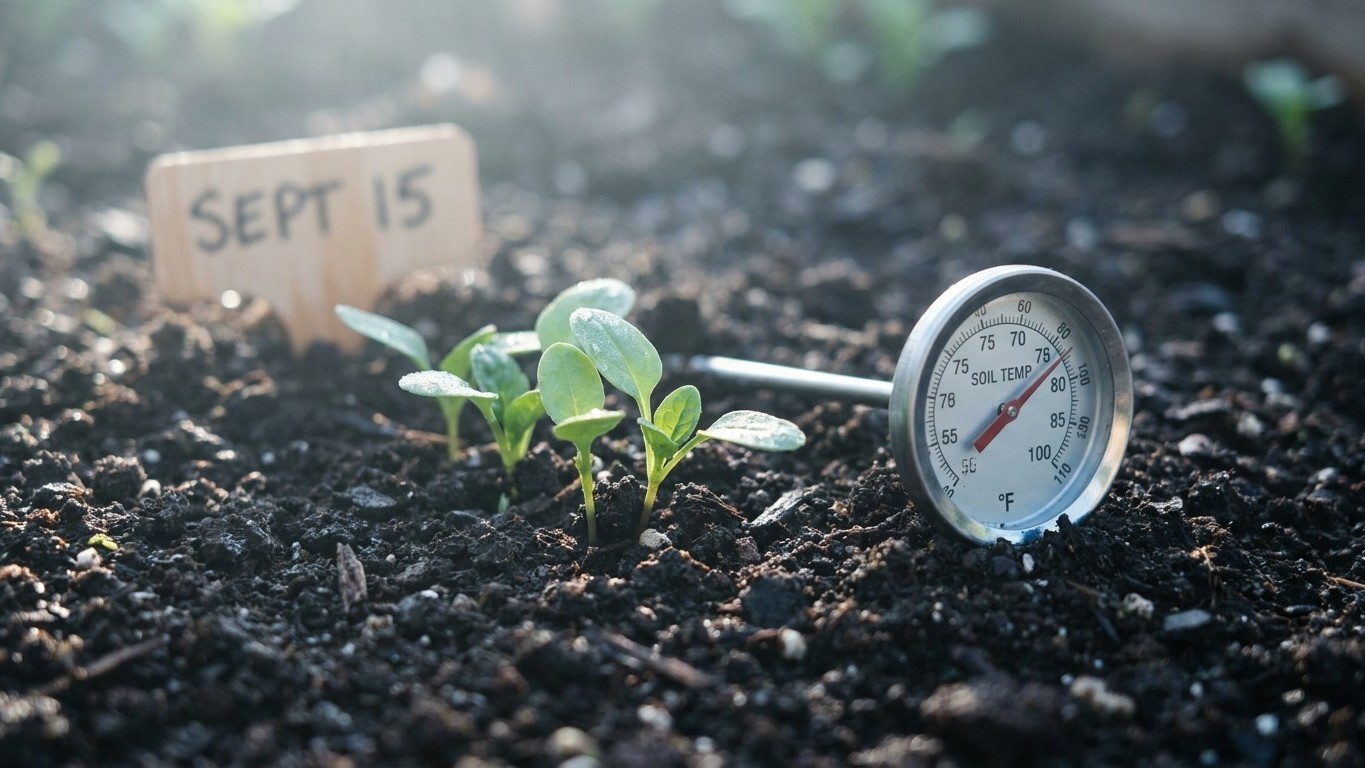
Spinach seed germination drops once soil temperature climbs above 80 F. Nova Scotia’s maritime climate, with essentially zero days a year reaching 90 F in the air, keeps soil from baking the way it does farther inland or farther south. Even so, late July soil in a sunny raised bed or a south-facing plot can still sit close to that 80 F mark, especially after a run of clear days. Gardeners sowing at the early edge of the window, around late July, do better checking soil by hand or with a simple soil thermometer rather than assuming the mild regional climate has already solved the problem for them. Waiting into early August, when soil has had more time to cool from its midsummer peak, is often the safer default in a warm or exposed spot.
Utah State University Extension names four spinach varieties in its guidance for cool-season planting: Bloomsdale, Melody, Teton, and Olympia. The source gives no performance data, no maturity ranges, and no comparison between them, so nothing more specific can be said here about how each behaves in a Nova Scotia garden. No seed company is named in that guidance either.
The frost that ends the season
The average first fall frost at Halifax Stanfield falls on October 18. That figure is a mean drawn from the 1981-2010 climate normals published by Environment and Climate Change Canada, and a mean is not a promise. In roughly half the years on record, the first frost arrives later than October 18; in the other half, it comes sooner. Treat the date as the midpoint of a range, not a safe cutoff to plant right up against.
The station itself covers one location. Nova Scotia is not one climate: inland valleys and upland districts away from the coast often run behind the Halifax Stanfield reading, with frost settling in earlier in the season than this average suggests. A gardener working an interior or elevated site does better treating early-to-mid October as already risky, rather than assuming the whole province matches the reference station.
Common questions
Can I really sow spinach for a fall harvest as early as July in Nova Scotia?
Yes, and for many spots it is close to necessary. Counting back 50 to 75 days from an early-October harvest lands sowing between roughly July 22 and mid-August. Sowing later than that risks running out of growing time before frost arrives in mid-October.
Why doesn’t a cool Nova Scotia summer let spring spinach grow longer?
Because bolting is triggered by long days as well as by heat. Halifax gets 15 hours and 25 minutes of daylight on the longest day of the year, and that day-length signal pushes spinach to flower regardless of how mild the temperature stays. A summer with zero days above 90 F still ends the spring spinach crop on schedule.
Is October 18 a safe date to count on for the first frost?
No. It is a mean date from Environment and Climate Change Canada’s 1981-2010 climate normals for the Halifax Stanfield station, meaning frost arrives later than that in roughly half of all years, and it can arrive noticeably earlier in inland or upland parts of the province.
Are Bloomsdale, Melody, Teton and Olympia good choices for Nova Scotia gardens?
Utah State University Extension names these four varieties in its spinach guidance, but the source publishes no maturity dates or performance details for any of them, so there is no verified basis here for recommending one over another for this province.