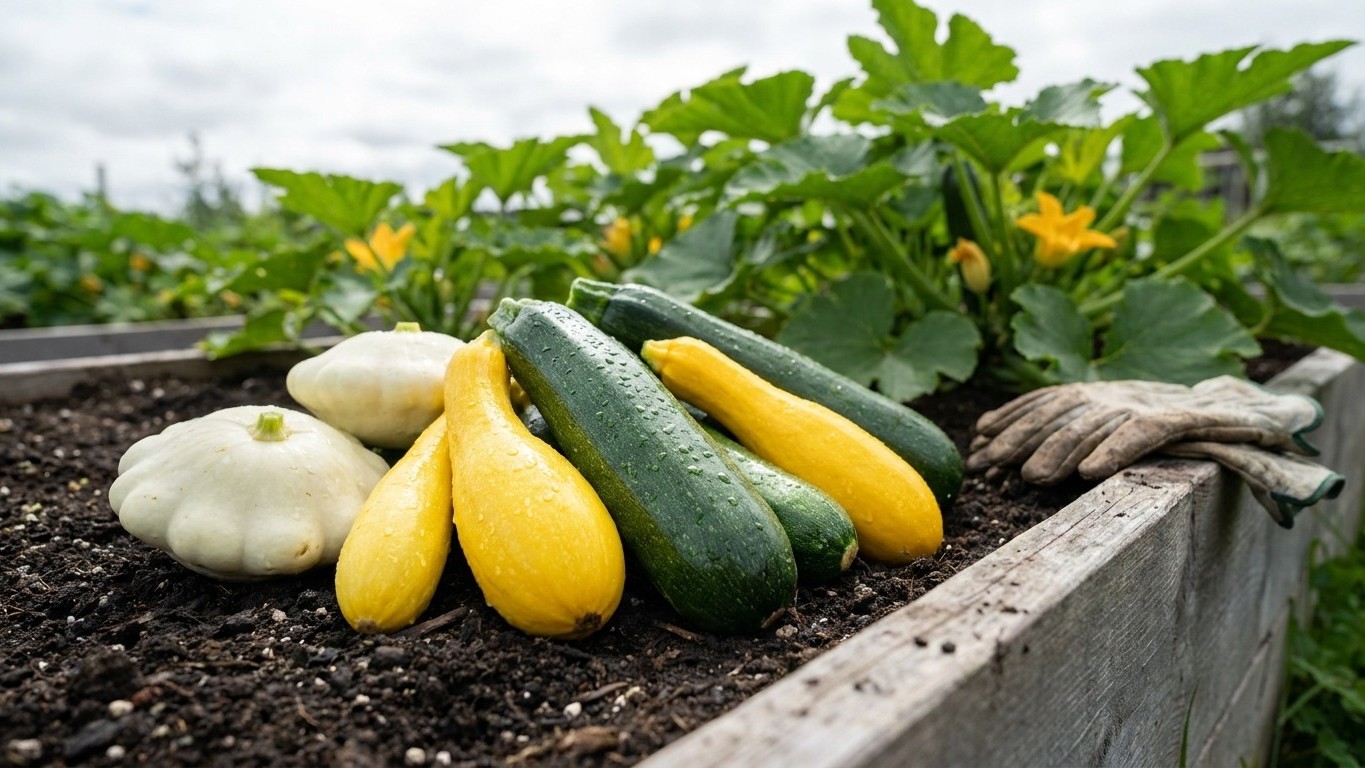

The short growing window along Nova Scotia’s coast rewards fast, forgiving summer squash: bush zucchini, yellow straightneck and crookneck types, and patty pan varieties that mature in roughly six to seven weeks. Anything bred for a longer, hotter season is fighting the calendar before it even sprouts.
The short answer for Nova Scotia
Start with the frost dates for the Halifax Stanfield reference station: last spring frost on average May 7, first fall frost on average October 18. That’s a window of a little over five months on paper. But these are mean dates from Environment and Climate Change Canada’s 1981-2010 normals, not safe dates and not a probability band. Half the years on record, frost arrived later than May 7 in spring, and half the years it arrived earlier than October 18 in fall. So the real, working season for tender squash is shorter than the calendar math suggests, and any variety choice needs a buffer built in on both ends.
That buffer is the whole argument for fast maturity. A summer squash that needs 65 to 70 days from transplant to first harvest is asking to be planted right at the frost-risk edge and picked right at the other one, with almost no room for a cool June or an early September chill. Bush-type zucchini, straightneck and crookneck yellow squash, and patty pan (scallop) types that finish in roughly 45 to 55 days give a much wider margin. Even in a year when the last frost lingers into mid-May or the first fall frost shows up in late September, a 50-day variety planted after the soil has warmed still has a realistic shot at several weeks of harvest.
Heat load matters here too, and Nova Scotia doesn’t have much of it. The reference station records 0.0 days a year at or above 90°F. That number is a proxy for how hard the plant gets pushed to flower and set fruit quickly, and how much water demand the garden faces from evaporation. With essentially no extreme heat days, squash here won’t stall from heat stress the way it might in a hotter province, but it also won’t get the vigorous, rapid fruit-set that heat-loving cultivars are bred to exploit. The practical takeaway: pick squash types selected for cooler, shorter summers rather than ones marketed for high-heat, long-season regions, and treat 90 degrees of unused thermal potential as a season-length problem, not a watering problem.
Put together, the decision by type is straightforward. Bush zucchini and yellow squash (straightneck or crookneck) suited to short seasons are the safest bet across most of the province. Patty pan varieties bred for early maturity are a reasonable second choice for gardeners who want variety on the plate. Vining or later-maturing summer squash types, and anything described on the seed packet as needing a long, hot summer, are the ones to leave for warmer growing regions.
What will not work here
The single biggest failure point is planting a long-season summer squash and expecting the average frost dates to protect it. Because May 7 and October 18 are means, not guarantees, a variety that needs the full stretch between them has zero margin if either frost arrives on schedule and none at all if one arrives early. A squash rated for 70-plus days to maturity, started even a week late because the soil was still cold, can end up with its first real flush of fruit arriving right as the average fall frost date hits, or after it.
Heat-dependent varieties are the second trap. Some summer squash cultivars are bred and marketed for regions that regularly clear 90°F, with fruit-set genetics tuned to that heat pulse. Halifax Stanfield’s normals show 0.0 days a year reaching that mark. Bringing a heat-hungry variety into a climate that structurally cannot deliver the heat it wants means slower flowering, fewer female flowers setting fruit, and a harvest that never quite catches up, even in a warm-for-Nova-Scotia summer.
Rain, humidity, and spacing
Summer rainfall across the province’s reference station averages about 11.2 inches over June, July and August, with August the driest month at 3.68 inches. That’s a moderate, fairly reliable amount of moisture, not a drought pattern and not a monsoon. The risk it creates isn’t thirst, it’s fungal. Squash varieties bred for tight spacing or dense, bushy canopies hold humidity around the leaves in a maritime climate where fog and coastal moisture are already part of the picture. Powdery mildew and other leaf diseases move faster in that kind of still, damp air. Varieties chosen for open growth habit and good air circulation cope with this rainfall pattern far better than compact types that pack leaves close together, even though both might do fine in a drier interior climate elsewhere.
The pattern to avoid, in short: don’t choose a squash for its yield potential in a hot Midwestern summer and expect it to translate to a cool, humid Atlantic coast season that simply doesn’t offer the same heat or the same dry air.
What changes across Nova Scotia
Nova Scotia is not one growing climate, and the hardiness zone figure makes that explicit rather than hiding it. The 6b rating comes from Natural Resources Canada’s Plant Hardiness Site, and it applies specifically to the reference city tied to the Halifax Stanfield station, not to the province as a whole. NRCan’s own documentation is blunt about this: the Canadian zone system is built from seven climate variables, not one, and a single Canadian zone can overlap as many as nine different USDA zones depending on where you compare it. That’s a reminder to treat 6b as a coastal, reference-point number, not a province-wide fact.
In practical terms, that means a gardener in the Annapolis Valley, along the South Shore, or up on the Cape Breton highlands is very likely working with a different effective season than the Halifax figures describe. Interior and upland areas typically run cooler and see frost linger later in spring and arrive earlier in fall than a coastal reference station suggests, simply because they lack the moderating effect of the ocean. Elevation compounds it further: a garden a few hundred feet higher than its nearest town can lose a meaningful chunk of frost-free days compared with a valley floor nearby.
The shift this calls for isn’t a different type of squash so much as a tighter margin on the fast-maturing end of the range already recommended. A gardener further from the coast or at higher elevation gains more from choosing the quickest-maturing bush zucchini or yellow squash on offer, and from starting seed indoors a few weeks ahead rather than direct-sowing, than from any other single adjustment. Nova Scotia spans enough variation that there is no single answer to “when is my soil warm enough” for any one garden. The zone map itself, at Natural Resources Canada’s Plant Hardiness site, is the tool built for narrowing that down by location rather than by province.
Where to check this for your own county
The Nova Scotia Department of Agriculture publishes provincial growing information, and that’s the right next stop for anyone trying to move past provincial averages toward something closer to their own backyard. What’s worth looking for there is specific: a local planting calendar that accounts for the county’s own frost pattern rather than the Halifax Stanfield station, and any record of which summer squash varieties have actually been trialled or recommended for growing conditions in that county.
That distinction matters more than it might seem. A single reference station’s climate normals are genuinely useful for comparing Nova Scotia’s short, cool, low-heat season against other territories. But a county-level recommendation, built from local frost records and local growing trials, will always outrank a provincial one when it comes to picking an actual planting date or a specific variety for an actual garden. The provincial picture is the broad answer. It’s a starting point for understanding why fast-maturing squash makes sense here, not a substitute for whatever county-specific guidance the provincial agriculture department or a local extension contact can offer.
Anyone gardening in one of the counties further from Halifax, whether that’s Cumberland to the north, Inverness or Victoria on Cape Breton, or Digby and Yarmouth to the southwest, should treat the provincial site as the place to ask specifically about local frost timing and locally trialled varieties, rather than assuming the Halifax Stanfield numbers used here apply directly to their soil.
Checking this against your own garden
None of the dates above beat what the garden itself is showing on any given spring. Soil warmth by feel is the first and most direct check: summer squash seed wants soil that feels warm to bare skin, not just frost-free air, and pushing a hand a couple of inches into the bed on a sunny afternoon tells a gardener more about actual planting readiness than any calendar date does. Cold, damp soil that feels chilly even after a few warm days is a sign to wait, regardless of what the average frost date suggests.
The first flush of male flowers is the second signal worth watching. Summer squash typically produces male flowers before female ones, and a plant putting out its first blooms is telling the gardener it’s shifting from vegetative growth into reproduction. If that first flush comes unusually early or late compared with what a gardener remembers from previous years, it’s a clue about how that particular season, and that particular spot in the yard, is running relative to normal.
The appearance of the first true leaves, the second set that emerges after the rounded seed leaves, marks the point where a young squash plant is established enough to start assessing its pace honestly. A slow gap between seed leaves and true leaves in a given bed often points to a cooler, shadier, or wetter microclimate than the rest of the garden, which is exactly the kind of detail no provincial average can capture. Watching these three things season after season, in the same beds, builds a far more reliable local calendar than any single date ever will.