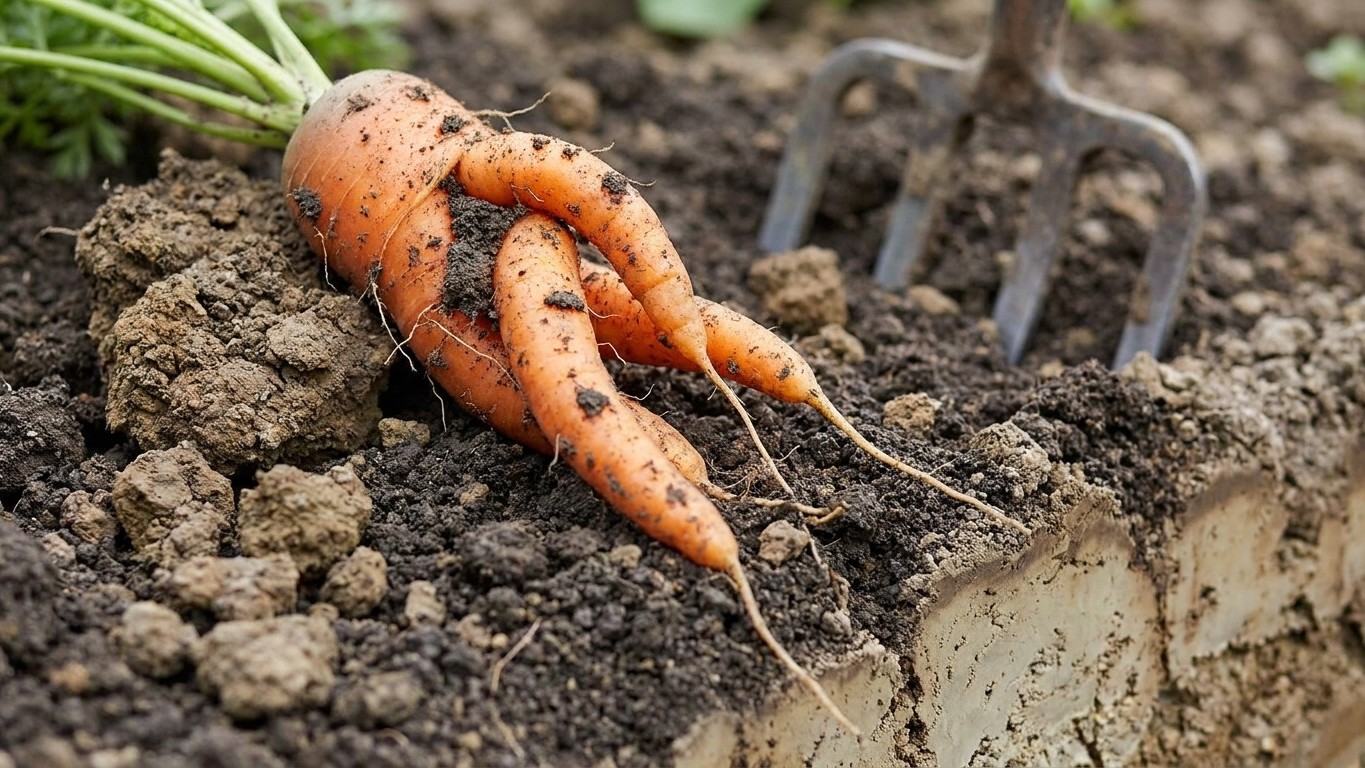

Pull carrots 70 to 100 days after seeding, when the shoulders at the soil line have reached the width the seed packet promises. Cut the tops off the same day, then chill the roots at 33 °F in high humidity. Carrots kept with their tops on last about 10 to 14 days, and trimmed roots last much longer. Yukon’s short, bright summer leaves little slack on the pulling date, so the storage spot deserves as much thought as the sowing did. For the full season, see Growing Carrots in Yukon.
Keeping them, and for how long
How do you know carrots are ready to pull?
Carrots are sown in place, so every day count starts at seeding. Packets commonly list 70 to 100 days, and Clemson Cooperative Extension puts harvest at about 65 to 75 days after planting. Both are guides. A cool spring, a late sowing or a stretch of cloudy weeks pushes the date back, and a northern garden has less room to make that up in fall. The simplest check is to brush the soil from one shoulder, compare it with the width on the packet, and pull a single root to taste and measure.
The ground matters at pulling time too. The farmland soil mapped across Yukon is most commonly a Brunisol (41 percent of the mapped surface), a young soil whose layers are only starting to separate. Its surface typically runs loam to silt, with 47 percent sand, 15 percent clay and 38 percent silt. Organic matter averages about 12.0 percent, and drainage is imperfect, according to Agriculture and Agri-Food Canada’s Canadian Soil Information Service. That tells you the ground tends to hold some water in fall, which makes roots harder to lift. Loosen the row with a garden fork before you pull, and wait for a drier day if the soil clings in clumps.
Treat that profile as a starting point. The survey covers the agricultural areas, and river bottoms, wet muskeg and any lot a builder has scraped or filled can be nothing like the median. A jar test settles it at home. Fill a straight-sided jar a third full of garden soil, top it with water, shake hard and leave it. Sand drops first, silt settles over the next hours, and clay stays cloudy longest. Then dig a hole a foot deep, fill it with water, and see whether it has drained by the next day. Utah State University Extension notes that carrots want deep, sandy, well-drained soil rich in organic matter, and that heavy or rocky ground makes the root fork. If your jar shows a lot of clay or the hole stays full, a raised bed or double digging is the fix. A different variety won’t help. Will Carrots Fork in Yukon Soil? covers that in detail.
How long do carrots keep after harvest?
Clemson Cooperative Extension’s Home and Garden Information Center gives the storage rule in one line: “Store them at 33 °F and high humidity to prevent wilting. Bunched carrots (plants with tops on) can be stored for about 10 to 14 days.” The number to write down is 33 °F. That is just above freezing, and it is much colder than a typical cellar. Roots held at 50 °F sprout and go soft in a fraction of the time.
Read the 10 to 14 days as a ceiling. It describes carrots held at the right temperature and humidity from the day they come out of the ground. A bruised root, a warm spot or dry air will shorten it.
The tops explain the short window. The leaves keep pulling moisture out of the root, so a bunched carrot dries and wilts even in a cold room. Cut the tops off close to the crown the day you pull, and the roots keep for months rather than days if the cold and humidity hold. A bunch with the greens still on looks fresh in the kitchen, but it is the quickest way to ruin a harvest you plan to eat in February.
Where in the house that actually is
Few rooms sit at 33 °F. A living area, a kitchen or a finished basement is kept comfortable for people, which is far warmer than carrots want, and roots there sprout and soften within weeks. An attached garage looks promising but swings with the weather. In a Yukon winter it can drop below freezing and freeze the roots solid, and in spring or fall it can climb well above the target within a few days.
A refrigerator is the room that comes closest. It runs a little above 33 °F, and carrots tolerate that cold, unlike tomatoes or basil, which turn mealy or lose flavor. The crisper drawer holds humidity best, and a loosely closed plastic bag adds more so the roots don’t wilt. A fridge holds only so much, so a full row’s harvest usually needs a second spot.
For that, look for an unheated cold room, a basement corner against an outside wall, or a closed-off porch or entry that stays cold but frost-free through winter. A traditional root cellar is often warmer than 33 °F, and a spot that is fine in November can freeze in January. Run a min-max thermometer in the spot for several days before you fill it, and put the probe at crate height, since cold air pools low. Skipping this check costs you the crop, because a few degrees too warm brings on sprouting and soft roots, and a few degrees too cold freezes them.
Pack only sound roots in the cold storage. Check the crates every couple of weeks, and use any root that has gone soft or sprouted before it affects its neighbors. Nibbled or cracked carrots go first, and What Eats Carrot in Yukon, and When explains what causes the damage you may find.
Common questions
How many days from seeding until carrots are ready?
Plan on 70 to 100 days from seeding, since carrots are never transplanted. Clemson Cooperative Extension gives about 65 to 75 days after planting for a quick harvest. Your packet gives the exact span for what you sowed. In a short northern season, sow as early as the soil can be worked, and pull one test carrot before you commit the whole row.
Can carrots stay in the ground into fall?
They can wait a while once they reach size, and the soil holds them better than open air does. The risk is that the ground freezes hard and you lose the chance to pull them without breaking roots. A layer of straw or leaves over the row delays that. Lift the crop before the soil turns solid, and do it on a dry day in this imperfectly drained ground.
Do I really have to cut the tops off?
Yes, if you want to store them. The leaves keep drawing moisture from the root, which is why Clemson Cooperative Extension gives only about 10 to 14 days for bunched carrots. Trimmed roots at 33 °F and high humidity keep far longer. If you want the greens for the kitchen, use them within a day or two and store the roots separately.
Should I store forked or damaged carrots?
Eat them first. Forking comes from heavy or rocky ground, as Utah State University Extension notes, and the roots are safe to eat but awkward to pack. Chewed or cracked roots tend to soften before sound ones, and they can start rot in a crate. Keep only clean, whole roots for long storage, and use the rest in the weeks after harvest.