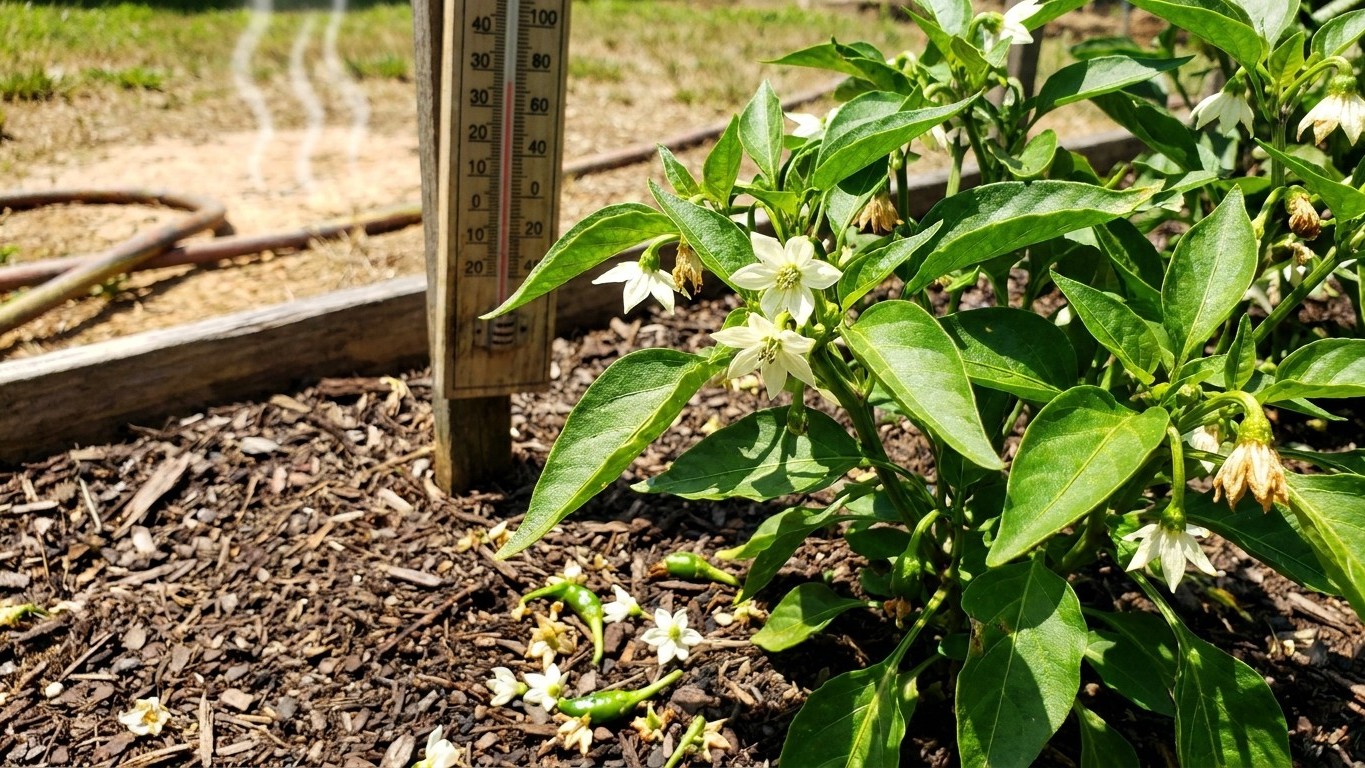

Peppers rarely set fruit outdoors in Nunavut because the territory’s growing season almost never delivers the steady warmth peppers need, and because the region sits at the opposite extreme from heat stress: nights that stay too cold for pollen to work, for weeks on end. Rankin Inlet averages zero days a year at or above 90 F, so heat is not the obstacle here. Cold is.
The short answer
Start with the number that actually describes Nunavut summers: 0.0 days a year at or above 90 F, based on the Environment and Climate Change Canada Climate Normals for 1981-2010 at the Rankin Inlet reference station. That figure tells you plainly that heat stress, the kind that causes blossom drop and pollen sterility in warmer states, is not a factor a Nunavut grower needs to plan around. Pepper flowers can tolerate a wide daytime range as long as the plant isn’t cooking, and in this territory it never gets close to cooking.
That’s the easy half of the story. The hard half is the other threshold Utah State University Extension flags for pepper fruit set: nights below 55 F. Cool nights slow pollen germination and can stop fruit set just as effectively as scorching days, sometimes more reliably, because the failure happens quietly, without wilted leaves or dropped flowers to warn you. The plant simply flowers and flowers and nothing turns into a pepper.
Here’s the limitation worth being honest about: this site tracks daytime heat extremes by territory, including the 0.0 figure above, but it does not carry summer night-time minimum temperatures for Nunavut or anywhere else. That is not a small gap. In a climate this far north, the night reading is more important to your harvest than the day reading, and no one can respond that gap by guessing. Latitude alone doesn’t tell you what a thermometer will read at 2 a.m. in a given valley, near a given body of water, or in a given yard with its own microclimate. A garden a few hundred yards from Hudson Bay can run several degrees cooler at night than one set back and sheltered by a building or a stand of trees.
What this means in practice: if you’re growing peppers in Nunavut, whether outdoors, in a cold frame, or in a hoop house, a simple min-max thermometer placed at plant height is not optional equipment. It’s the only way to know, night by night, whether you’re above or below the 55 F line that Utah State University Extension identifies as the threshold for reliable fruit set. Track it for a full growing season and you’ll know more about your own microclimate than any regional average could tell you.
When to start seed here
Timing a pepper crop in Nunavut means working backward from two anchor points: the date the soil actually warms to 60 F, and the average last spring frost. Both arrive later here than almost anywhere else this kind of gardening guidance gets written for, so the arithmetic matters more, not less.
- Start with the frost date. Rankin Inlet A’s Climate Normals from Environment and Climate Change Canada (1981-2010) put the average last spring frost at June 19. That is a mean, not a guarantee. In one year out of two, frost arrives after that date, so treat June 19 as the midpoint of a window rather than a safe line to plant against.
- Wait for 60 F soil, not just frost-free air. Utah State University Extension is specific that peppers should go into the ground once soil temperature reaches 60 F and the frost risk has passed, whichever comes later. In much of Nunavut, soil warms slowly even after air temperatures climb, so the soil reading, checked with a simple probe thermometer a few inches down, is the number that actually governs transplant day, not the calendar.
- Count back 8 to 10 weeks for indoor seed starting. Utah State University Extension recommends starting pepper seed indoors 8 to 10 weeks before that transplant date. If your soil and frost conditions suggest a transplant window opening in late June, count back 8 to 10 weeks from that point, which lands seed-starting in mid to late April.
- Build in a buffer for a late spring. Because the June 19 date is a 50/50 average and not a hard cutoff, consider starting seed on the earlier end of that 8-to-10-week range and holding transplants indoors a bit longer under grow lights if the ground stays cold. Peppers held too long in small pots will stall, so this is a buffer measured in days, not extra weeks.
- Track flowering separately from transplant date. Fruit typically develops 35 to 45 days after flowering begins, not from the sowing or transplant date. In a short-season territory like Nunavut, this detail matters: a plant transplanted on schedule that doesn’t flower until nights warm past 55 F will push your harvest date later than the seed-starting math alone would suggest.
Redo this arithmetic with your own county’s numbers if you’re gardening outside the Rankin Inlet area. Kugluktuk, Iqaluit, and the Kivalliq communities do not share one frost date, and a station reading from one location should be treated as a starting estimate, not a fixed rule for the whole territory.
What goes wrong here
Given the numbers above, the failures Nunavut gardeners actually run into look different from the ones described in hot-summer states. Here’s what typically derails a pepper crop in this climate, and what to do about each one.
- Blossom drop from cool nights. This is the dominant failure mode in a territory averaging 0.0 days above 90 F. When nights fall below 55 F, pollen doesn’t germinate reliably and flowers drop without setting fruit. The remedy is protection: a cold frame, low tunnel, or unheated hoop house can hold several degrees of warmth overnight compared to open ground, which may be the difference between a flower that sets and one that falls. Track your own night minimums with a thermometer rather than assuming; this site doesn’t publish that number for you.
- Blossom drop from an unexpected hot spell. Even in a territory where 90 F days don’t happen on average, a plant inside a closed hoop house or greenhouse on a sunny, still afternoon can experience localized heat stress well above outdoor air temperature. Vent structures on warm afternoons and avoid letting daytime temperatures inside a covered structure climb into stress range, even briefly.
- Sunscald on exposed fruit. Where the growing season is short and gardeners lean on cover structures or reflective surfaces to bank heat, some fruit can end up more exposed to direct, intensified light than it would be in open-field conditions elsewhere. Keep foliage cover intact rather than pruning leaves away from developing peppers, since leaves are the fruit’s natural sunscreen.
- Blossom-end rot from uneven watering. Short seasons often push gardeners toward containers, raised beds, or hoop-house soil that dries faster than open garden ground. Inconsistent moisture interferes with calcium uptake and shows up as a sunken, dark patch on the blossom end of the fruit. Keep watering even and consistent rather than letting containers swing between soaked and dry, particularly in a hoop house where rain doesn’t reach the soil naturally.
Common questions
Can peppers set fruit outdoors in Nunavut at all?
It’s difficult without protection. With 0.0 days above 90 F on average, heat is never the barrier, but the territory’s short frost-free window and the likelihood of cool nights make a cold frame or hoop house a practical way to buffer the crop rather than relying on open ground alone.
Is June 19 a safe date to transplant peppers in Nunavut?
No. That date is the average last spring frost from Environment and Climate Change Canada’s Rankin Inlet A station, meaning frost arrives after it in roughly half of all years. Combine it with a soil temperature reading of 60 F before transplanting, and expect to wait past June 19 in a cooler-than-average year.
Why do my pepper flowers keep dropping even though it’s not hot?
Cool nights below 55 F are the more likely cause in a territory that almost never sees 90 F days. Pollen doesn’t germinate well in cold conditions, so flowers form and fall without ever setting fruit. Nighttime protection, such as a cold frame or row cover, is the direct remedy.
How early should I Start Pepper Seed if I garden in Nunavut?
Work backward from your expected transplant date, which depends on 60 F soil and frost passing, then count back 8 to 10 weeks for indoor seed starting, per Utah State University Extension guidance. Given the late average frost date at Rankin Inlet, many Nunavut gardeners land in mid to late April for starting seed indoors, with some buffer built in for a late spring.