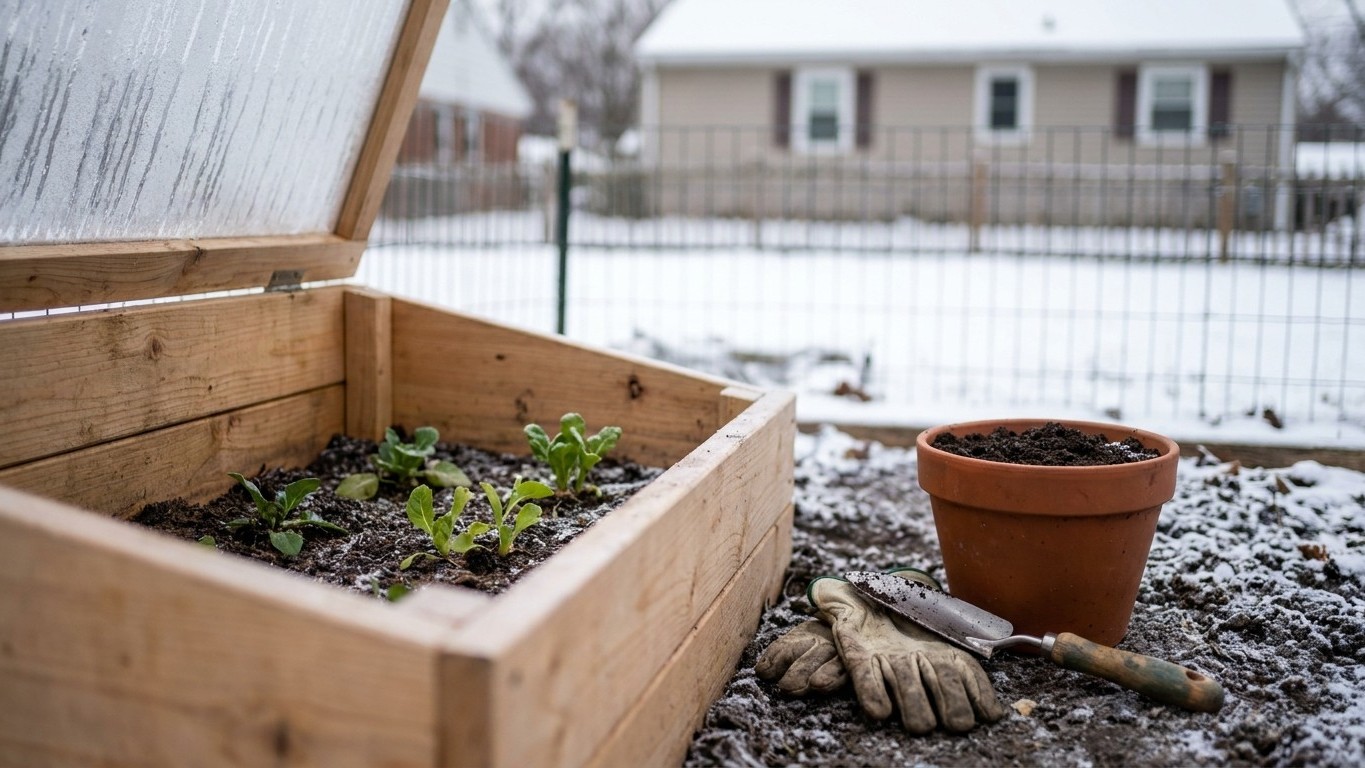

The direct answer: nothing goes into open ground in Nunavut in January. The soil is frozen to a depth of several feet, daylight is short or absent depending on latitude, and no amount of mild weather in the forecast changes that. What the month actually offers is indoor work: forcing, stratifying, and the planning that decides whether anything gets planted at all once the ground finally opens.
What goes in the ground in January

The reason nothing goes outdoors here isn’t the calendar, it’s the frost window itself. At the Rankin Inlet A station, Environment and Climate Change Canada’s 1981-2010 climate normals put the average last spring frost at June 19 and the average first fall frost at September 13. That’s the frost-free season for a typical year, and it’s already short: roughly three months between two dates that are themselves averages, not guarantees. In one year out of two, the real last frost lands later than June 19. January sits nowhere near either edge of that window. It is the deepest part of the year the ground stays shut.
Nunavut’s hardiness rating reinforces the point. The reference city here falls in Canadian zone 0a, the coldest classification the Canadian system assigns. That’s a different scale from the USDA zones used elsewhere on this site: the Canadian system is built from seven climate variables, not one, and Natural Resources Canada is explicit that a single Canadian zone can span nine different USDA zones. Don’t try to convert 0a into a USDA number. Just take it as confirmation that January ground here is not workable ground, full stop.
So garlic cloves, shallot sets, bare-root fruit stock, none of it goes into open soil this month, and pretending otherwise wastes both the planting stock and the gardener’s time. What actually works in January is contained and indoors: forcing rhubarb crowns or chicory roots in a dark, cool space for an early harvest of something fresh; keeping bulbs meant for spring color in cold stratification in a refrigerator or unheated porch; and starting the season’s onion or leek seed under lights, since those crops tolerate the long indoor lead time better than almost anything else. None of it touches the yard. All of it sets up what happens once thaw arrives, months from now.
What to start under cover
Counting backward from the frost window is the only way this works, and the arithmetic is unforgiving here. If the average last spring frost is June 19, and some years push well past it, then a crop that needs 10 to 12 weeks under lights before it can go outside should be started in late March or early April, not January. Starting that far ahead in January means weeks of extra time indoors with nowhere to go, and that’s exactly how seedlings end up rootbound and leggy, stretching toward whatever light they can find and losing vigor before they ever see soil.
The exception is the handful of crops slow enough, and cold-hardy enough once mature, to justify an early indoor start: onions and leeks grown from seed rather than sets. Onion seedlings tolerate months under grow lights better than tomatoes or peppers do, and given a season that runs perhaps 86 days between mean frost dates, anything that needs a long head start to bulb up properly benefits from getting going now, provided there’s supplemental lighting and the patience to pot up as roots fill their containers.
Everything else, the peppers, the tomatoes, the squash starts, should wait. Starting those in January just means a longer stretch of indoor babysitting with no outdoor transplant date in sight for months, and a higher chance of disease or stress setting in before the plants ever get outside. The second failure mode, starting too late, isn’t really a January risk here. Given how short the frost-free window already is, the more common and costly mistake in this climate is starting too early and burning out a seedling’s vigor before summer even begins.
What is ready to pick
Outdoors, nothing. There’s no honest way to soften that in a place where the ground has been locked since fall and won’t open again until the average frost date passes, if it passes on schedule at all. Anyone expecting a harvest calendar for January in Nunavut is looking at the wrong month.
What still reaches the table comes from indoor production and from what was put up before the ground froze. Sprouts and microgreens are the fastest option: a tray of pea shoots or radish sprouts on a windowsill can be ready in a week or two, no grow light setup required beyond a bright spot. Anyone forcing chicory or rhubarb crowns from the section above should start checking them for tender growth by late in the month, depending on when the forcing began.
The other job this month is triage on whatever got stored: root cellars, insulated bins, or cold rooms holding squash, potatoes, and onions from the last harvest. January is when the early failures show up. Squash with a soft spot or a sweetish smell should come out and get used immediately rather than left to spread rot to its neighbors. Potatoes that have started sprouting in storage are still edible once the sprouts are removed, but they’re on borrowed time. Onions gone soft at the neck are done. Going through the stored crop now, rather than waiting for the smell to announce a problem, is the difference between losing one squash and losing the bin.
The jobs that matter this month

January carries its weight in a garden calendar even without a single seed going into open ground, because the work that happens now is what makes the short growing season usable at all. Seed ordering tops the list. Given how brief the frost-free window is here, on average about 86 days between the mean last spring frost and the mean first fall frost, the varieties that actually mature in that stretch are a narrower list than most seed catalogs suggest, and the fast-maturing, cold-tolerant varieties tend to sell out earlier in a short-season region than a long one. Ordering now, rather than waiting, is what keeps those varieties available.
Dormant pruning belongs on the list too, for anyone with fruiting canes or hardy shrubs surviving in a sheltered spot. Pruning while the plant is fully dormant and the wood is easy to see, before any sap starts moving, reduces stress on the plant and makes disease or winter damage obvious against bare wood. Tool care runs alongside it: cleaning soil and sap off pruners and shovels, sharpening blades, and oiling anything that will sit unused for another month or two, so nothing seizes up or rusts through before it’s needed.
Indoors, this is also the month to plan next season’s layout and rotation, particularly for anyone growing in raised beds or containers where soil quality is built up rather than inherited from open ground. Testing soil or amending compost mixes for spring, turning any compost that’s still active, and repairing bed frames, cold frame glazing, or fencing before the rush of planting season all belong here. None of it produces a visible result in January. All of it determines whether spring, whenever it finally arrives, starts on schedule or two weeks behind because a cold frame needed repair no one got around to.
What not to do in January
The most common mistake in a climate this cold is treating a mild spell as permission. A few days of warmer air, even sun strong enough to soften the top inch of snow, does not mean the ground underneath has thawed, and it certainly doesn’t mean the season’s average last frost, June 19, has moved any closer. Planting anything outdoors on the strength of a warm afternoon in January is a guaranteed loss.
Uncovering anything that’s been protected for winter, whether that’s a cold frame, mulched perennial bed, or insulated container, is a related error. A brief thaw can trick a gardener into pulling back mulch or opening vents to “let things breathe,” and then a return to normal winter temperatures hits an unprotected plant that had no time to reharden. Leave winter protection in place until the season has genuinely turned, not until one warm day suggests it might.
Fertilizing anything right now is also a waste. Dormant plants aren’t taking up nitrogen, and feeding a plant that isn’t actively growing does nothing but sit in the soil, or worse, encourage a weak flush of tender growth right before the next hard cold snap kills it back. Save the feeding schedule for when growth actually resumes. And on the storage side, the mistake is inspecting stored crops too rarely rather than too often. A single soft potato or moldy squash left unchecked for weeks can take out everything stored around it.
Checking this against your own county
Everything above is built on averages from one weather station, Rankin Inlet A, and Nunavut is not one climate. Elevation, exposure to open water, and the difference between coastal and inland communities can shift a frost window by weeks in either direction, and a mean frost date is, by definition, wrong half the time. Treat June 19 and September 13 as a starting point for thinking about the season, not as dates to plan around exactly.
For anything more specific to a particular community, the federal agriculture department’s site is the place to start: Agriculture and Agri-Food Canada. Local knowledge, from neighbors, community greenhouses, or anyone who has gardened in the same spot for several seasons, still beats any regional average for deciding when the ground is actually ready.
Common questions
Can anything survive outdoors in Nunavut over winter?
Very little in open ground without protection. Hardy perennials suited to Canadian zone 0a and below can persist under insulating snow cover, but active outdoor growth or planting isn’t realistic in January regardless of species.
Is a cold frame enough to grow food in January here?
An unheated cold frame won’t keep soil workable through a Nunavut winter. Cold frames become useful again as the season turns toward the frost-free window, not during the coldest month of the year.
When should seed starting actually begin for this region?
Count back from the average last spring frost, June 19, and remember it’s a mean date, not a safe one. Most warm-season crops should start 6 to 12 weeks before that window, which lands in spring, not January.
Why does the Canadian hardiness zone matter if I’m used to USDA zones?
Because they aren’t interchangeable. The Canadian system factors in seven climate variables against the USDA’s one, and a single Canadian zone can overlap several USDA zones. Zone 0a describes extreme cold, but it shouldn’t be read as an equivalent to any specific USDA number.