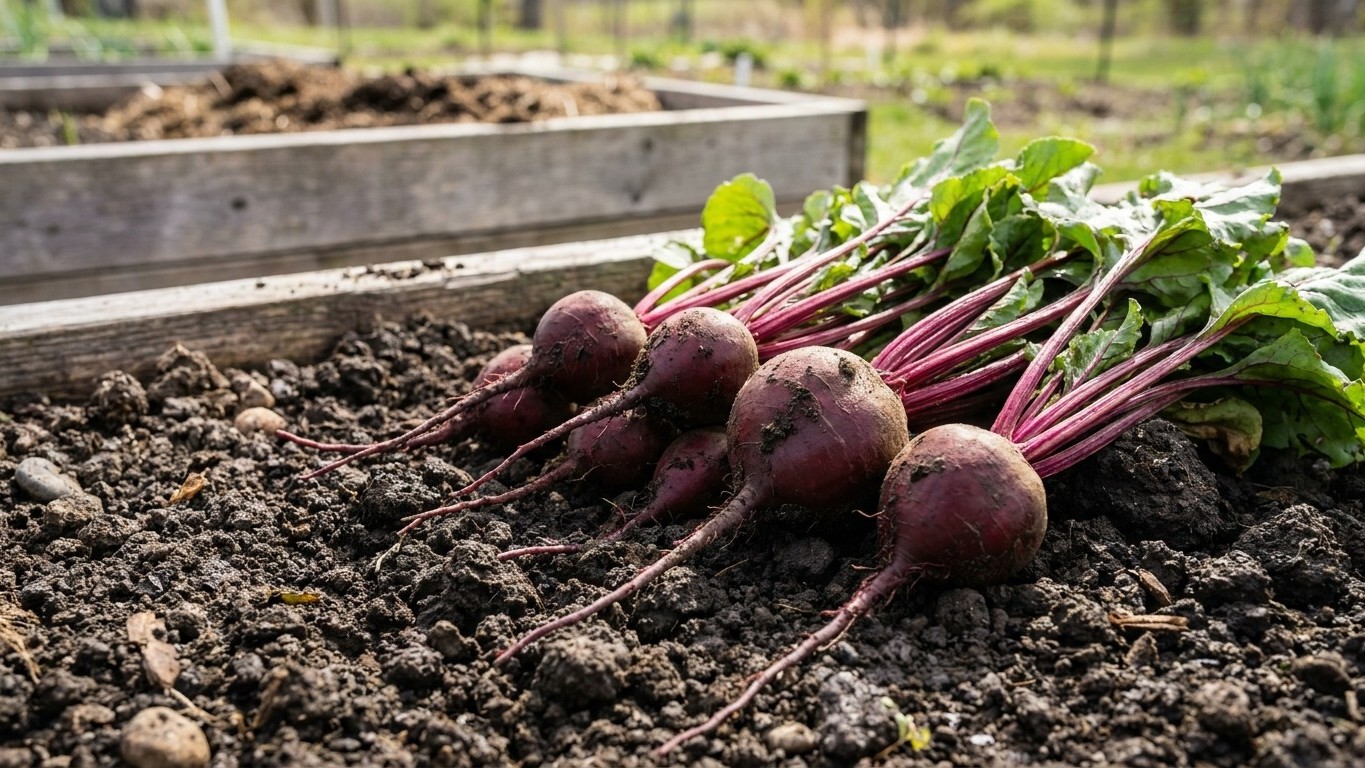

In Ohio, what eats into a beet crop is mostly thirst, heat and a refrigerator set too cold. Insects and critters are outside the data behind this page. Thirst in the first weeks sends plants toward flowering. Later heat combined with thirst turns roots woody. After harvest, storing near freezing invites black spot and rot. Each problem has its own season and its own fix.
The short answer
Ohio’s state soil is the Miamian series, an Alfisol, which is a forest soil of moderate fertility that holds nutrients reasonably well. USDA’s representative surface values for it are 26 percent sand, 20 percent clay and 53 percent silt, so it reads as loam to silt. Surface pH is about 6.5 (slightly acid), organic matter is about 2.0 percent, and the drainage class is well drained. Those figures come from USDA NRCS Soil Data Access, averaged across 401 mapped components of the series.
Utah State University Extension describes the beet’s ideal as deep, sandy, well-drained soil rich in organic matter. Miamian meets two of those three. It drains freely, which keeps roots from sitting wet. It is silty rather than sandy, though, and 2.0 percent organic matter is modest. Utah State caps compost at no more than 1 inch of composted organic matter per 100 sq ft, so a thin layer is the whole budget, not a license to bury the bed.
Treat all of this as a starting point. Ohio spans hundreds of soil series, and the numbers describe a mapped surface layer, not a worked garden bed and not your pH. River bottoms, hill country and any lot a builder has scraped or filled can look nothing like it. A soil test gives your own numbers, and Beet Soil in Ohio: What the Root Will Meet goes deeper on what to do with them.
Heat is a separate problem from soil
The brief for this page called for a count of days per year above 90 F for the reference city. That count is not published here, and I won’t guess at one. It matters less than it sounds, anyway. Utah State’s threshold is 85 F: heat above that combined with water stress makes the root woody. Any day between 85 and 90 F counts against the beet, and a 90 F tally would miss those days.
Woodiness is a late failure, a problem of roots already sizing up. The early failure, bolting, has a different cause and a different window. For the full picture of the crop in this state, see Growing Beets in Ohio.
The six weeks that decide it here
Ohio State University Extension’s Ohio Gardening Calendar puts the last spring frost at May 5 to May 15 for zone 6a. Beets go in the ground 2 to 3 weeks before that, which works out to roughly April 14 through May 1. They are sown in place, so the count to harvest, 60 to 80 days, runs from seeding and never from a transplant. A mid-April sowing could be ready by mid-June. A May 1 sowing, at the far end of the range, would not be ready until late July. When to Sow Beets in Ohio covers the choice of date in detail.
Those first six weeks therefore run from mid-April to early June for the earliest sowings, and into mid-June for the latest. That stretch of an Ohio spring is a swinging one. Cold snaps, soaking weeks and sudden warm, dry spells can all show up inside it. This page carries no rainfall or temperature records, so I can’t say how many dry weeks to expect. What I can say is that the pattern is changeable, and a beet only has to hit one stretch of thirst to react.
Where the bolting risk sits
Utah State is blunt about it: water stress in the first 6 weeks causes premature flowering. The risk is not a date on the calendar. It is a dry stretch that lands inside the six-week window, and the window moves with your sowing date. Miamian drains freely, which protects roots from wet feet but also means the top few inches can dry out between rains, right where seedlings and young roots are working. A dry week in early May hits an April sowing. A dry week in early June hits a sowing made at the end of the range.
Bolting and woodiness should not be lumped together as “keep it watered.” Early thirst makes the plant flower. Later heat above 85 F with thirst makes the root tough. The first is a spring problem and the second belongs to late June and July, when the roots are bulking up. Water steadily in the first six weeks, then pay attention again when the forecast turns hot.
What goes wrong here
Ohio’s soil and climate cause a handful of predictable failures, and some of them happen after the beets are out of the ground.
In the bed
- Bolting from early thirst. Plants send up flower stalks after water stress in the first six weeks from seeding. Remedy: check the top inch of the seedbed regularly in April and May, and water through any dry spell inside that window. Don’t wait for the leaves to droop.
- Woody roots from later heat. This is a different failure, triggered by heat above 85 F combined with water stress. Remedy: keep moisture even once roots are sizing, and watch the forecast for runs of hot days. Pulling roots on schedule beats leaving them in the ground through July.
- Over-amended beds. It is tempting to fix a modest 2.0 percent organic matter with heaps of compost. Utah State’s limit is no more than 1 inch of composted organic matter per 100 sq ft. Remedy: spread a thin layer and stop there.
- Assuming your soil is Miamian. The state soil tells you what the region’s ground tends to do, not what your yard does. Remedy: get a soil test before you amend or lime anything, especially on fill, scraped lots, river bottoms or hill ground.
In the cellar and fridge
- Storing too cold. Every other root crop on this site rewards colder, and beets do not. USDA Agricultural Handbook 66 says more black spot and rot occur at 32 to 34 F than at slightly warmer temperatures. Remedy: aim for 33 to 36 F at 98 percent humidity for topped roots. In a pit or cellar, stay between 31 F and 41 F.
- Leaving the tops on. Bunched beets with leaves keep only about 10 to 14 days at 32 F and above 98 percent humidity. Remedy: twist or cut the tops off first if you plan to store them longer.
- Saving the wrong roots. Small roots lose water and shrivel faster than large ones. Remedy: eat the small beets first and put the big ones away.
Common questions
Is Ohio’s state soil good for beets?
It is a decent match. The Miamian series is well drained, loam to silt, with a surface pH around 6.5, which suits a crop that wants deep, well-drained ground. It has more silt than the sandy texture Utah State prefers and only about 2.0 percent organic matter. Your garden may differ, so test it.
When does bolting happen, and when does woodiness?
They are different problems on different schedules. Bolting follows water stress in the first 6 weeks after seeding. Woodiness comes later, when heat above 85 F combines with water stress while roots are sizing. Fixing one does not prevent the other.
How long from seeding to harvest?
Sixty to eighty days, counted from seeding. Beets are sown in place, so there is no transplant date to count from. With sowing roughly 2 to 3 weeks before the May 5 to May 15 last frost, that puts harvest anywhere from mid-June to late July depending on when you sow.
What is the best way to store beets?
Top them first, since bunched beets with leaves last only 10 to 14 days. Then hold the roots at 33 to 36 F and 98 percent humidity. Colder is not better here, because 32 to 34 F brings more black spot and rot. Save the big roots for storage, since they shrivel more slowly, and eat the small ones first.