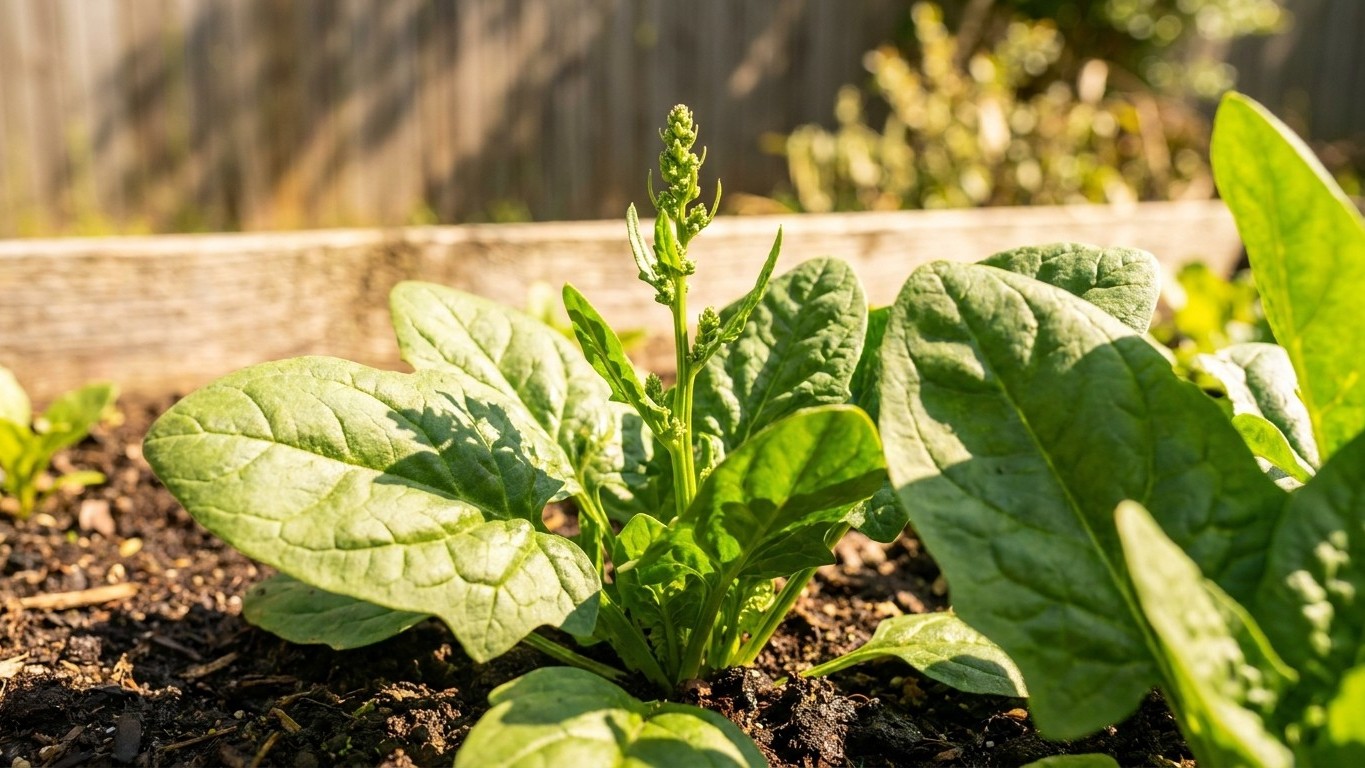

Yes, spinach will bolt early in most of Ohio. The state’s summer days grow long enough on their own to push the plant into flower, and that daylight trigger arrives well before the hottest weather does. The real question isn’t whether bolting happens, but how much usable growing time you get on each side of it, in spring and again in fall.
The short answer
At the reference city, the longest day of the year holds 14 hours and 51 minutes of daylight. That number matters more than any thermometer reading, because spinach flowers in response to long days, not just heat. Once day length stretches past a certain point in late spring, the plant shifts from making leaves to sending up a seed stalk, and that shift happens whether the season has been mild or scorching. A cool, cloudy Ohio spring does not buy extra weeks of harvest, because the daylight clock keeps running underneath the weather.
So which is the limiting factor here, day length or heat? In Ohio, it’s both, and they arrive in sequence rather than together. Day length is the first trigger, building through May and peaking near the solstice, and it starts nudging spinach toward bolting before the worst summer heat ever shows up. Heat then finishes the job and adds a second problem: spinach grows best where temperatures stay under 75°F, and Columbus averages 15.3 days a year at 90°F or hotter. Those hot days cluster in July and August, arriving after the daylight trigger has already done most of the damage, but they make sure any spinach that survived the long days won’t last much longer anyway.
That combination is why growers in this state treat spinach as a two-season crop rather than a summer-long one. The plant gets a real run in spring, when days are still moderate in length and soil temperatures haven’t climbed, and again in fall, when daylight is shrinking back down and the punishing heat has passed. Summer itself, for spinach, is mostly a dead zone bracketed by long days on one end and high heat on the other. Growers who try to push a summer sowing usually watch it bolt within a couple of weeks, sometimes before the leaves are even worth picking.
The 75°F ceiling carries a second consequence beyond stunted growth. Leaves that mature under warmer conditions turn bitter, so even a plant that hasn’t visibly bolted yet can already taste worse than a spring-grown batch. That’s a separate effect from bolting itself, but the two problems show up on the same calendar, which is part of why Ohio gardeners tend to treat late spring as a hard deadline rather than a soft suggestion.
How long the spring window really is
Working out the spring window means lining up three things: the last frost date, the recommended sowing lead time, and the point where day length and heat start working against the plant.
- Last frost: Ohio State University Extension puts the last spring frost for zone 6a between May 5 and May 15, depending on location within the state.
- Sowing date: spinach seed goes in the ground 2 to 3 weeks before that last frost date, since the plant tolerates cold soil better than most vegetables. That puts a realistic sowing window somewhere in the middle-to-late part of April.
- Growth ceiling: good growth stops once temperatures push past 75°F. In central Ohio, that threshold typically becomes a regular occurrence by early-to-mid June, well before the state’s hottest stretch of the year (the days above 90°F mostly land in July and August, not June).
- Usable stretch: from a mid-to-late April sowing to an early-to-mid June cutoff leaves roughly six to seven weeks of decent growing conditions before bolting and heat stress take over.
Six or seven weeks isn’t a long run, but it’s enough for a full cut-and-come-again harvest if the seed goes in as early as the soil allows rather than waiting for guaranteed warm weather. Spinach germinates in cool soil, so there’s little upside to delaying past that 2-to-3-week-before-frost window. Waiting even ten extra days in spring can mean losing the crop to bolting before it produces a full harvest, since the daylight clock doesn’t pause for a late start. Gardeners who sow right at the early edge of that window, rather than the late edge, tend to get more usable leaf before the plant turns toward seed.
The autumn crop, and when the soil lets you sow
Fall spinach in Ohio runs into two separate obstacles, and they sit at opposite ends of the season. The first blocks sowing too early; the second ends the harvest outright.
Soil still too warm to germinate
Utah State University Extension notes that spinach seed germination drops off once soil temperature climbs above 80°F. That’s the practical reason fall spinach can’t simply be sown right after the summer heat starts to fade on the calendar. In Ohio, soil holds onto summer warmth well after the air feels cooler, and with 15.3 days a year averaging 90°F or above, the ground has plenty of stored heat to shed before it drops back under that 80°F mark. Realistically, that means waiting until late summer, once the hottest stretch has passed, before the soil is reliably cool enough for seed to sprout well. Sowing into soil that’s still too warm doesn’t just slow things down, it can mean a thin, patchy stand that never fills in.
Counting back from the first fall frost
Ohio State University Extension lists the first fall frost for zone 6a between October 5 and October 15. Utah State University Extension’s guidance for fall spinach is to sow 50 to 75 days before the date you want to harvest, not before the frost itself. Picking a harvest target of early October, right before that frost window arrives, means counting back 50 to 75 days lands sowing somewhere between mid-August and mid-September.
That range overlaps neatly with the point where Ohio soil finally cools below the 80°F germination threshold, which is what makes fall spinach workable here at all. Sow too early in that window and warm soil fights the seed; sow too late and there isn’t enough time left before frost ends the season. Splitting the difference, aiming for early-to-mid September, gives the seed cooled soil to germinate in and still leaves close to the full 50-to-75-day stretch before frost shuts things down. Unlike the spring crop, the fall planting isn’t racing against long days pushing it toward bolting, since daylight is shrinking rather than growing through that stretch, which is part of why many Ohio gardeners find the fall harvest more forgiving than the spring one.
On variety selection, the available guidance names four spinach varieties commonly grown, Bloomsdale, Melody, Teton, and Olympia, but doesn’t publish maturity data, bolt resistance ratings, or other performance figures for any of them. Choosing among them comes down to local availability and personal preference rather than published numbers, since none are documented here.
Common questions
Can I sow spinach in summer in Ohio?
It’s not recommended. Summer daylight length alone is enough to trigger bolting, and that’s before accounting for the heat stress that comes from Columbus averaging 15.3 days a year at 90°F or above. Spinach sown in June or July typically bolts within a couple of weeks.
Does shade delay bolting in Ohio gardens?
The source material used for this guide doesn’t address shade cloth or planting location as a bolting countermeasure. The documented triggers are day length and heat exposure, specifically growth stalling above 75°F, not light intensity or sun versus shade positioning.
Is fall spinach easier to grow than spring spinach in Ohio?
Generally, yes, mainly because daylight is shrinking through the fall growing period rather than building toward the bolting trigger the way it does in spring. The main obstacle in fall is timing sowing around warm soil (above 80°F slows germination) rather than fighting a daylight clock.
What temperature makes spinach bitter, not just bolt?
The same 75°F figure covers both effects. Utah State University Extension notes that spinach grows best below that mark; temperatures above it are tied to both slowed growth and a shift toward bitterness in the leaves, separate from whether the plant has visibly started to bolt.