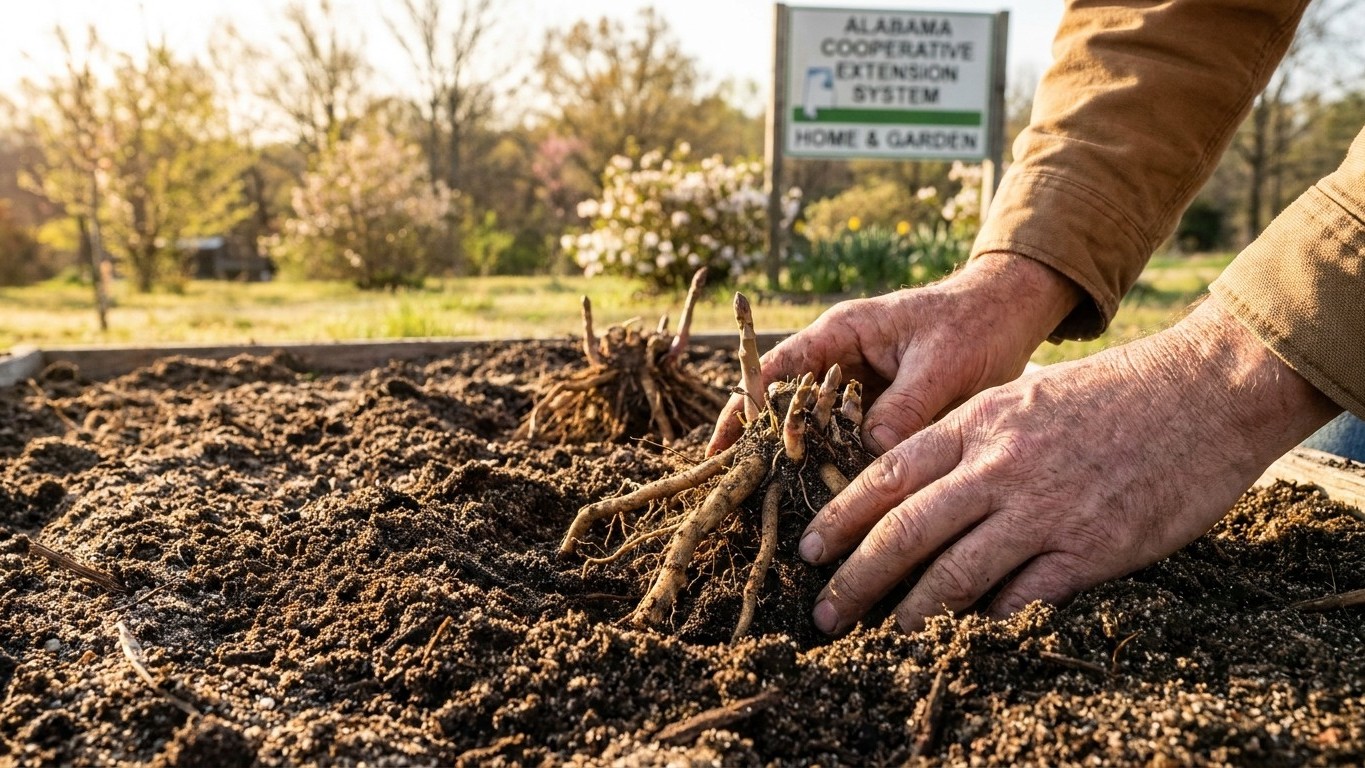

Plant asparagus crowns in early spring, timed to this region’s frost window rather than a fixed date on the calendar. West of the Cascades, that generally falls between March 6 and March 21, though gardens in central and eastern Oregon run on a shorter, harsher calendar entirely. The bigger decision isn’t really the week, though. It’s the ground itself, because a well-placed asparagus bed will still be sending up spears a decade and a half from now, long after the planting date is forgotten.
The short answer
Asparagus is not a crop you replant next season if the spot turns out wrong. A bed put in this spring can still be producing in ten, twelve, even fifteen years, so the ground it goes into matters more than almost any other decision a home gardener makes here. Utah State University Extension’s guidance on the crop is blunt about it: any soil will grow asparagus, as long as it drains. That’s the only requirement the university publishes, and it’s worth sitting with, because a bed that stays wet through winter will rot crowns that were supposed to outlive the family dog.
So does the ground around here drain? The state soil, the Jory series, offers a partial answer. USDA’s Natural Resources Conservation Service records the Jory as well drained, a clay-heavy soil that’s about 14 percent sand, 34 percent clay and 52 percent silt at the surface, with organic matter running around 5.0 percent. Drainage class and clay content aren’t the same measurement, though clay this heavy usually means water moves through slowly instead of pooling on the surface for days at a time. The Jory also runs naturally acid, with a surface pH around 5.6, and it’s low in nutrients after ages of weathering and leaching, which is what soil scientists mean when they call it an Ultisol, an old, worn-out type of ground.
None of that tells a gardener what’s actually under their own lawn. The Jory series is the soil this state adopted as its official representative, not a survey of every backyard in it. River bottoms drain differently than hillsides. Ground a builder has scraped, filled or compacted drains differently than either one. The only way to know for certain is to dig a hole about a foot deep after a rain, fill it with water, and watch the clock. Water gone within a few hours is fine. Water still sitting there the next morning means the bed needs help before a single crown goes in.
That help doesn’t have to be complicated. Raised beds or mounded rows lift the crowns above standing water without changing the planting timing at all, and they’re the standard fix wherever native ground runs heavy or sits low. What the guidance doesn’t offer is a target pH to aim for or a lime recommendation, so treat the Jory’s acidity as background information about the region’s soil chemistry, not an instruction for your own garden. A soil test, not a state soil profile, is what actually settles that question for the fifteen years ahead.
Will the summer here water it for you?
Short answer: not on its own. Asparagus wants a steady 1 to 2 inches of water every other week for its first two summers while roots establish, then eases into needing that same amount roughly every three weeks once the bed matures. Here’s how that measures up against what actually falls from the sky.
- A newly planted crown is putting its energy into roots nobody can see yet, and it needs 1 to 2 inches of water every two weeks through summer to do that, across two full growing seasons.
- By year three, the same 1 to 2 inches only needs to show up every three weeks, since a mature root system reaches deeper and holds moisture longer between drinks.
- Across June, July and August combined, long-term climate normals for this region show roughly 2.7 inches of rain, against an annual total of 36.9 inches. Almost all of the year’s moisture falls somewhere other than summer.
- Month by month, the normals run 1.63 inches in June, 0.51 inches in July and 0.54 inches in August, meaning the peak of asparagus’s growing season lines up with the driest stretch of the entire year.
- A young bed’s two-week target of 1 to 2 inches can eat through July’s entire monthly rainfall in one watering. Established beds need less frequent help, but through July especially, rain alone won’t come close to the every-three-week rhythm the plant wants.
- Soil and heat both widen or narrow that gap further. A clay-heavy bed like the state’s Jory series holds onto whatever rain does fall longer than a sandy one would, while stretches of 90-degree days pull moisture out of the top few inches faster than a single thunderstorm can put it back. A rain gauge on the actual bed, not a regional average, is what tells a gardener exactly how much to add in a given week.
When to put the crowns in
Crowns go into the ground in early spring, planted in furrows about 8 inches deep, well before the plant has any leaves to worry about frost damage. In much of this region, that window lines up with the average last spring frost, which sits at around March 6 to March 21 based on decades of climate data collected by the National Centers for Environmental Information. Read that as a mean, not a promise: some years the last frost arrives earlier, some years later, and the window says nothing about central or eastern Oregon, where the high desert runs on a shorter, colder calendar entirely.
The furrow itself doesn’t get filled in all at once. Crowns are laid into that 8-inch trench and covered gradually, with about two inches of soil added back roughly every other month across the first year, rather than burying the whole thing on planting day. That slow backfill gives emerging shoots room to push through loose soil instead of fighting their way up through a foot of packed dirt.
Seed is the other route into an asparagus bed, though it’s a longer one. The guidance on this crop centers on crowns rather than seed timing specifics, but the tradeoff is well known: starting from seed means an extra year or more before the plant reaches crown size, pushing the whole harvest clock back further. Crowns exist mainly to skip that wait.
Whichever the start, no spears get cut the first two years, and even year three comes with limits: harvest runs about 4 weeks that year, stretching to roughly 6 weeks the year after, and about 8 weeks once the bed is fully mature. The rule for when to stop cutting each season isn’t a date on the calendar. It’s the spears themselves. Once most of what’s coming up is thinner than a pencil, cutting stops for the year and the plant is left to grow tall and rebuild the roots for next spring.
Crown varieties come in two categories, sorted only by sex, with no published guidance on which tastes better or yields more.
| Variety | Type |
|---|---|
| Jersey Giant | All-male |
| Jersey Knight | All-male |
| UC 157 F1 | Male and female |
| Purple Passion | Male and female |
The choice among these four largely comes down to what a given nursery happens to carry, not any documented difference in flavor or performance.
Common questions
Can heavy clay soil support an asparagus bed?
It can, provided water doesn’t sit on it. The region’s representative soil, the Jory series, is classified as well drained despite being clay-heavy at the surface, which shows that clay content alone doesn’t rule out a good asparagus spot. But that classification describes a mapped soil series, not any one backyard. A simple drainage test, digging a hole and timing how fast standing water disappears, is the only way to know if a particular bed needs raising before crowns go in.
How many years until the first harvest?
None of the first two years, and only a limited window in year three. Cutting starts around 4 weeks in year three, extends to about 6 weeks in year four, and reaches roughly 8 weeks once the bed is fully established. Harvest never runs by a set number of weeks alone, though; it stops once most spears coming up are thinner than a pencil, whatever week that happens to fall in.
Does the guidance say anything about soil pH or fertilizer targets for asparagus?
No. The Utah State University Extension guidance behind this article is silent on both a target soil pH and any specific fertilizer program, and nothing here should be read as filling that gap. The state’s representative soil runs naturally acid, but that’s a fact about regional ground, not a planting instruction. A soil test remains the only reliable way to know what a given bed actually needs.
Is the frost-based planting window the same across the whole state?
No, and this matters more than it might seem. The March 6 to March 21 average last-frost window applies to areas west of the Cascades. Central and eastern Oregon sit in high-desert conditions with a noticeably shorter growing season, and no specific frost window for those areas is included in the data behind this article. Gardeners there should work from local frost records rather than assuming the western window applies.