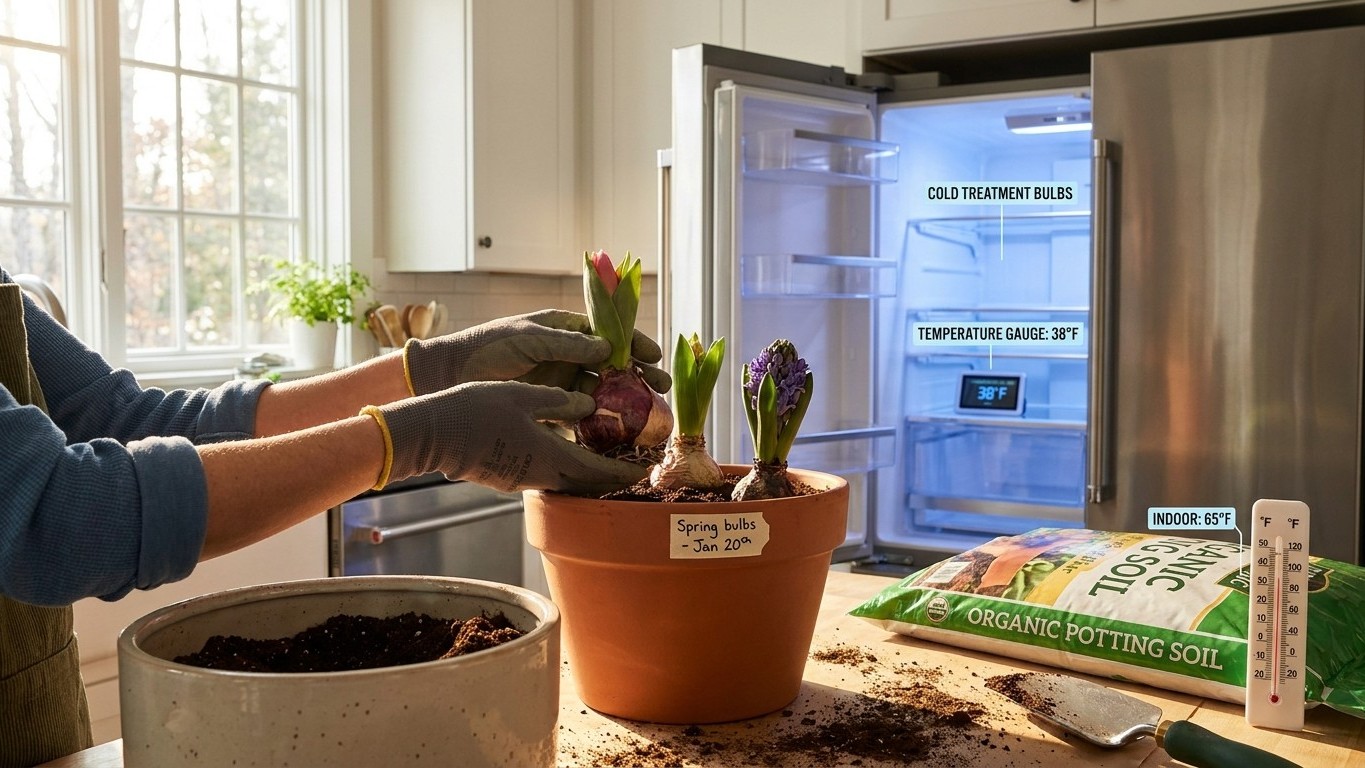

Forcing Spring Bulbs Indoors works in Oklahoma because it sidesteps the state’s uneven winter chill rather than fighting it. A gardener supplies the twelve to fourteen weeks of cold a tulip or hyacinth needs to bloom, using a refrigerator or unheated garage instead of waiting on the ground to do it. Containers add a separate risk the ground doesn’t share.
Why this matters in Oklahoma

The number that decides this is the mean daily minimum for the coldest month at the Oklahoma City reference station: 27.0°F, per NOAA NCEI Climate Normals for 1991-2020. That’s a mean, not a record low, and it sits close enough to freezing that it explains two separate problems gardeners here run into with bulbs.
The chilling deficit
The state’s USDA hardiness zone range runs from 6a up to 8a, and that spread matters more than a single zone number would. A bed in the cooler northern or panhandle counties gets enough consistently cold weeks in the ground to satisfy a tulip’s chill requirement without any help. Toward the warmer end of that range, zone 8a, a mild stretch of winter can leave the soil too warm, too often, to log the full twelve to fourteen weeks below 45°F. Forcing indoors, in a refrigerator held at a steady temperature, replaces whatever the ground failed to deliver.
The container problem
A pot doesn’t behave like a garden bed. Soil in the ground is insulated by the mass around it, so even when air temperatures drop well below that 27°F coldest-month average, the earth a few inches down stays milder. A container has no such buffer: cold air reaches the pot wall on every side, and the soil inside can freeze solid, roots included, at temperatures the same bulb would shrug off in a bed. That’s why a bulb rated hardy for a given zone in the ground needs a container rated two zones hardier, or it needs to come indoors, to survive the same winter unharmed.
So this is not a single-cause problem. Parts of Oklahoma run short on ground chill; every part of Oklahoma exposes a potted bulb to a freeze-through risk the garden bed doesn’t have. Forcing addresses the first. Moving or insulating containers addresses the second, and the two fixes are not interchangeable.
How to do it here
The sequence below assumes a bulb that needs cold to bloom, tulips and hyacinths chief among them, and it’s built around the twelve to fourteen weeks below 45°F those bulbs require to complete flower formation before they’ll send up a stem.
- Pick the bulb and the container together. Use a pot with drainage holes, deep enough that the bulb tip sits about an inch below the rim, and fill with a well-draining potting mix, not garden soil.
- Water once at planting, then find your cold source. An unheated garage that stays above freezing but below 45°F through the winter works if you can verify the temperature with a simple thermometer left inside it for a few days first. A refrigerator produce drawer works too, but only if it holds no ripening apples, pears, or other fruit nearby, since the ethylene gas they give off will kill the flower bud forming inside the bulb before it ever emerges.
- Track the twelve to fourteen weeks on a calendar. Mark the start date when the pot goes into cold storage and the earliest date it can come out, so you’re not guessing later.
- Check the container’s hardiness margin if it’s staying outdoors instead. A pot left outside for its chilling period needs to be rated at least two USDA zones hardier than the bulb itself, given the state’s 6a-8a range, or it needs to be moved into an unheated structure and its sides mulched heavily to slow the freeze.
- Bring the pot into light and warmth only after the full cold period is logged. Move it to a cool, bright spot first, around 60°F, before it goes anywhere warmer, so the stem has a chance to elongate before the flower opens.
Which bulbs are worth it
Some bulbs pay back the effort of forcing generously; others resent it in ways that show up right at bloom time. The difference usually comes down to how long a chill period the species needs and how tall and top-heavy the finished stem gets, since a stem built for open ground doesn’t always hold itself up in a lightweight pot.
- Tulips – a shorter chill requirement means a quicker turnaround from cold storage to bloom.
- Hyacinths – dense, sturdy stems that stand well in a pot without staking.
- Crocus – small enough that toppling is never an issue, and quick to flower once warmed.
- Muscari (grape hyacinth) – low growing, reliable, and forgiving of a slightly shorter chill.
- Paperwhite narcissus – needs no cold period at all, which makes it the simplest bulb to force and, since it’s typically discarded after blooming anyway, one where forcing costs nothing in the long run.
Others are better left in the garden bed than pushed into a pot.
- Large trumpet daffodils (King Alfred types and similar) – tall, heavy-headed stems that lean or snap in a lightweight container.
- Fritillaria – a finicky, extended chill requirement that’s easy to undershoot indoors.
- Alliums – a long chill period paired with a bloom stalk that’s simply too tall for most indoor pots.
What goes wrong, and when you can still fix it
Leaves, but no flower
The cold period ran short. A tulip or hyacinth forms its flower bud inside the bulb during those twelve to fourteen weeks below 45°F, and if the bulb came out of cold storage early, the leaves emerge but the bud never finished developing. This bulb won’t flower this season, and forced bulbs generally aren’t worth forcing a second time. If it’s a species that tolerates garden planting afterward, moving it outdoors gives it a shot at recovering over a future season, but not this one.
A flower sitting on a stem you can barely see
This one was warmed too early. The stem does most of its elongating during the cool, dim period right after chilling and before the plant is exposed to bright light and warmth. Skip that transition and the flower opens anyway, just low and stunted. There’s no fix for the bloom already open. Next time, give the pot a few days in a cool, bright spot before moving it somewhere warmer.
Rot at the base of the bulb
This is a drainage failure, not a cold problem. Water sitting against the bulb in a pot without adequate drainage holes or a well-draining mix breaks down the base tissue before the roots ever get going. The bulb itself can’t be saved. The pot can: drainage holes and a looser mix fix the setup for the next bulb that goes in.