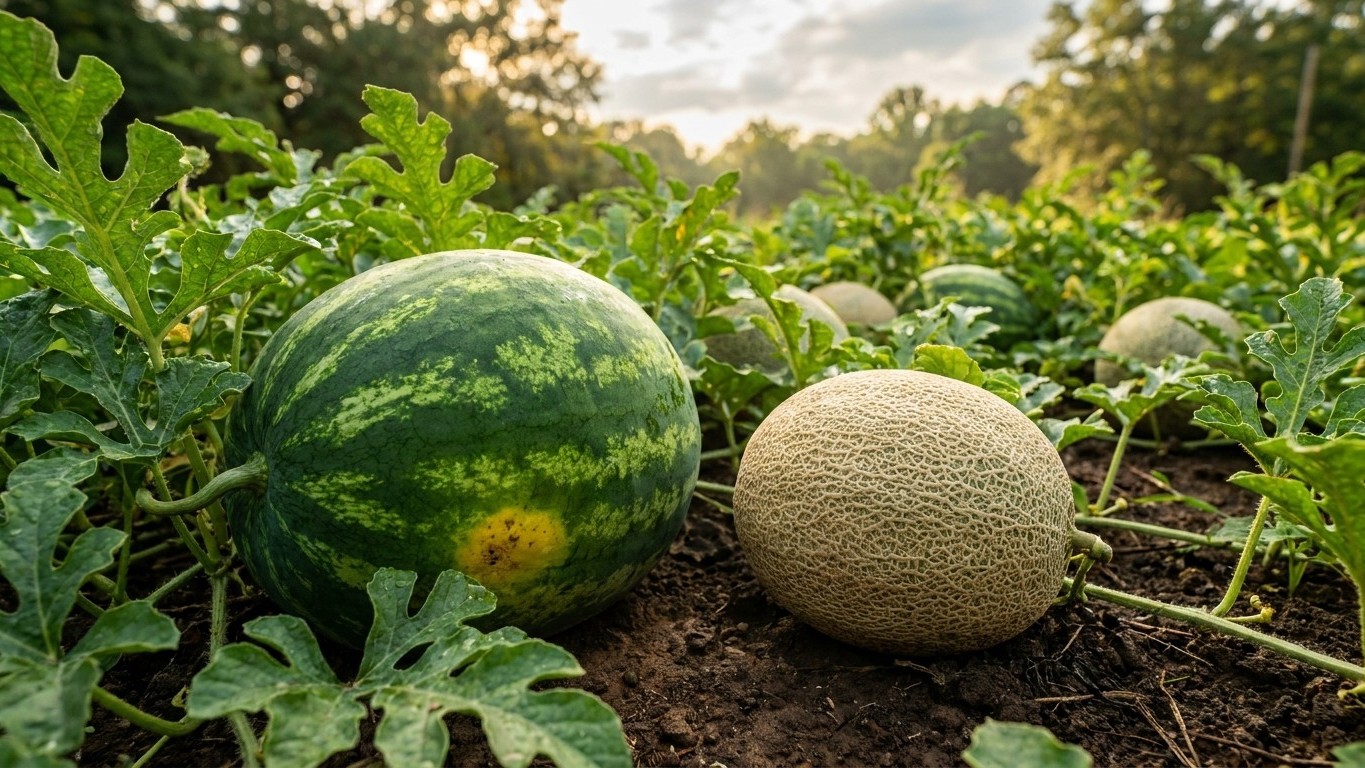

Oklahoma’s frost-free stretch runs roughly 200 to 225 days depending on the year and the station, plenty of time for most melon types to mature. The real filter here is heat: with 70.7 days a year at 90F or hotter and barely 11.7 inches of rain across the whole summer, the varieties that thrive are the ones bred for drought tolerance and disease resistance, not the ones that need a long, gentle season.
The short answer for Oklahoma
Start with the math. Using the reference station’s frost dates, a last spring frost falling between March 28 and April 10 and a first fall frost between October 29 and November 8 gives a growing window somewhere between 202 and 225 days, depending on which end of each range a given year lands on. That’s long enough to carry nearly any melon type from seed to harvest, including 90-day cantaloupes, 85-to-100-day watermelons, and even some of the slower heirloom muskmelons that push past 95 days.
So season length isn’t the constraint. Heat load is. Oklahoma City’s reference station averages 70.7 days a year at 90F or above, which means a meaningful chunk of the growing season runs at temperatures that stress shallow-rooted plants, accelerate soil drying, and push pollinators to slow down during the hottest afternoon hours. Add summer rainfall of about 11.7 inches across June, July, and August, with July the driest month at just 3.59 inches, and the picture becomes clear: melons here need to tolerate stretches of dry heat, not steady moisture.
What actually performs
Icebox-type watermelons, the smaller, quicker-maturing varieties bred to finish in 75 to 85 days, are a strong fit because they get off the vine before the worst of late-summer heat compounds any watering gaps. Cantaloupes and muskmelons bred with resistance to powdery mildew and fusarium wilt hold up better through the humid start of summer and the dry stretch that follows. Honeydews can work, but they demand more consistent soil moisture than the summer rainfall pattern here reliably provides, so they lean more on the gardener’s irrigation schedule than on the sky.
The practical takeaway: pick melon types by how they handle heat and drought stress first, days-to-maturity second. A 90-day cantaloupe with strong disease resistance will usually outperform an 80-day variety that wilts the moment July’s dry spell sets in.
What will not work here
Some melons are set up to fail here before the first seed goes in the ground. The clearest example is anything bred for consistently moist, cool-summer climates, think of varieties developed for coastal or northern growing regions with mild 80-degree summer highs. Those plants expect steady soil moisture and moderate heat. Oklahoma offers neither for long stretches: 70.7 days a year at 90F or hotter means the soil surface dries fast, and a variety that hasn’t been selected for heat tolerance will show it through blossom drop, stunted fruit, or bitter flavor.
Watering schedule matters as much as variety choice. A gardener sticking to a once-a-week watering routine, which works fine in wetter climates, runs into trouble here because the math doesn’t add up. Summer rainfall averages only about 11.7 inches over three months, and July alone drops to 3.59 inches. On a hot week with several days above 90F, that rainfall gets pulled out of the soil through evaporation faster than it can be replenished by a weekly soak, especially for melons planted in sandy or fast-draining soil. Thin-skinned melons and shallow-rooted varieties are the first to show stress, cracking or aborting fruit when the moisture swings get too wide.
The humidity-to-drought whiplash
June’s rainfall, at 4.49 inches, is the wettest of the summer months, which means young melon plants often start life in fairly humid, wet conditions, right when powdery mildew and downy mildew take hold most easily. Then the pattern flips: July drops to 3.59 inches and the heat climbs, hitting the plant with drought stress just as it’s trying to size fruit. Varieties without built-in disease resistance struggle in that first phase; varieties without drought tolerance struggle in the second. A melon that only handles one half of that swing is a melon that underperforms in Oklahoma, no matter how good its maturity date looks on the seed packet.
Extremely long-season melons, the 100-plus-day types bred for regions with a longer, more forgiving fall, also carry more risk here. If a late spring frost pushes planting back and the plant needs its full maturity window, it can bump right up against that October 29 to November 8 fall frost range with fruit still sizing up.
What changes across Oklahoma
Oklahoma is not one growing climate, and the hardiness zone range makes that obvious. The USDA Plant Hardiness Zone Map, built from the average annual extreme minimum temperature, places the state anywhere from zone 6a to zone 8a. That’s a real spread, not a rounding error. A 6a winter regularly bottoms out colder than a 8a winter, which usually means a shorter frost-free season, a later last frost in spring, and an earlier first frost in fall for gardens on the colder end of that range compared to gardens on the warmer end.
Practically, that spread changes two things for melon growing: when it’s safe to set plants out, and how much margin there is at the back end of the season for a slower-maturing variety to finish. A garden sitting toward the cooler end of Oklahoma’s hardiness range should lean toward the quicker-maturing melon types discussed above and treat the state’s frost dates as a starting estimate rather than a guarantee, likely needing to wait longer in spring and wrap up harvest earlier in fall than the reference station’s numbers suggest. A garden on the warmer end has more room to experiment with a longer-season variety, though the heat and rainfall patterns described above still apply across the whole state.
This page can’t tell an individual reader which zone their own garden sits in, because that depends on local elevation, terrain, and microclimate factors that a state-level page doesn’t capture. What it can say is that the difference between the coldest and warmest corners of Oklahoma is large enough to matter for melon planting decisions, and that checking a hardiness zone map for the exact address is worth five minutes before choosing a variety or a planting date.
Where to check this for your own county
Oklahoma State University Extension is the source that turns this state-level answer into a county-level one. The state and national numbers cited on this page, frost dates, heat days, rainfall averages, come from a single reference weather station, and Oklahoma is too large and too varied in elevation and terrain for one station’s readings to speak for every county.
Two things are worth looking for on the extension site specifically. First, the local planting calendar for the reader’s own county or the nearest county office, which will reflect frost timing and season length as observed locally rather than at a distant airport station. Second, any variety trial results or recommended cultivar lists published for melons in that region, since Oklahoma State’s horticulture specialists periodically test cantaloupe, watermelon, and muskmelon varieties under Oklahoma conditions and report which ones handled the state’s heat and disease pressure best in actual field trials.
A county-level recommendation will always beat a state-level one, because it accounts for local soil type, local rainfall patterns that may run higher or lower than the statewide summer average, and local frost timing that can shift by a week or two from what a single reference station shows. This page has done the work of laying out what’s true for Oklahoma as a whole, using verified climate normals, but it stops there by design. The county extension office is where a gardener trades the state’s average for their own plot’s reality.
Checking this against your own garden
Every date and average on this page is a starting point, not a substitute for what’s actually happening in a specific garden. Three simple observations, none requiring anything beyond a hand and a bit of attention, tell a gardener more about their own microclimate than any regional chart.
Soil warmth by feel comes first. Melon seed germinates poorly in cold soil, and a gardener who digs a couple of inches down and finds the soil still cool to the touch, even after the calendar says it’s past the last frost date, is looking at a garden that runs cooler than the regional average, whether from shade, elevation, or heavier clay that holds cold longer.
The first flush of male flowers is the second signal. Melons produce male flowers before female ones, and a burst of male blooms with no sign of the rounder-based female flowers yet is normal early on, but it also marks how far along the plant’s internal clock is running compared to a typical season. A garden running noticeably ahead of or behind the general timeline for the area is telling the gardener something about its own conditions, sun exposure, soil temperature, air drainage, that a regional average can’t capture.
The first true leaves, the ones that appear after the initial seed leaves and actually look like miniature melon foliage, mark the point where the plant has shifted from living off seed reserves to relying on its roots and the surrounding soil. How quickly and how sturdily those leaves come in says more about whether that particular spot has the warmth and moisture a melon needs than a printed frost date ever will.