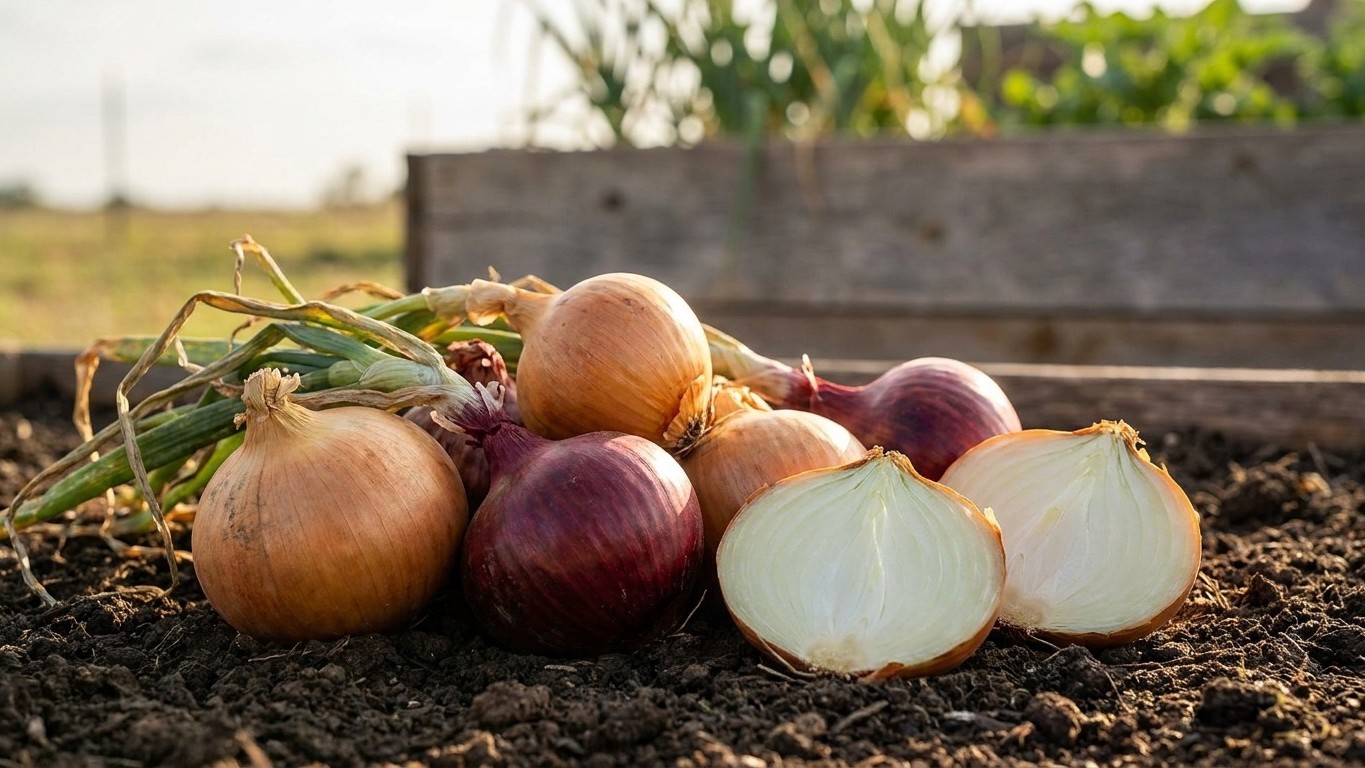

Oklahoma City sits at 35.39 degrees north, and its longest day of the year delivers 14 hours and 24 minutes of daylight. That number decides almost everything about which onions will actually bulb in an Oklahoma garden. The right pick for most of the state is an intermediate-day onion, sometimes called day-neutral, with a handful of short-day and long-day varieties working at the northern and southern edges. Anything bred for higher latitudes never gets enough daylight here to do more than grow leaves.
The short answer for Oklahoma

At 35.39 degrees north, Oklahoma City’s summer solstice brings 14 hours and 24 minutes of daylight. That’s the signal onions read to decide whether to keep making leaves or start forming a bulb. Short-day types flip the switch at around 12 hours, according to Clemson Cooperative Extension’s onion growing guide, so they bulb early almost everywhere. Long-day types hold off until 14 to 16 hours of daylight, which most of them never see this far south. Oklahoma sits in the gap between the two groups, and that gap is exactly where intermediate-day onions were bred to work.
Intermediate-day varieties that fit Oklahoma City’s latitude
Nine intermediate-day onions documented on this site list a range that covers 35.39 degrees north, meaning Oklahoma City’s daylight hours fall inside their published bulbing window:
- Cabernet (35-45N)
- Calibra (35-45N)
- Candy (33-40N)
- Elsye (32-45N)
- Expression (32-45N)
- Monastrell (35-46N)
- Red Long of Tropea (35-48N)
- Scout (32-46N)
- Sierra Blanca (32-45N)
Two long-day varieties also reach this latitude, but only at the low end of their range: Bridger (35-50N) and Walla Walla Sweet (35-55N). Oklahoma City sits at their southern limit, not comfortably in the middle of it. Two short-day varieties, Red Rock (30-36N) and White Castle (30-38N), reach the northern edge of their own range here. Neither has its own page on this site, but both are documented as workable at this latitude.
A separate group of short-day onions, Gabriella, Madalyn, Red Sensation, Texas Grano 1015Y, and Vidora, list an upper bound of 35 degrees north, putting Oklahoma City within about a degree and a half of their published edge. These may bulb here, but a gardener planting them is working at the edge of the documented range, not the middle of it.
What will not work here
Thirteen varieties documented on this site list a range that starts north of 35.39 degrees, which means Oklahoma City’s longest day, 14 hours and 24 minutes, never reaches the daylight threshold these onions need to start bulbing. Plant one anyway and the result isn’t a smaller onion. It’s leaves all season, followed by rot, because the plant never gets the signal that tells it to stop making top growth and start making a bulb.
- Ailsa Craig (38-60N): needs far more summer daylight than Oklahoma provides
- Barolo (38-55N): same problem, bred for northern latitudes
- Blush (38-55N): never reaches its bulbing trigger here
- Frontier (40-50N): daylight tops out short of what it needs
- New York Early (38-50N): bred for a longer summer day than Oklahoma gets
- Patterson (38-55N): a northern storage onion, out of range in Oklahoma
- Powell (43-47N): needs a latitude 8 degrees north of Oklahoma City
- Red Carpet (40-45N): daylight requirement never met this far south
- Red Long of Florence (38-50N): the one intermediate-day variety on this list, still out of range
- Redwing (43-65N): bred for latitudes approaching the far north
- Rossa di Milano (38-50N): needs longer summer days than Oklahoma sees
- Safrane (42-50N): out of range by 7 degrees
- Talon (42-50N): same gap, no bulb forms
Every variety on that list is a long-day onion except Red Long of Florence, which is intermediate-day but still published for latitudes starting at 38 degrees north, three degrees above Oklahoma City. These are onions bred for the long summer days of the northern United States and Canada, where the sun barely sets in June. Planted here, they’ll look healthy through early summer, tall and leafy, right up to the point where a properly matched onion would be swelling into a bulb. Instead they keep pushing leaves until the plant runs out of season, and what’s left in the ground by fall is soft and unusable. There’s no partial credit. A long-day onion planted three degrees of latitude too far south doesn’t give a small onion. It gives no onion at all.
What changes across Oklahoma
Oklahoma isn’t one latitude, and the figures above belong specifically to Oklahoma City’s weather station, USW00013967, at 35.39 degrees north. The state stretches from the Red River along the Texas border, near 33.6 degrees north, up through the panhandle to just above 37 degrees north, a span of roughly three and a half degrees. That’s enough to shift which onions make sense at either edge.
A gardener near the southern border sits closer to the short-day varieties in the blurred zone, since their published range tops out right around 35 degrees north. Someone gardening in the panhandle sits closer to the long-day varieties reaching in from the north, Bridger and Walla Walla Sweet, both of which list Oklahoma City’s latitude as their southern edge rather than their comfortable middle.
| Location | Approx. latitude | Summer day length | What it changes |
|---|---|---|---|
| Red River border (south) | ~33.6°N | Slightly under 14h24 | Blurred-zone short-day onions fit more comfortably; intermediate-day types still bulb reliably |
| Oklahoma City (reference) | 35.39°N | 14h24 | The baseline used throughout this page |
| Panhandle (north) | ~37°N | Slightly over 14h24 | Bridger and Walla Walla Sweet move from edge case toward workable; planting dates shift earlier by a couple weeks |
A reader gardening near either edge of the state should treat the Oklahoma City figures as a starting point, not a rule. Checking a personal latitude against the ranges above matters more the farther a garden sits from Oklahoma City itself.
Sweet now, or onions that last
Every onion carries a trade-off between flavor and shelf life, and it isn’t a matter of breeding preference. It’s chemistry. The volatile sulfur compounds that make an onion sharp enough to bring tears are the same compounds that protect the bulb in storage. University of Missouri Extension puts it plainly: sweet onions do not store as well as the more pungent types, because pungency comes from those sulfur compounds. Fewer of them means a milder bite on a sandwich in July. It also means faster spoilage by January.
This lines up with the day-length groups already covered. Short-day onions, bred for Deep South latitudes, tend to run sweeter and store for a shorter window. Long-day onions, bred for the North, run sharper and keep for months. Oklahoma’s intermediate-day varieties sit in the middle of that spectrum, part of why they’re the safer default here: some sweetness without giving up all of the storage life.
The practical version shows up in the pantry. A garden built entirely around the sweetest blurred-zone short-day varieties will produce onions worth eating fresh through late summer, but few will still be good by the holidays. A garden leaning on the intermediate-day varieties suited to Oklahoma City’s latitude, or mixing in a longer-keeping type near the panhandle where Bridger or Walla Walla Sweet becomes workable, has a better shot at onions still sound in a cool pantry come March. No single variety does both. Where to land on that spectrum is a decision every Oklahoma gardener makes on purpose, not by accident.
Checking this against your own garden
Everything above is built on one weather station’s data, in one city, on one day of the year. That’s a useful baseline, but it isn’t a substitute for checking the numbers that apply to a specific piece of ground, especially for anyone gardening well north or south of Oklahoma City.
A few things worth confirming before ordering onion sets or seed:
- Look up the latitude of the nearest town, not just the state as a whole, if the garden sits more than an hour’s drive from Oklahoma City.
- Check local frost dates through the county extension office rather than a statewide average, since Oklahoma’s frost-free window shifts by several weeks between the panhandle and the southern border.
- Compare a variety’s published latitude range against the local figure, not against Oklahoma City’s, if gardening near the state’s northern or southern edge.
- Ask the county extension office which onion varieties local gardeners have had the most success with, since results on the ground sometimes catch details a published range misses.
- Note the locally recommended planting window, since it can run two to three weeks earlier or later than Oklahoma City depending on where in the state a garden sits.
Oklahoma State University’s Cooperative Extension maintains offices across the state, and they remain the most direct way to confirm both frost dates and variety performance for a specific address rather than a statewide estimate.