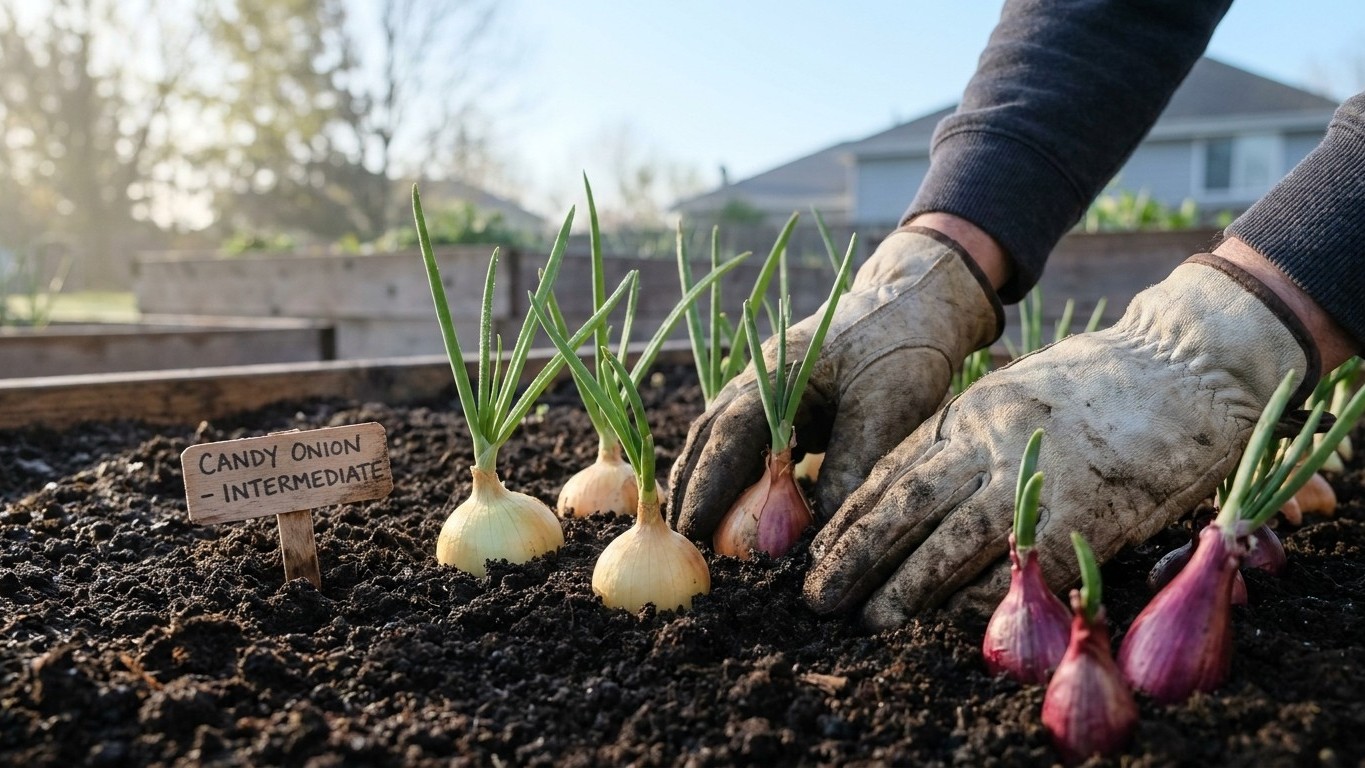

Most Oklahoma gardeners should Plant Onions in late winter to early spring, typically from mid-February through March, not in fall. That window exists because of one number: 14 hours and 24 minutes of daylight on the longest day of the year at Oklahoma City’s latitude. Onions don’t bulb because of warmth. They bulb because of day length, and everything about timing in this state flows from that single fact.
The short answer for Oklahoma

Oklahoma City sits at 35.39 degrees north latitude, the reference point tracked by the National Weather Service station at Will Rogers World Airport. On the summer solstice, the day there stretches to 14 hours and 24 minutes. That figure matters more than any frost date, because it tells you which onions can even finish the job of forming a bulb, and it tells you how much lead time you need to give the plant before the calendar forces the switch from leaf-growth to bulb-growth.
At this latitude, intermediate-day onions are the safe default. Their published ranges, drawn from catalogue data, typically run from around 32 to 46 degrees north, comfortably bracketing Oklahoma’s midsection. Varieties in that group include Cabernet, Calibra, Candy, Elsye, Expression, Monastrell, Red Long of Tropea, Scout, and Sierra Blanca, along with Bridger and Walla Walla Sweet on the long-day side of the intermediate boundary, whose ranges start at 35 degrees and extend north. These plants wait until roughly 13 to 14 hours of daylight before they commit to bulbing, which lines up almost exactly with what Oklahoma’s summer sky delivers.
Short-day varieties sit at the edge of usefulness here rather than squarely in range. A handful, including Red Sensation, Texas Grano 1015Y, and Vidora, have published ranges that top out between 25 and 35 degrees, putting Oklahoma City right at the boundary. They may bulb reliably in a warm, early spring, but they’re working at the far edge of their design, not in the middle of it.
This is also why the calendar looks different than it does in Texas or further south. In genuinely mild-winter regions, gardeners set onion transplants in fall and let them overwinter as small plants, ready to take off the moment days lengthen. Oklahoma’s winters are colder and less predictable than that, with hard freezes common enough to kill young transplants outright. Late winter to early spring planting sidesteps that risk while still leaving enough weeks of growth before the bulbing trigger arrives in early summer.
What will not work here
Planting onions late in Oklahoma doesn’t push the harvest back. It shrinks it. Bulb size is locked in by how much leaf growth the plant has managed by the moment day length crosses its trigger threshold, whether that’s 12 hours for a short-day type or 14 hours for an intermediate one. A transplant set out in April instead of February has fewer weeks to build leaves before that switch flips, and whatever size it has reached at that point becomes the ceiling for the bulb. There’s no catching up once bulbing starts. The plant redirects its energy and stops adding leaf mass, for good.
Variety choice carries the same kind of hard stop, and it’s less forgiving than a smaller bulb. Long-day onions, the ones bred for regions where summer days stretch well past 14 hours, are excluded from Oklahoma entirely. The day here never gets long enough to flip their switch. Planted anyway, they simply keep making leaves all season, with no bulb forming, and eventually the plant rots in the ground as the growing season ends.
Thirteen varieties documented on this site fall into that category for Oklahoma’s latitude:
- Ailsa Craig (38-60N) : Oklahoma’s day length never reaches its bulbing trigger.
- Barolo (38-55N), published range starts three degrees north of Oklahoma City.
- Blush (38-55N), same gap; leaves all season, no bulb.
- Frontier (40-50N), needs day length Oklahoma summers don’t provide.
- New York Early (38-50N), bred for a longer summer day than this latitude offers.
- Patterson (38-55N), will not bulb; the plant rots instead.
- Powell (43-47N), a full climate zone north of Oklahoma’s range.
- Red Carpet (40-45N), day length threshold out of reach here.
- Red Long of Florence (38-50N, intermediate-day), its range still starts north of 35.39N.
- Redwing (43-65N), designed for far-northern summers.
- Rossa di Milano (38-50N), same story as the others in this group.
- Safrane (42-50N), no bulb forms at Oklahoma’s latitude.
- Talon (42-50N), excluded for the same day-length shortfall.
None of these fail gently. They don’t produce an undersized onion the way a late-planted intermediate variety might. They fail completely, and the only sign until late summer is a healthy-looking row of leaves with nothing happening underground.
What changes across Oklahoma
Oklahoma isn’t a single latitude, and the advice above bends depending on where in the state a garden sits. The state runs from around 33.6 degrees north at the Red River border with Texas up to roughly 37 degrees north along the Kansas line, a spread of nearly 3.5 degrees. Oklahoma City, at 35.39 degrees, sits close to the middle, and every figure in this article comes from that reference point, tied to the NOAA station at Will Rogers World Airport.
A gardener near Idabel or Durant, close to the Red River, is working with a shorter summer day than Oklahoma City sees, which nudges the blurred-zone short-day varieties toward more reliable performance. A gardener near Enid or up in the Panhandle, closer to the Kansas line, sees a longer summer day, which favors intermediate-day types even more strongly, though still well short of the 38-degree threshold where the excluded long-day group would start to make sense.
| Location | Approx. latitude | Longest-day daylight vs. Oklahoma City | What it changes |
|---|---|---|---|
| Southern Oklahoma (Red River border) | ~33.6N | Slightly less than 14h24 | Blurred-zone short-day varieties become more reliable |
| Oklahoma City (reference) | 35.39N | 14h24 | Intermediate-day is the safe default |
| Northern Oklahoma / Panhandle | ~37N | Slightly more than 14h24 | Leans further into intermediate-day territory, still short of the 38N long-day cutoff |
None of this changes the timing rule itself. Wherever in the state a garden sits, the plant still needs to reach its full leaf potential before day length crosses the trigger for whichever variety group is planted. It only shifts which varieties belong on that specific piece of ground.
Sweet now, or onions that last
Oklahoma’s spot in the middle of the day-length map comes with a trade the gardener doesn’t get to opt out of. The compounds that give an onion its bite are volatile sulfur compounds, and those same compounds are what protect the bulb in storage. A sweeter onion has fewer of them, which makes it better sliced raw and worse at surviving a pantry shelf past a few weeks. University of Missouri Extension puts it plainly: sweet onions do not store as well as the more pungent types.
Southern Oklahoma gardens, leaning on blurred-zone short-day varieties, land on the sweeter end of that spectrum. The onions taste milder, but they’re built for eating within a couple of months of harvest, not for holding through winter. Northern Oklahoma gardens, leaning further into the intermediate-day group, sit closer to the middle of the trade-off: not as sharp or long-keeping as the true long-day onions grown in states with genuinely northern summers, but noticeably better keepers than a short-day sweet onion.
What that means for the pantry is straightforward. A gardener in southern Oklahoma growing short-day varieties should plan to use or preserve most of the crop by early winter. A gardener further north growing intermediate types can expect onions to hold longer, but by March, most of that harvest will be thinning out or gone, well ahead of what a northern state growing true long-day onions could still pull from storage. Oklahoma doesn’t grow the onion that lasts until spring. It grows the one that’s good on the table in fall and early winter, and that’s a fair trade for a state sitting where it does on the map.
Checking this against your own garden
Every figure here is anchored to Oklahoma City, and a garden fifty or a hundred miles away sits under a slightly different sky. Before locking in a planting date or a variety, it’s worth confirming a few things specific to the actual plot of ground being planted.
- Look up the latitude of the nearest town if the garden sits well north or south of Oklahoma City, since even a degree or two shifts which day-length group performs best.
- Check local average last-frost and first-frost dates rather than relying on a statewide range, since Panhandle and southeastern Oklahoma frost dates can differ by several weeks.
- Contact the county extension office for regional variety trial results, since local agents often track how specific onion varieties have actually performed in nearby soil and weather.
- Note the garden’s elevation, since higher ground in the Panhandle or western Oklahoma tends to run cooler and frost later into spring than the state’s eastern lowlands.
- Watch the transplant’s leaf count before day length ramps up in late spring, since that leaf count, not the calendar, is the real predictor of final bulb size.
A statewide figure is a starting point, not a guarantee. The county extension office remains the most reliable source for adjusting these numbers to the specific patch of ground being planted.