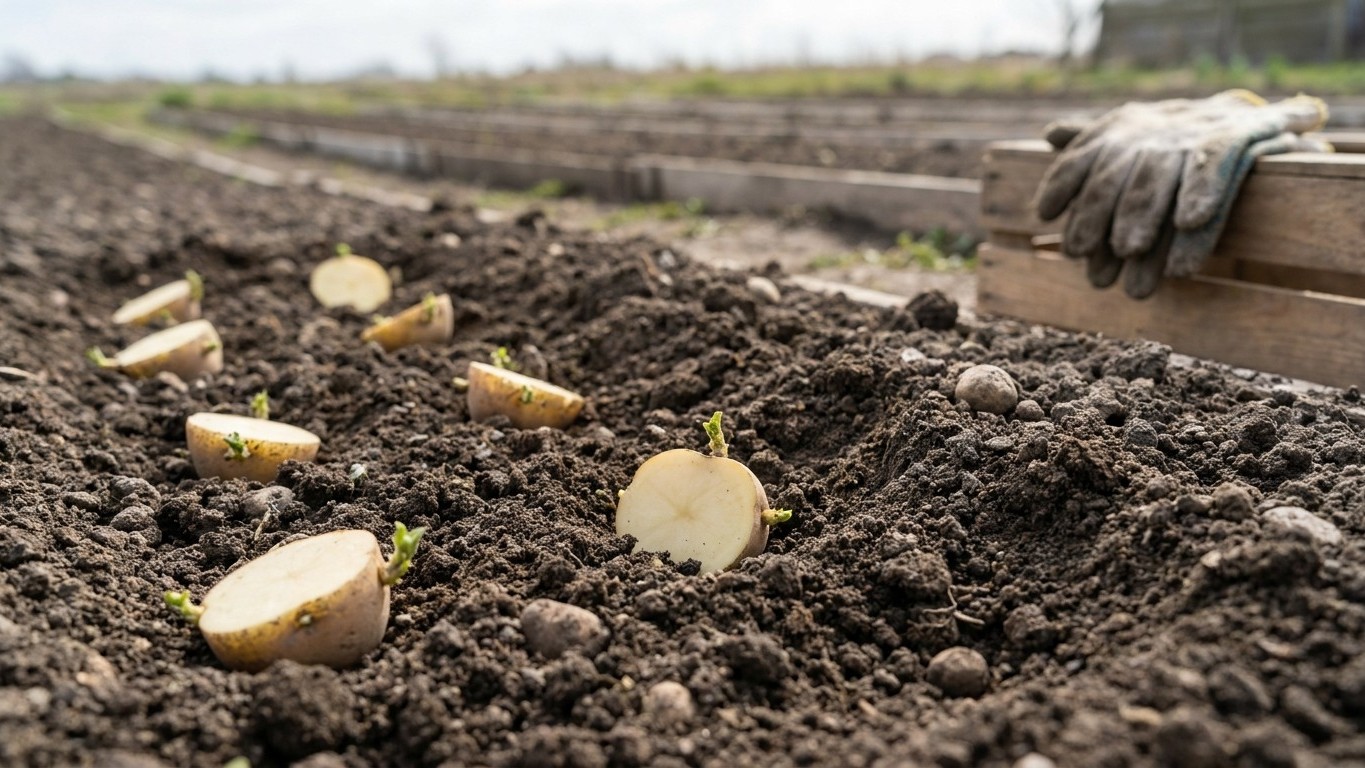

Early- and mid-season potato varieties, planted as a spring crop rather than nursed through summer, are what work across most of Oklahoma. The reason isn’t cold hardiness. It’s a soil temperature ceiling that arrives well before a full-season potato could ever finish filling out its tubers.
The short answer
Oklahoma City’s Will Rogers World Airport weather station, the reference point for NOAA’s 1991-2020 U.S. Climate Normals, puts the last spring frost window between March 28 and April 10. That’s the freeze-probability band where the odds of a 32°F freeze drop from 70% down to 30%, according to NOAA’s National Centers for Environmental Information. It’s a useful anchor, but it’s an airport reading. Gardens in the surrounding suburbs, and especially rural plots with more open sky or higher elevation, typically see their own last frost land one to two weeks later. Check your county extension office or your own frost log before you trust this date for your yard.
That frost window matters less on its own than what it triggers. Potatoes go in the ground as soon as soil temperature hits 50°F, which lands 14 to 21 days before the last frost date, according to Utah State University Extension’s fact sheet on growing potatoes in the home garden. In Oklahoma, that means seed potatoes are often in the ground in early-to-mid March, sometimes even late February in a warm year, well ahead of that airport-station frost window closing.
Why rush? Because the clock that actually governs an Oklahoma potato crop isn’t frost risk in spring. It’s heat in early summer. Tuber set and fill shut down once soil temperatures climb past 90°F, and no amount of extra watering reverses that, according to both Utah State University Extension and the University of Maine Cooperative Extension’s Bulletin #2077. Oklahoma racks up a lot of 90°F soil days by June. A potato variety that needs the whole growing season to bulk up its tubers simply runs out of usable time before the heat shuts the process down. An early or mid-season variety, planted at that 50°F soil mark and dug before peak summer heat, gets its tuber-filling window in while the soil is still cooperating.
| Season class | How it behaves in Oklahoma soil heat | Common kitchen use |
|---|---|---|
| Early | Finishes tuber fill well before soil regularly exceeds 90°F | Boiling, salads, new potatoes |
| Mid-season | Usually completes fill if planted at the 50°F soil mark, tight against the heat | Boiling or baking depending on variety |
| Late | Frequently still filling tubers when soil crosses 90°F, growth stalls | Baking, storage, but a gamble in most Oklahoma counties |
Neither Utah State nor the University of Maine publishes a days-to-maturity figure for specific varieties. What they do publish is the season class, early, mid-season, or late, and that classification is exactly what a gardener needs to weigh against a state where summer soil heat, not spring cold, is the limiting factor.
What actually decides it
Soil temperature, not the calendar
A calendar date tells you nothing about what’s happening six inches underground. Soil warms at its own pace depending on sun exposure, mulch, and soil type. Utah State University Extension’s guidance is soil-based for a reason: potatoes planted into cold, wet ground rot before they sprout, while potatoes held back until a fixed calendar date miss their planting window entirely in a year when soil warms early. The 50°F soil reading, checked with a simple soil thermometer a few inches down, is the trigger. That reading, not the date on a seed packet, is what determines when a seed piece goes in the ground.
The 90°F ceiling that stops tuber fill
This is the mechanism that decides the whole crop, and it’s the part gardeners tend to miss. Above 90°F soil temperature, tuber set and fill are inhibited. The plant doesn’t die. It doesn’t even necessarily look stressed above ground. But underground, the tubers stop sizing up, and irrigation doesn’t undo that. A gardener who waters through a July heat wave, expecting the extra moisture to compensate, is fighting a mechanism that water doesn’t touch. The only lever that works is timing: get the crop planted early enough that most of its tuber-fill period happens before the soil crosses that line, and dig before the heat locks in for the summer.
Your frost date versus the reference station’s
The NOAA frost window cited above comes from one station. Cold air pools in low spots, elevation shifts frost timing, and tree cover or open exposure changes how fast a specific plot warms or cools. A garden fifteen minutes from the reference station can run a week or more different in either direction. That’s not a caveat to skim past. It’s the reason a gardener who plants strictly by the airport’s frost date, without checking their own plot’s history, ends up either burned by a late freeze or losing weeks of the pre-heat growing window that Oklahoma potatoes depend on.
How to do it
- Starting in late winter, check soil temperature a few inches deep in the planting bed every few days using a soil thermometer, rather than watching the calendar.
- Once soil holds steady at 50°F, count back to confirm you’re roughly 14 to 21 days ahead of your area’s expected last frost, adjusting the NOAA reference-city window (March 28 to April 10) later by a week or two if your garden is rural, low-lying, or at higher elevation.
- Buy certified seed potatoes in an early or mid-season class suited to how you plan to cook them, boiling or baking, rather than saving grocery-store potatoes or uncertified seed from a prior harvest.
- Cut larger seed pieces so each has at least one eye, and let cut surfaces dry and callus for a day or two before planting to reduce rot risk in cool soil.
- Plant seed pieces once the soil has held at 50°F, spacing and depth following the variety’s tag or extension guidance.
- Track soil temperature again as early summer approaches, watching for the point where it starts regularly exceeding 90°F.
- Dig the crop before that heat ceiling locks in for good, rather than leaving tubers in the ground hoping for more sizing once the hot stretch has already begun.
What goes wrong
- Planting a late-season variety expecting a full harvest. Oklahoma’s soil crosses the 90°F tuber-inhibition threshold before a late-season variety finishes filling out. The remedy is choosing an early or mid-season class instead, so the fill window closes before the heat does.
- Waiting for a fixed calendar date instead of checking soil temperature. A gardener who plants “on schedule” in a year when soil warms early loses weeks of cool-season growing time; one who plants too early into cold soil risks seed piece rot. The fix is a soil thermometer, checked directly, every season.
- Using uncertified or saved seed potatoes. Uncertified seed carries virus that saved grocery-store or leftover garden potatoes can’t be checked for. Buying certified seed each season is the one habit that prevents a slow, hard-to-diagnose yield decline.
- Watering harder during a heat wave to try to push tuber size. Once soil passes 90°F, tuber fill stops regardless of moisture. The remedy isn’t more water, it’s earlier planting and earlier digging, so the crop is largely finished before that heat arrives.
- Trusting the reference-city frost date as gospel for a specific yard. A rural or low-lying garden can run a week or two later on its last frost than the airport station NOAA measures from. Checking a personal frost log, or a county extension office, before locking in a planting date avoids both a late freeze and a missed early window.
Common questions
Can I grow a late-season potato in Oklahoma?
It’s possible in a cooler microclimate or an unusually mild year, but the season class means tuber fill is still underway when soil temperatures typically cross the 90°F threshold in most Oklahoma counties. An early or mid-season class carries far less risk.
What’s the best time to plant potatoes in Oklahoma?
Plant once soil temperature holds at 50°F, which generally falls 14 to 21 days before your area’s last frost. For reference, Oklahoma City’s Will Rogers World Airport station shows a last-frost window of March 28 to April 10 under NOAA’s 1991-2020 Climate Normals, though your own yard may run later.
Do I need certified seed potatoes, or can I use ones from the grocery store?
Certified seed matters. Uncertified seed, including grocery-store potatoes or saved tubers from a prior harvest, can carry virus that reduces yield in ways that are hard to trace back to the seed source.
Can I plant a fall crop of potatoes to avoid the summer heat entirely?
Neither Utah State University Extension nor the University of Maine Cooperative Extension publishes maturity-day figures that would let a gardener plan a fall crop’s timing with confidence in Oklahoma’s climate. What’s established is the spring window: plant at 50°F soil, ahead of the last frost, and dig before soil regularly tops 90°F.