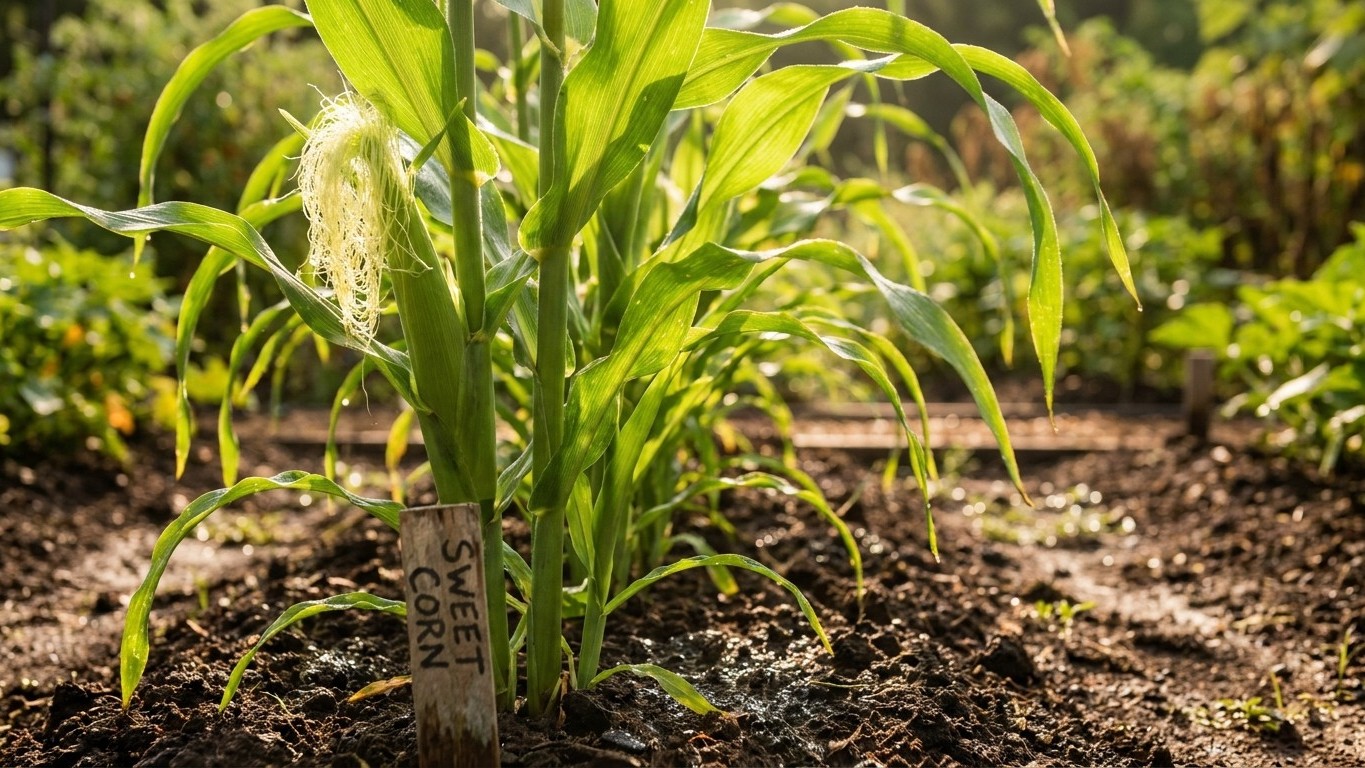

Yes, sweet corn ripens in Oklahoma. The state’s frost-free stretch runs long enough that even a slower-maturing variety has room to finish before autumn shuts things down. The catch isn’t the calendar so much as the soil thermometer: corn won’t germinate reliably until the ground itself warms past 60 F, and that date lands well after the last frost has come and gone.
The short answer
Here’s where a lot of home gardeners trip up. They see the last spring frost pass and assume it’s planting time. It isn’t, not for sweet corn. According to NOAA NCEI’s 1991-2020 Climate Normals, the reference station near Oklahoma City sees its last spring frost sometime between March 28 and April 10. That’s the freeze date, not the soil date. Sweet corn seed sitting in cold, wet ground below 60 F doesn’t germinate well, it just sits there and often rots before it sprouts. Utah State University Extension is blunt about this threshold: soil needs to be above 60 F before sweet corn goes in the ground, full stop.
The exact week Oklahoma soil crosses that 60 F mark isn’t published in the frost data above, and it varies by county, by how much sun a bed gets, and by whether the ground is heavy clay or sandy loam. What matters for planning is the sequence, not a fixed date: frost passes first, then the soil needs additional weeks to actually warm through, and only then does planting make sense. Gardeners who want precision should use a soil thermometer pushed a few inches down rather than trust the frost date alone.
Once soil warmth allows planting, the second half of the question is whether 60 to 90 days (the maturity window Utah State University Extension gives for sweet corn) fits before the first fall frost shuts the season down. That first fall frost, per the same NOAA NCEI normals, arrives between October 29 and November 8 at the reference station. Count backward from early November and there’s a wide gap, easily more than five months, between whenever the soil finally warms and whenever the cold returns. That gap is the real answer to whether sweet corn ripens here: it’s not tight, it’s generous.
Keep in mind these frost dates come from one airport-adjacent weather station. Suburban yards and rural gardens tend to see their last frost later and their first fall frost earlier than an airport reading, sometimes by one to two weeks, more if the garden sits at higher elevation or in a low spot where cold air pools. Anyone gardening outside the immediate metro area should treat these dates as a starting reference and confirm timing against their own county’s typical pattern before betting a planting date on it.
Does a late variety fit here?
Given how wide Oklahoma’s frost-free window runs, both a quick 60-day type and a slower 90-day type have room to work, though they draw on that room differently.
A 60-day variety
A fast-maturing sweet corn needs roughly 60 days from planting to harvest. Once soil has warmed past 60 F, likely sometime in mid-to-late spring depending on the specific site, a 60-day variety planted then would be ready in under nine weeks. Given the first fall frost doesn’t show up until late October or into November, this type finishes with weeks to spare even if the soil warms later than expected. There’s little risk of running out of season. The bigger consideration is heat: with an average of 70.7 days a year reaching 90 F or higher at the reference station, a corn crop that tassels during a stretch of that heat can suffer poor pollen viability and spotty kernel fill. Planting early enough that flowering happens before the hottest weeks helps sidestep that problem.
A 90-day variety
A slower, 90-day sweet corn asks for roughly three months between planting and harvest. Even allowing for soil that takes its time warming past 60 F, and even planting later than a 60-day type would need, a 90-day variety planted anytime through late spring or into early summer still has enough runway to mature before the October 29 to November 8 frost window closes. So no, the late variety does not get squeezed out here. Oklahoma’s long frost-free stretch is exactly the kind of climate where a 90-day type is realistic rather than risky. The tradeoff is that a longer season in the ground means more exposure to those 90-plus-degree days, so growers choosing a slow variety should watch soil moisture closely through the hottest stretch to keep pollination on track.
What goes wrong here
Most sweet corn failures in Oklahoma trace back to one of three mistakes, and only one of them has anything to do with the state’s climate at all.
- Sowing into soil that’s still too cold. Planting right after the last frost, rather than waiting for the soil itself to clear 60 F, is the most common cause of poor stands. Seed sits in cold ground, takes on water, and rots before it can sprout. The fix is simple: check soil temperature with a thermometer rather than going by the calendar, and hold off until it’s consistently above that mark.
- Choosing a variety too late for the season. This is less likely in Oklahoma given the long stretch between soil warming and the first fall frost, but it can still happen if planting is delayed too far into summer, leaving a 90-day variety racing the October frost. The remedy is to plant as soon as soil conditions allow rather than pushing the date back for convenience.
- Losing sweetness to nearby tasseling, which has nothing to do with weather. Sweet corn types (su, se, and sh2) lose their signature sweetness if they tassel at the same time as each other, because cross-pollination between types dilutes the sugar genetics in the kernels. Utah State University Extension doesn’t publish a specific isolation distance for this, so the fix isn’t measured in feet, it’s measured in timing: stagger plantings so different types don’t flower during the same window, and grow each variety in its own block of three or more rows rather than a single thin row, which also improves pollination overall.
Common questions
Does frost date tell me when to plant sweet corn in Oklahoma?
Not by itself. The last spring frost (March 28 to April 10 at the reference station) marks when freezing temperatures typically stop, but sweet corn seed needs soil above 60 F to germinate reliably, and that warmth arrives after the frost date, not on it.
Can I grow a 90-day sweet corn variety in Oklahoma?
Yes. The gap between when soil typically warms enough to plant and the first fall frost (October 29 to November 8) is wide enough that a 90-day variety has time to mature without racing the season’s end.
Why did my sweet corn turn out starchy instead of sweet?
This usually isn’t a climate problem. It happens when different sweet corn types (su, se, sh2) tassel at the same time nearby, and pollen crosses between them. Stagger planting dates by type and grow in blocks rather than single rows to reduce the odds of it happening.
How does Oklahoma’s summer heat affect sweet corn?
The reference station averages 70.7 days a year at 90 F or above. That heat load raises water demand and can stress pollination if tasseling coincides with the hottest stretch, so timing planting to flower before the peak heat arrives helps kernel fill.