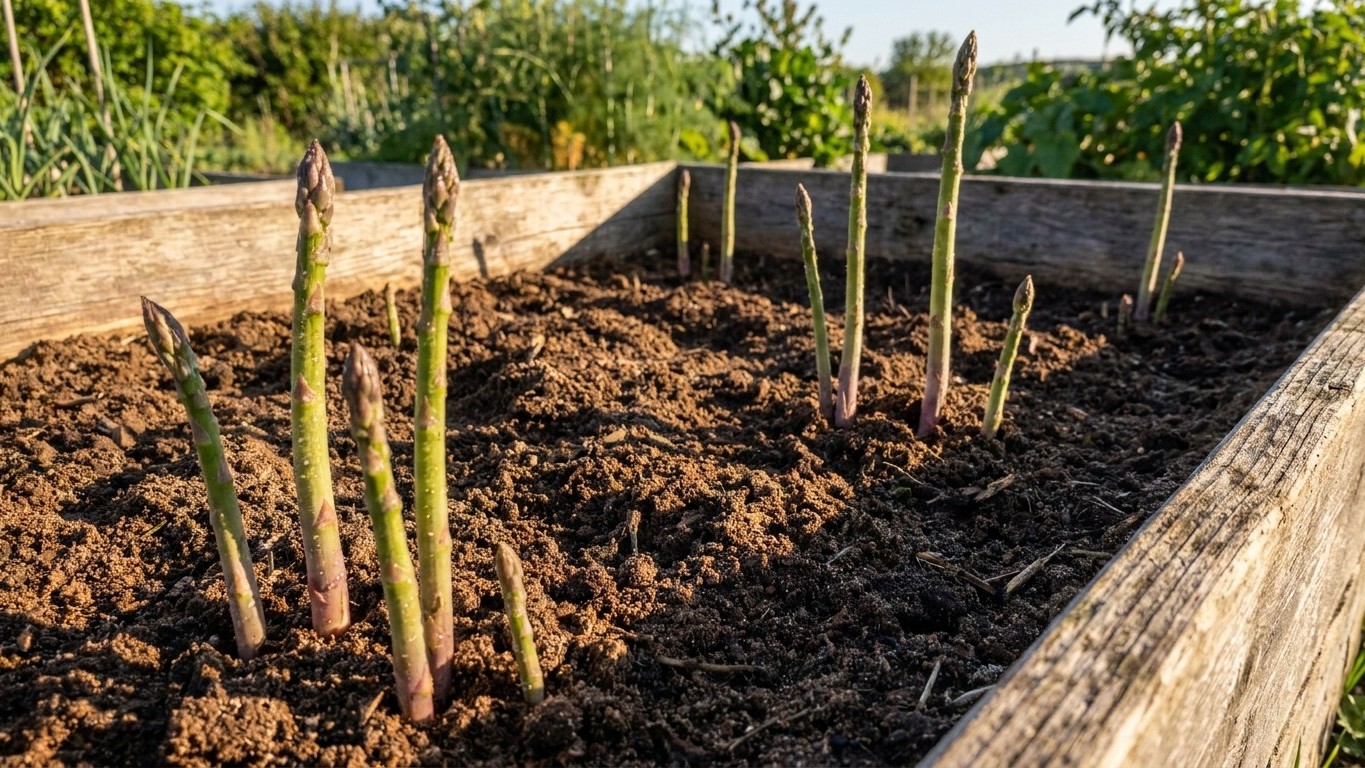

Stop cutting when most of the spears coming up are thinner than a pencil. That is the rule, and it works as an object, not a date. Before it applies at all, nothing gets cut until year 3. Then the season runs 4 weeks, then 6, then 8. Cut spears keep best at 0 to 2°C (32 to 35.6°F) with the butts standing in water. The rest of this page covers the ground, the water and the planting that make those years possible. For the full picture, start with Growing Asparagus in Ontario.
The short answer
A bed of asparagus lasts 10 to 15 years. You pick the spot once, and the one soil requirement Utah State University Extension gives is that the ground drains. Most soils will do if they drain well. So the first question for an Ontario gardener is whether the ground sheds water, because a heavy, soggy corner is an annual chore for tomatoes and a permanent mistake for asparagus.
What the province’s ground tends to do
The most common soil in Ontario’s mapped farmland is a Luvisol. It is a forest soil in which clay has washed down out of the surface layer, leaving the top lighter and the subsoil underneath denser. Luvisols cover 39 percent of the mapped surface, with Gleysolic soils next. The typical surface horizon, taken as the median of 846 mapped soil components, is loam to silt: 43 percent sand, 17 percent clay and 41 percent silt. Organic matter sits near 4.3 percent, the median surface pH is about 6.5 (slightly acid), and the dominant profile is classed as well drained.
So the typical answer is yes, the province’s ground tends to drain well enough. But that figure is a median, not a diagnosis. The survey covers agricultural regions only, so the far north is missing. River bottoms, wet lowland pockets and any yard a builder has scraped or filled can behave nothing like it. The 6.5 is the province’s number, not yours. A soil test gives you your own, and this page does not claim asparagus wants any particular pH.
The Luvisol’s dense subsoil is the detail to watch. The furrow for crowns is 8 inches (20 cm) deep, and a bed that sits above a tight, clay-rich layer can hold water in the root zone even when the surface feels crumbly. The longer treatment is in Will Ontario Soil Hold an Asparagus Bed for Fifteen Years?.
If your spot does not drain
Dig a hole about the depth of the furrow, fill it with water, let it empty, then fill it again. If the second fill is still standing after a day, believe the hole. Your choices are to build the bed up above the wet ground or to move it to a different part of the yard. Amending a poorly draining spot a little each season is not a plan here, because the crowns stay put for the life of the bed.
Will the summer here water it for you?
What summer delivers
At the Toronto Pearson station, June through August brings about 226 mm (8.9 inches) of rain, out of 785 mm (30.9 inches) for the whole year. June is the driest of the three at 71 mm (2.81 inches). July and August run slightly wetter, at 2.98 and 3.07 inches. These normals come from an earlier 30-year period than the US figures elsewhere on this site, so don’t set the two side by side. They describe what a typical summer there can usually deliver, not a forecast, and a slope, a city or a rain shadow changes them.
The bed wants 25 to 50 mm (1 to 2 inches) every other week for two years, then every three weeks after that. Spread evenly, 226 mm works out to roughly 35 mm per fortnight, comfortably inside that range. On paper, the summer waters the bed. In practice, rain does not arrive evenly.
What you add
- Put a rain gauge on the plot. A gauge on your own ground settles what the station figure cannot.
- For the first two years, give 25 to 50 mm every other week, counting rain. If a fortnight brings less than 25 mm into the gauge, you make up the difference with the hose. If it brings more, skip the watering.
- Discount thunderstorms. A single downpour mostly runs off instead of soaking in. A 40 mm storm in one evening is not the same as 40 mm over two weeks, so look at how the rain fell as well as the total.
- Add extra in heat. Days at or above 32°C (90°F) pull water out of the soil faster, and a dry, hot stretch can leave a fortnight short even in a wet summer.
- Move to every three weeks from year 3. The same gauge-and-subtract method applies, just with a longer gap between waterings.
The soil changes the arithmetic. A loam to silt surface holds moisture better than sand, which lets a rain pass through within the day. If your plot is sandier than the province’s median, the every-other-week schedule may be too slow. Sand can need watering far more often, even in a wet summer.
When to put the crowns in
Crowns and frost
Crowns go in early in spring, in 8-inch (20 cm) furrows. At the Toronto Pearson station, the last spring frost falls on average around April 30. Treat that as the midpoint of a window, not a safe date. In one year out of two the last frost comes later, and the station is a single point in a large province, so northern and upland districts run weeks behind it. Check your own forecast before the crowns go in.
The furrow is not filled in at planting. You backfill it gradually across the year, 2 inches (5 cm) every other month, as the shoots grow up through the soil. Filling it all at once is the common error.
Then comes the wait. Asparagus is not harvested until year 3, and the first cutting season lasts 4 weeks. The next year gets 6 weeks, and after that, 8. There is no “take a few spears” shortcut in the first two years, because the bed is busy building the crown that will feed you for a decade or more. At the end of each cutting season, the thin-as-a-pencil rule says when to put the knife down.
The seed route and the variety question
Starting from seed is the alternative to buying crowns. The source behind this page gives no sowing date or timing for it, so none is offered here. Follow the seed packet and your own frost date.
Utah State University Extension names four varieties and gives only one fact about each: its sex. Jersey Giant and Jersey Knight are all-male. UC 157 F1 and Purple Passion are male and female. No flavor, yield or reason to prefer one is published, so any claim that one tastes better or produces more is not backed by this source. This page names no nursery.
Common questions
How do I know it’s time to stop cutting this season?
Look at the spears, not the calendar. When most of the new spears are thinner than a pencil, stop cutting. The first harvest is year 3, at 4 weeks, followed by 6 weeks, then 8, and the pencil rule is what ends each of those seasons.
Can I take a few spears in the first two years?
No. The bed is not harvested until year 3. Once it is established, it produces for 10 to 15 years.
How should I store the spears I cut?
Aim for 0 to 2°C (32 to 35.6°F) with air as close to saturated as you can get, which UC Davis puts at 95 to 100 percent humidity. Both edges of the window bite. Above 10°C (50°F), spears toughen rapidly. At -0.6°C (30.9°F) or lower, they freeze and go soft. In a home kitchen, stand the butts in water, or wrap them damp, since the cut end loses moisture faster than anything else. The UC Davis asparagus fact sheet has the full figures.
What eats the spears, and does it change when I stop cutting?
Pests are a separate question from the cutting schedule. What Eats Asparagus in Ontario, and When covers what turns up in the bed and when.
One nuance about storage: a household refrigerator is not set to the narrow window above, and a cold shelf near the back can sit close to freezing. Check where your spears are sitting.