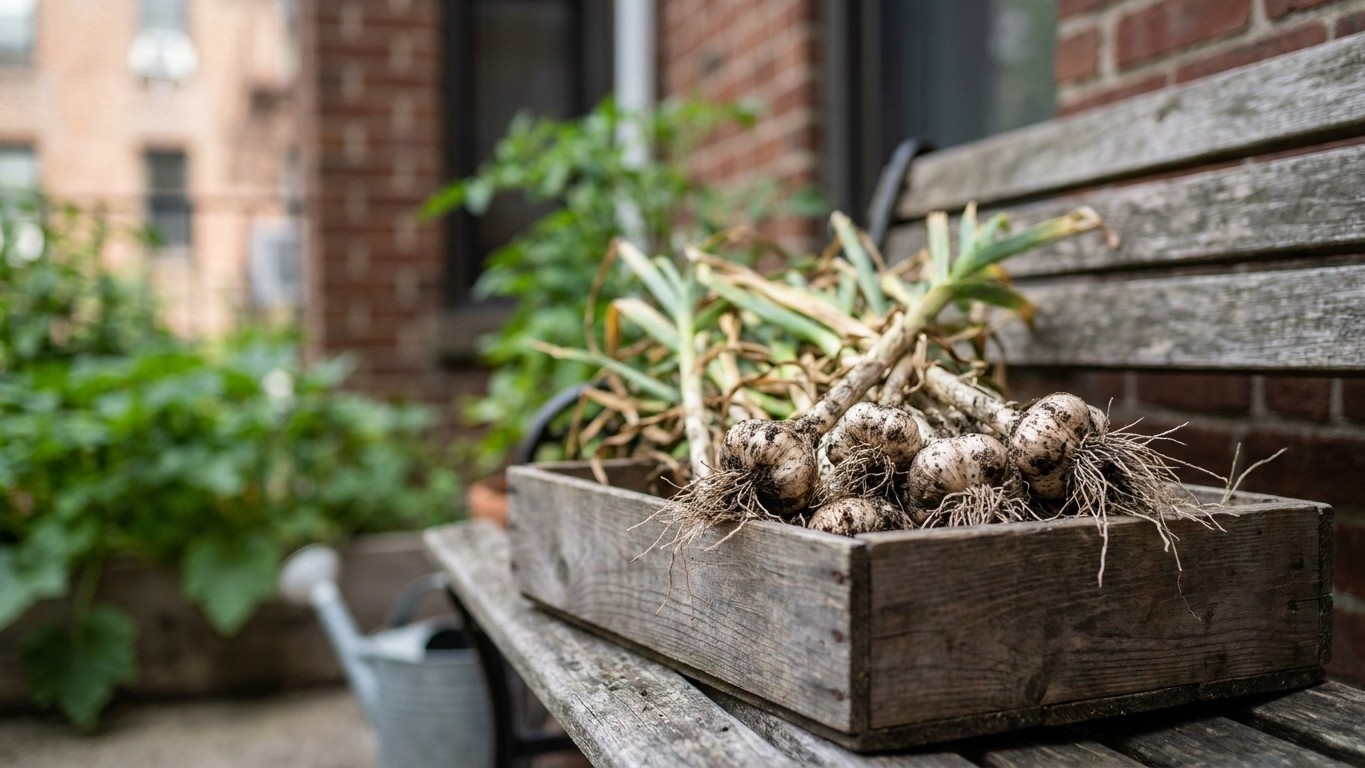

Most Ontario garlic growers pull hardneck bulbs in mid to late July, softnecks a week or two later, once the bottom third to half of the leaves have browned. From there, three to four weeks of curing in a dry, shaded, airy spot turns thin-skinned bulbs into ones that keep. Get the timing wrong on either end and you lose storage life fast.
When garlic is ready to lift in Ontario
Garlic grown in this province goes into the ground the previous autumn and comes out the following summer, there’s no spring planting option that produces comparable bulb size. That long dormant stretch under snow is what triggers the bulb to divide into cloves come warm weather, and it’s why the harvest calendar runs on leaf condition rather than a calendar date you can circle in January.
The signal to watch is straightforward: count green leaves. When roughly five to six leaves are still green from the top down and the lower leaves have gone brown and started to dry, the bulb below has usually finished sizing. Pull too early, while eight or nine leaves are still green, and you get small bulbs with loose, underdeveloped wrappers. Wait too long, past the point where nearly all the foliage has collapsed, and the wrappers split, the cloves separate in the ground, and the bulb loses the papery layers that protect it in storage.
Confirm before you commit
Because leaf color can mislead in a wet or unusually dry season, dig one or two test bulbs before pulling the whole bed. A clove that’s plump with skins still intact and unbroken means you’re in the window. If the skins have already started to flake off in the ground, that bulb is past its point and the rest of the bed likely is too.
Southern Ontario, with its longer, warmer growing season, tends to reach this stage earlier than areas farther north or at higher elevation, where cooler soil in spring delays growth by a couple of weeks. Hardneck varieties, which are better suited to Ontario’s cold winters, typically mature a bit ahead of softnecks planted in the same bed. Lift on a dry day if you can manage it. Wet soil clings to the bulbs, makes them harder to handle without bruising, and adds moisture you’ll only have to dry off during curing anyway.
Loosen the soil with a garden fork set well outside the bulb rather than pulling straight up on the stalk, which tends to snap the neck and leave the bulb behind. Shake off loose soil by hand, but don’t scrub, wash, or brush the bulbs vigorously at this stage. That work happens later, after curing, when the outer skins have hardened and can take some handling.
Curing it, and where to hang it here
Curing is the step growers skip or rush, and it’s the one that determines whether garlic lasts until spring or turns soft by Christmas. The idea is simple: dry the bulb, neck, and outer wrappers slowly enough that moisture leaves without the cloves shrinking or the skins cracking. That takes three to four weeks in most cases, longer for thick-necked hardneck varieties.
Bunch a handful of stalks together with twine and hang them, or lay bulbs in a single layer on a screen or slatted rack so air moves underneath as well as above. What the space needs is shade, warmth, low humidity, and airflow, in that order of importance. Direct sun will scald the bulbs and can cook the cloves right through the wrapper. A garage with the door cracked, a covered porch, a barn bay, or a screened-in shed all work, provided rain and dew can’t reach the bulbs.
Ontario’s summer humidity works against you here
Southern Ontario summers run humid, and that slows curing compared to a drier climate. A fan set to circulate air through the curing space, without blowing directly on the bulbs, helps move that moisture along. Skip curing in a sealed plastic tote or a closed room with no air exchange. Trapped humidity is one of the fastest ways to get mold on the wrappers before the bulb has even finished drying.
Leave the leaves and roots attached during curing. Trimming them early opens a cut end that lets moisture escape unevenly and invites rot to start at the neck. Once the outer wrapper has gone papery and the neck has tightened down hard, roots and stalks can be trimmed, leaving about an inch of neck.
Keep an eye on the calendar as you plan curing space. Environment and Climate Change Canada’s Canadian Climate Normals for 1981-2010, recorded at the Toronto Lester B. Pearson International Airport station, put the average first fall frost at October 16. That’s a midpoint, not a safe date. In roughly half of all years, frost arrives later than that; in the other half, it comes earlier, sometimes well earlier in areas north of the Pearson station or at higher elevation, where cold settles in weeks ahead of the provincial average. If your curing setup is outdoors or in an unheated structure, plan to have bulbs cured and moved indoors before the weather turns, rather than counting on that October date holding.
Storing it through a Ontario winter
Once cured, garlic wants a cool, dark, moderately humid spot with steady air movement. The target range most growers aim for is somewhere between 32 and 50 degrees Fahrenheit, with humidity in the 45 to 65 percent range. That’s cooler and drier than a typical kitchen but not as cold or as damp as a root cellar built for carrots and potatoes.
An unheated basement corner, an insulated but unheated porch, or a cold room near an exterior wall can all work through an Ontario winter, provided the temperature doesn’t swing above 60 degrees for extended stretches or drop into freezing territory where cloves can suffer chill damage. Mesh bags, cardboard boxes with ventilation holes, or loosely woven baskets all let air move around the bulbs, which matters more than the container material itself.
Skip the refrigerator
A kitchen refrigerator sits in the 34 to 40 degree range, close to the cold end of ideal storage temperature, but the humidity inside a fridge runs high enough to trigger sprouting in stored garlic within a matter of weeks. Save the fridge for bulbs you’re using within the next few days, not for the winter’s supply.
Hardneck varieties, generally the better performers in Ontario’s climate, tend to store for four to six months under good conditions before quality drops off. Softnecks, when you grow them here, often hold longer, sometimes eight months or more, which is part of why some growers plant both types side by side rather than relying on one.
Check stored bulbs every few weeks. Pull anything showing soft spots, mold, or an early sprout before it spreads to bulbs sitting next to it. One bulb that starts to break down in a bag of thirty can take several neighbors with it if it’s left in place.
What goes wrong here
Most storage failures trace back to one of three things: garlic that wasn’t fully cured, garlic that got wet after curing, or garlic stored somewhere too warm and too humid at once. Softneck varieties are more forgiving of minor curing shortfalls than hardnecks, whose thicker necks hold moisture longer and need the full three to four weeks to dry down properly.
On the pest side, extension resources in Ontario’s neighboring growing regions, specifically Cornell University CALS Insect Diagnostic Laboratory, the MSU Extension Bulletin E3276 on diseases and insects in Michigan cucurbits, and Ohio State University Extension (Ohioline), document a range of insects that affect allium and vegetable crops in this general climate zone. Of the pests these sources track, the ones most relevant to garlic and onion-family crops include:
- Onion maggot
- Seedcorn maggot (Delia platura)
- Aphids
- Cutworms
Onion maggot and seedcorn maggot both attack at the root and basal plate level, sometimes before harvest, and damage from either can show up later as soft, rotting tissue in bulbs that looked fine when pulled. A bulb with maggot damage rarely improves in storage, it degrades faster than an undamaged one sitting next to it. Aphids and cutworms tend to be foliage or seedling-stage problems earlier in the season rather than storage issues, but heavy pressure during bulb development can weaken plants enough to reduce bulb size at harvest.
For broader growing and pest management guidance specific to Ontario conditions, Ontario’s Ministry of Agriculture, Food and Rural Affairs maintains resources at ontario.ca/page/agriculture-and-food.
Common questions
Can I speed up curing if I need the space sooner?
Not without risking quality. Cutting curing time short leaves moisture in the neck and outer wrappers, which shows up later as soft bulbs or early mold in storage. Three to four weeks is the range most growers find necessary, and thick-necked hardnecks often need the longer end of that.
Do I need to remove the leaves before curing?
No, and doing so early can hurt storage life. Leave leaves and roots attached through curing so moisture leaves the bulb gradually rather than through a fresh cut. Trim once the neck has tightened and the outer wrapper feels papery.
Is it fine to store garlic in the same spot as onions or potatoes?
Potatoes give off moisture and ethylene gas that can shorten garlic’s storage life and encourage sprouting, so keep them in separate spaces if possible. Onions and garlic have similar storage needs and generally coexist fine.
What if frost arrives before my garlic is fully cured?
Move bulbs indoors to finish curing rather than leaving them exposed once temperatures drop toward freezing. Given that the October 16 average first frost date for this region is a midpoint rather than a guarantee, and can arrive earlier in northern or upland parts of Ontario, it’s worth having an indoor curing option ready before you actually need it.