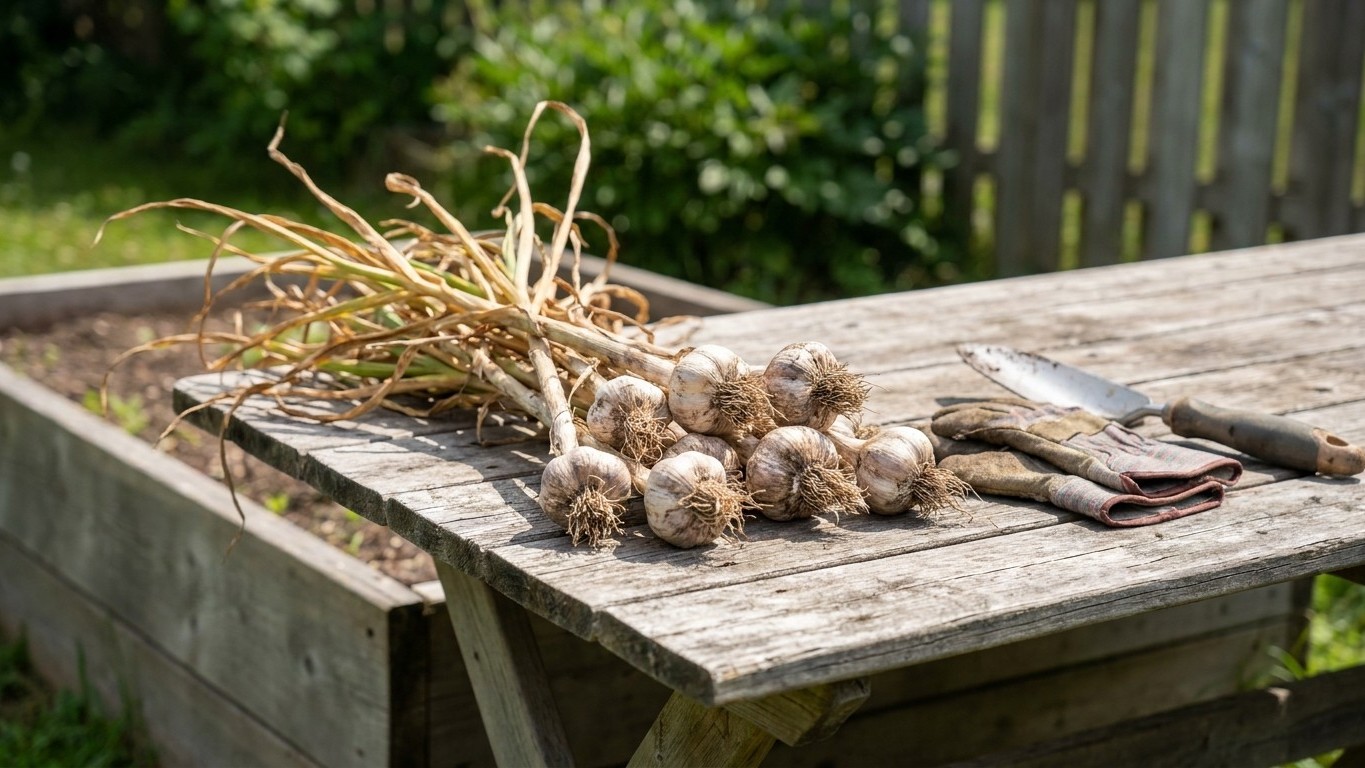

Cold enough for garlic to split into proper cloves? In almost every part of Ontario, yes — the winter that follows an October frost holds well below the freezing mark for weeks on end, more than enough to trigger the vernalization a hardneck bulb needs. Get your hardneck cloves into the ground two to four weeks before your local first fall frost, so roots take hold before the soil locks up for winter.
Will garlic get the cold it needs in Ontario

Garlic clove division depends on a stretch of real cold after planting, not on the date it goes into the ground. Skip that cold and the bulb never splits into separate cloves. You dig up something closer to a single round onion instead of a head of garlic. University of Georgia Extension publication C854 sets the bar at six to eight weeks of soil temperatures below 40°F for the vernalization that triggers clove formation in hardneck types.
Most of Ontario clears that bar without any special effort. Environment and Climate Change Canada’s 1981-2010 climate normals for Toronto Lester B. Pearson International Airport put the average first fall frost at October 16, and the months that follow typically hold well below 40°F for a stretch measured in months rather than weeks. Once a clove is in the ground ahead of that frost date, the province’s own winter does the vernalizing, and growers here are rarely the ones reaching for a refrigerator to make up a shortfall.
The exception sits in the milder pockets close to Lake Erie and Lake Ontario, where the lake’s stored heat pushes the first frost later and softens the coldest weeks of winter compared with land further inland or further north. Growers working with a much gentler winter, the kind described in the guide to growing garlic in Oregon, lean on refrigeration or a softneck fallback far more often than an Ontario grower ever needs to. A grower in one of Ontario’s own lakeside microclimates who is unsure whether the season delivers a full six to eight weeks below 40°F still has two working options rather than one. The first is to refrigerate seed cloves at 40°F for four to six weeks before planting, substituting a fridge for a cold snap that might arrive short. The second is to lean toward a softneck variety, which tolerates a lighter vernalization than a hardneck and still forms a usable head of cloves even in a milder pocket, and checking a guide to Garlic Varieties That Suit Ontario Winters helps narrow down which softneck holds up best in a lakeside pocket.
Neither option is a reason to skip garlic in a warm corner of the province. Checking the cold decides which type and method to use, not whether to plant at all. Away from the moderating lakes, the standard advice holds everywhere else in Ontario: plant a hardneck in autumn, let winter do its job, and expect full clove division by the following summer.
When to put the cloves in
Plant garlic by counting backward from the first fall frost, not from a date on the calendar, using When to Plant Garlic in Ontario as a guide. Environment and Climate Change Canada’s 1981-2010 climate normals put the average first fall frost at Toronto Pearson at October 16, and growers across the province generally aim to have cloves in the ground roughly two to four weeks ahead of their own local frost. That gives roots time to establish while the soil is still workable, but keeps top growth from getting far enough along to be knocked back hard once a freeze arrives. Counting back from October 16 lands that window at late September for most of southern Ontario, which lines up with the planting timing given for every variety later in this guide.
Treat October 16 as a midpoint, not a safe date. A climate normal is drawn from thirty years of records, which means that in roughly half of those years the first frost fell later than October 16 and in half it fell earlier. Planning around frost holding off until mid-October is a coin flip. Planting a couple of weeks ahead of that average date buys margin against the years frost comes early.
How local terrain shifts the date
The Toronto Pearson station describes one point in a large province, and local terrain shifts the real date by weeks in either direction. Higher ground and inland valleys away from the Great Lakes lose their first frost earlier than the Pearson average, sometimes by two weeks or more, since they lack the lake’s stored summer heat to moderate autumn nights. The Niagara Peninsula, Essex County and other land close to Lake Erie or Lake Ontario typically hold off frost later than the Pearson date, because the lake keeps nearby air a few degrees warmer into October. A grower on high ground north of Toronto should treat late September as the safer end of the planting range. A grower in a lakeside county has more room to plant into early October instead.
Rooting is the goal at this stage, not leaf growth. A clove planted at the right time pushes roots into soil that has not yet frozen solid, then sits through winter with little or no visible shoot above ground. Planting too early risks several inches of green growth before the freeze, which then takes damage from the season’s first hard cold. Planting too late risks the ground closing before roots take hold at all. A territory with no reliable frost anchor, such as the one covered in the guide to growing garlic in Hawaii, has to time planting off the drop in soil temperature and local grower practice instead. Ontario growers get to skip that workaround because the autumn frost gives a dependable anchor to count back from.
Which types suit Ontario
Ontario’s winter is exactly the kind of cold season hardneck garlic is built for, and it shows in what fills seed catalogues aimed at growers here. Hardneck varieties need a real winter to perform well, and most of the province delivers one reliably. Given the frost and cold pattern described above, hardneck is the type to plant unless you are gardening in one of the milder lakeside pockets close to Lake Erie or Lake Ontario.
Varieties for a late-September planting
| Variety | Type | Group / note |
|---|---|---|
| German Red | Hardneck | Rocambole; large, easy-to-peel cloves |
| German White | Hardneck | Rocambole |
| Chesnok Red | Hardneck | Purple Stripe; cooks down soft rather than firm |
| Duganski | Hardneck | Porcelain; fewer, larger cloves per bulb |
| Georgian Crystal | Hardneck | Porcelain |
| Georgian Fire | Hardneck | Porcelain; noted for a sharper, hotter flavor |
| Bavarian Purple | Hardneck | Porcelain |
| Blue Music | Hardneck | Porcelain-type hybrid |
| Fall Festival | Hardneck | Marbled Purple Stripe |
| Ivan | Hardneck | Purple Stripe |
| Early Red Italian | Softneck | Artichoke type |
| Italian Late | Softneck | Artichoke type |
| Inchelium Red | Softneck | Artichoke type |
| Lorz Italian | Softneck | Artichoke type |
Among the hardnecks, German Red and German White are both Rocambole types known for cloves that peel easily. Chesnok Red is a Purple Stripe type valued in the kitchen for cooking soft rather than staying firm, and Duganski is a Porcelain type that tends toward fewer, larger cloves per bulb. Georgian Crystal and Georgian Fire add two more Porcelain options, the second sharper and hotter in flavor than most, and Bavarian Purple and Blue Music round out the Porcelain and hybrid choices worth trying in a cold-winter bed. Fall Festival and Ivan are further hardneck options for a grower who wants to compare scape and bulb character across more than one variety in the same row.
Softneck garlic is not off the table in Ontario, it is simply the second choice where winter is reliably cold. Early Red Italian, Italian Late, Inchelium Red and Lorz Italian all tolerate a milder or shorter cold spell than a hardneck needs, which makes them the more forgiving pick for a lakeside garden with a later, softer winter. Softneck varieties also store considerably longer in a pantry or cellar than most hardnecks, which is reason enough for a lot of home growers to plant a row of each rather than committing the whole bed to one type. Catalogue days-to-maturity figures matter less here than for most vegetables, since garlic goes in during autumn and is lifted the following summer. What decides success in Ontario is winter survival and clove count, not a maturity number counted in days.
Soil and bed preparation
Garlic spends eight or nine months in the same bed, through freeze-thaw cycles, spring melt and whatever rain the following months bring, so the soil has to work harder for garlic than for a crop that is in and out in a single season. Drainage matters more than fertility at planting time. A clove sitting in saturated, heavy soil through a wet Ontario winter rots before any disease even gets involved, simply from a lack of oxygen at the root.
Getting drainage right before planting
Raised beds or ridged rows solve most of the drainage problem on the heavier clay soils common across parts of southern Ontario. Working several inches of compost or well-rotted manure into the bed loosens clay and improves the soil’s ability to shed excess water, and it should go in weeks before planting rather than at the same time as the cloves, so it has time to settle and start breaking down.
Test drainage before committing a bed: dig a hole roughly a foot deep, fill it with water, and see how long it takes to disappear. Water still standing after several hours signals a spot to raise with additional soil or avoid planting into at all.
Garlic also wants a bed free of the previous season’s crop residue, particularly anything from the onion family, since garlic shares pests and diseases with onions, leeks and shallots. Rotate garlic away from any bed that grew alliums in the previous two to three years to keep soil-borne pressure down before the crop even goes in.
A soil pH close to neutral suits garlic best, and a simple soil test taken in late summer, ahead of planting, gives enough lead time to adjust with lime or sulfur if the reading comes back well off target. Fall is also the point to work in a balanced, phosphorus-and-potassium-leaning amendment rather than a high-nitrogen one. Nitrogen pushed on newly planted cloves encourages exactly the top growth a cold-climate planting date is trying to avoid before winter sets in.
What the climate here favours, and what it does not
Garlic diseases are tracked against soil temperature ranges, and Ontario’s air temperature record is the only local figure available to compare against them. The figures below describe air temperature, not the soil temperature the published thresholds were actually measured against, and soil lags air by weeks and swings less through any given month. Treat what follows as a tendency worth knowing, not a forecast of infection.
Using the published ranges from UC IPM’s Pest Management Guidelines for Onion and Garlic (UC ANR Publication 3453), white rot, caused by the fungus Sclerotium cepivorum, has a temperature range of 50-75°F. Ontario’s growing-season mean air temperature falls inside that range in four months: September, May, June and July, with one of those months sitting at the pathogen’s published optimum. That is the widest window of any disease checked here, and it means white rot is the one to watch on any bed with a history of it, since the sclerotia the fungus forms can survive in soil for years regardless of what a given season’s weather does.
Fusarium basal rot, caused by Fusarium oxysporum f. sp. cepae, has a published range of 59-90°F, and Ontario’s growing season sits inside that range in three months: September, June and July. Three months in range is not three months of guaranteed disease, since a monthly average blends cool nights with warm afternoons and the fungus needs sustained warmth to build real pressure, but it is enough to call Fusarium a realistic risk on stressed or previously infected soil during Ontario’s warmer summer stretch.
Southern blight and pink root fare differently here. Southern blight, from Sclerotium rolfsii, has a published optimum of 86-95°F that no month of Ontario’s growing season reaches on average, and pink root, from Setophoma terrestris, has a published optimum of 75-85°F that likewise sits outside every month’s mean here. Neither figure means the disease cannot occur. Falling outside a published optimum means the pathogen is less active, not absent, and infected seed garlic or contaminated soil can bring either disease into a garden regardless of what the local climate reading suggests. Buying certified seed stock and rotating beds away from prior allium plantings does more to keep all four of these organisms out than any temperature trend working in Ontario’s favour.
Getting it through the winter
Mulch is what turns a marginal planting date into a safe one through an Ontario winter. A four-to-six-inch layer of straw or shredded leaves laid over the bed after the ground has started to cool, but before a hard freeze locks it up, insulates the soil enough to smooth out the freeze-thaw cycles that do more damage to a shallow-planted clove than steady cold ever does.
Frost heaving, not low temperature, is what kills most garlic that fails over an Ontario winter. Repeated freezing and thawing pushes a clove upward out of the soil a little at a time, and a clove that ends up sitting at or above the surface loses both its insulation and its root contact in one move. Planting cloves a full two to three inches deep, pointed end up, gives them enough soil above to resist being pushed out over a winter of freeze-thaw swings, and mulch cuts down on how many of those swings the soil actually goes through.
Leave the mulch in place through the coldest months. Pulling it back too early, at the first mild stretch in late winter, exposes the bed to exactly the freeze-thaw cycling the mulch was laid down to prevent, and a late cold snap after an early uncovering can do more damage than the whole winter before it. Wait until new green shoots are visibly pushing through before thinning the mulch back to an inch or two, which still suppresses weeds without smothering the emerging shoot.
Snow cover, where it is reliable and sits through the season, does some of this insulating work on its own, but Ontario winters vary enough from year to year in snow depth and timing that mulch is the more dependable choice to lay down regardless of how the season’s snowfall turns out.
Harvest and curing here
Read the leaves, not the calendar, to time the harvest. Lift garlic when roughly the bottom half of the leaves have browned and the top few are still green, since pulling too early leaves the bulb undersized and immature, while waiting until every leaf has died back lets the wrapper split and cloves separate in the ground, both of which shorten how long the harvest keeps in storage.
Curing through an Ontario summer
Curing is where a season’s growing effort is won or lost after the hard part is already done. Bulbs need two to four weeks in a warm, shaded, well-ventilated spot, out of direct sun and rain, before the wrappers dry down enough for long storage. A dry summer stretch makes this straightforward: hang bundles or lay bulbs in a single layer somewhere airy, like an open shed, a covered porch or a garage with the door cracked, and let the wrappers paper over on their own.
A humid summer, which southern Ontario gets its share of, calls for more airflow rather than more time. A fan running on low in the curing space keeps moist air moving past the bulbs and heads off the mold and soft rot that stagnant humid air encourages during the drying weeks. Crowding bulbs together or curing in a closed space with no air movement is the most common way a fully sound harvest turns soft and unsellable within a month of coming out of the ground, regardless of how well the crop grew.
Once the wrappers are dry and papery and the roots have shriveled, trim roots close to the base and cut hardneck stalks down to an inch or two above the bulb. Softneck varieties can be braided instead if the wrappers are intact enough to hold together. Store cured bulbs somewhere cool, dark and dry rather than in a refrigerator, which is too humid for long-term storage and can trigger early sprouting.
Local help
County-level frost dates, soil test results and planting windows all vary from the Toronto Pearson figures used throughout this guide, and the fastest way to a number specific to your own soil is Ontario’s agriculture and food resources, which can point you toward a soil testing lab and county-specific guidance beyond what a single provincial average can tell you.
Common questions
Can I Plant Garlic in spring instead of fall in Ontario?
You can, but spring-planted garlic in a cold-winter climate usually produces small, undivided bulbs because it misses the extended cold period that triggers clove formation. Fall planting timed to the local frost window is the reliable route here.
What if my ground is already frozen and I haven’t planted yet?
Once the soil is frozen solid, cloves cannot root before winter and are better held over. Store the seed garlic somewhere cold and dry and plant it at the correct window the following autumn rather than forcing it into ground that won’t accept it.
Can I plant garlic bought from a grocery store?
You can try it, but grocery garlic is often treated to slow sprouting and is rarely sold with a known variety or disease history, which makes it a poor bet compared with certified seed garlic from a supplier who names the cultivar. A bed planted with unknown stock also risks introducing white rot or Fusarium into soil that was previously clean.
Why did my garlic come up as one round bulb instead of separate cloves?
That is a classic sign of insufficient cold before or during the growing season, sometimes from a mild winter, sometimes from planting too late for roots and cold exposure to line up properly. It can also happen with softneck varieties planted where a hardneck was expected to perform, since softnecks form fewer, less distinct cloves under marginal conditions.
Do I need to remove the winter mulch as soon as it warms up in spring?
No, and doing it too early is a common mistake. Wait until you see new green shoots pushing through before thinning the mulch layer back, since an early thaw is often followed by another hard freeze that the mulch would otherwise have buffered.