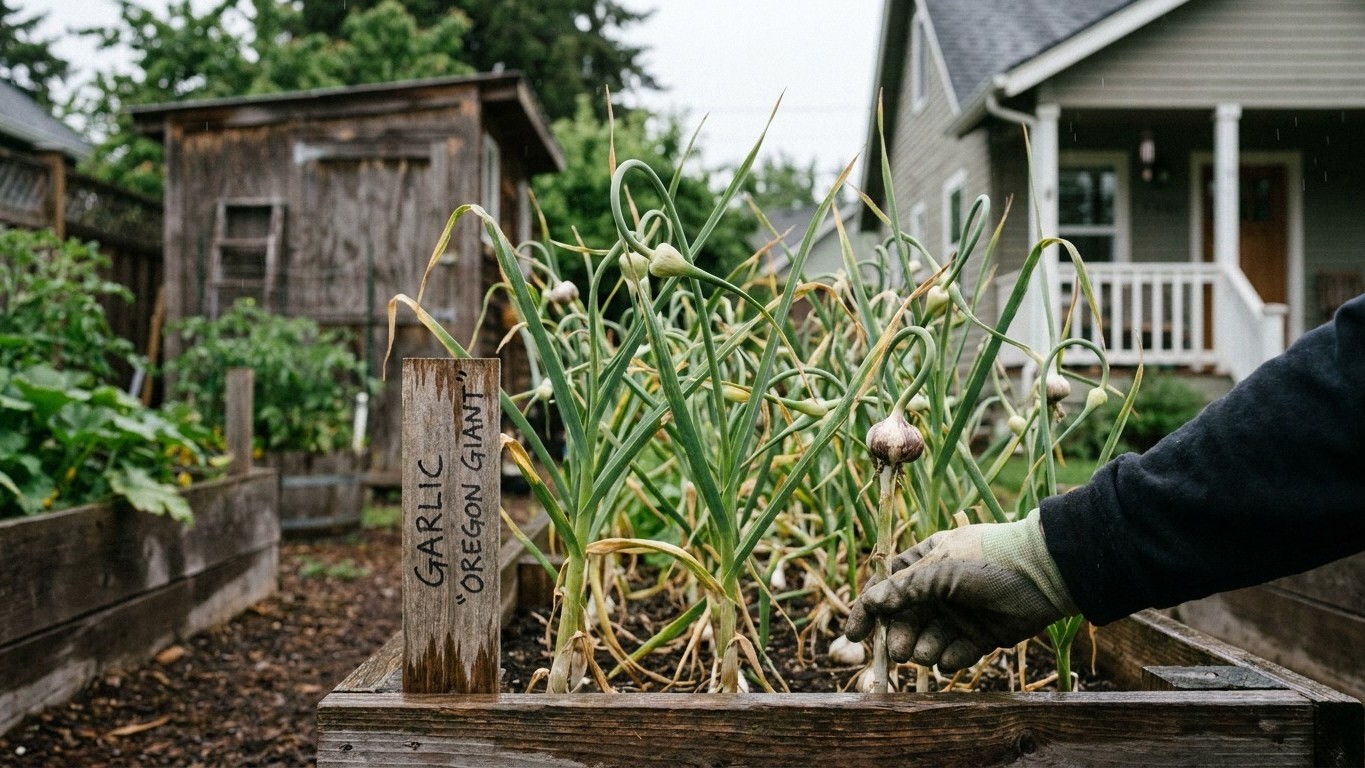

Late October in Portland sits two to four weeks ahead of the season’s first hard freeze, and that gap is what decides everything else here. Cloves need that stretch of workable soil to root before cold shuts them down, then six to eight weeks under 40°F to split properly — a threshold Oregon’s winters clear twice over. Chill was never the question. The real fork in the road is softneck or hardneck, and that comes down to how long you want the bulb to last on the shelf.
The short answer for Oregon

Garlic goes into Oregon soil in late October to early November, a window timed against NOAA’s 1991-2020 climate normals for Portland, which place the first fall freeze between November 11 and November 27. That planting window sits roughly two to four weeks ahead of the freeze range, giving cloves time to send down roots while the soil is still workable, before rain and cold slow root growth to a crawl. Planted this fall, the crop is not lifted until the following summer, so the variety chosen now is the one drying on the rack next July.
Softneck or hardneck first
Garlic needs six to eight weeks of soil temperatures under 40°F after planting to split into individual cloves, a threshold set by the University of Georgia Extension in publication C854. Oregon’s winters, measured near Portland, run 17.4 weeks below 40°F across the growing season, more than double what garlic requires, so vernalization is rarely the limiting factor for either type west of the Cascades.
With chill accounted for, the real choice is storage life and clove count. Softnecks such as Inchelium Red and Lorz Italian store the longest in the pantry and tolerate the state’s milder, wetter valleys without complaint. Hardnecks such as Chesnok Red and Blue Music produce fewer, larger cloves that peel more easily, but they don’t keep as many months in storage as the softnecks do. All of them go in during the same late October to early November window. The difference between them is what happens after harvest, not whether they survive the winter.
Working it out for your own garden
The frost-to-planting math
Start from your own first fall freeze, not Portland’s. NOAA’s 1991-2020 normals place that freeze at Portland between November 11 and November 27, a sixteen-day spread that reflects how much year-to-year weather varies even at one station. A frost date is a midpoint, never a guaranteed safe date: in roughly half of all years, the first freeze arrives later than that stated range, so treat the window as a planning guide rather than a deadline to plant around.
Catalogue planting advice for varieties from Bavarian Purple to German White gives late October to early November as the target regardless of type. Work backward from your own local freeze range the same way: subtract roughly two to four weeks to land on a planting week that lets roots establish in soil still loose enough to work, before saturation sets in. For the full backward count from your own frost date, see When to Plant Garlic in Oregon: Counting Back From the First Frost.
What shifts the date
Elevation is the biggest mover. Cooler air pools at higher ground, so a garden a few hundred feet above the valley floor commonly sees its first freeze arrive earlier than a lower reporting station would suggest. Coastal gardens run the opposite way: the Pacific keeps fall air temperatures more even, so a coastal first freeze often lags an inland one by roughly two weeks. A large lake or reservoir nearby has a similar moderating effect, holding warmth into the evening and delaying the first hard freeze on ground closest to the water.
None of this changes the arithmetic, only the date fed into it. If your garden sits at elevation or hugs the coast, shift the whole planting window by that same couple of weeks, then watch the soil rather than the calendar. Garlic planted into ground you can still work with a spade roots faster than garlic forced into wet, compacted soil on a fixed date.
What changes across Oregon
West of the Cascades vs the high desert
Portland’s frost data describes the northern Willamette Valley and nearby lowlands, not the whole state. NOAA’s freeze probabilities for that station reflect a mild, marine-influenced climate west of the Cascades, and central and eastern Oregon run on a different clock entirely. That high desert loses the ocean’s moderating effect, so both the first fall freeze and the frost-free season length fall well outside the Portland range, and the window for planting and for the crop to finish moves earlier and shorter than anything calculated from a west-side station.
Within the valley itself, the Coast Range and the Cascade foothills add elevation on both sides, and a garden climbing into that higher ground tends to see its first freeze arrive ahead of one sitting on the valley floor. The immediate coast, moderated by the ocean, holds mild air longest into fall, which is one reason softneck types such as Italian Late and Early Red Italian, neither of which needs a hard, prolonged cold snap, do well in coastal gardens.
Inland valleys and higher ground, with more reliably cold nights, suit hardnecks such as German Red, German White and Georgian Crystal, which respond to a full, uninterrupted chill period with larger, easier-to-peel cloves. None of this is a hard boundary. Check your own site against the nearest reporting station rather than assuming a valley or coastal average applies to your particular garden.
The mistakes this climate punishes
Oregon’s costliest mistakes are about water and depth, not about missing the chill. With 17.4 weeks below 40°F on the books near Portland, vernalization takes care of itself almost everywhere in the state. The failures that actually cost a crop here come from the wet: planting too shallow in ground that stays saturated all winter, or planting late enough that roots have not anchored before the rains set in for good.
- Planting too shallow in soil that freezes and thaws repeatedly rather than freezing solid, which heaves cloves out over winter
- Delaying past the local window because the calendar frost date has not arrived yet, leaving too little root time before wet, cold soil stalls growth
- Replanting garlic or other alliums into the same bed year after year, which builds up soil-borne disease regardless of variety
Planting too shallow is the single most common mistake in the wet, freeze-thaw winters typical west of the Cascades. Ground here rarely freezes solid for weeks at a stretch the way it does in a continental climate. Instead it freezes and thaws in cycles, and that repeated movement heaves shallow cloves right out of loose or waterlogged soil. Planting an inch deeper than the packet suggests, and mulching with straw, keeps cloves anchored through a winter of freeze-thaw rather than a winter of hard, unbroken frost.
Disease pressure to watch
Wet soil does more than heave cloves loose. It also sets up conditions for soil-borne disease, and that risk does not disappear because a variety was well chosen for the climate. UC IPM’s guidelines for onion and garlic, UC ANR Publication 3453, track four pathogens against soil temperature. Set against the mean air temperatures typical of Oregon’s growing season, the pattern looks like this.
| Disease | Pathogen | Months in published range | What it means |
|---|---|---|---|
| White rot | Sclerotium cepivorum | 6 of 10 (Sept, Oct, Apr, May, Jun, Jul), 2 at optimum | Longest window of risk, persists in soil for years once established |
| Fusarium basal rot | Fusarium oxysporum f. sp. cepae | 3 of 10 (Sept, Jun, Jul) | Most active at planting and again near harvest |
| Southern blight | Sclerotium rolfsii | 0 at optimum (86-95°F) | Less active in this climate, not impossible |
| Pink root | Setophoma terrestris | 0 at optimum (75-85°F) | Less active in this climate, not impossible |
These are air temperature counts measured against thresholds published for soil, and soil lags air by weeks and swings less than air does, so read the table as a seasonal pattern rather than a forecast for a given week. One reporting station cannot describe every garden in the state either. None of the four pathogens above is ruled out by Oregon’s climate: infected seed garlic carries white rot and fusarium into a garden regardless of how well the variety suits the local winter, so the real defense is clean, certified planting stock and a bed that hasn’t grown alliums recently, not a variety choice on its own.
Checking this against your county
Portland’s frost data is the only NOAA station referenced here, and it describes the northern Willamette Valley, not Grants Pass, Bend or Astoria. Check your own county’s frost pattern with OSU Extension before finalizing a planting week, since county offices keep local figures a single statewide page cannot cover. Oregon State University’s Extension Service, at extension.oregonstate.edu, publishes county contacts and garlic-specific guidance for growers outside the Willamette Valley. If you haven’t settled the basics of the crop yet, the overview at Growing Garlic in Oregon covers them.
Common questions
Can I plant softneck garlic in Oregon or does it need a colder climate?
Softneck garlic grows well in Oregon, especially in milder valley and coastal gardens where it doesn’t need the deep, sustained cold some hardnecks prefer. With roughly 17 weeks of temperatures below 40°F measured near Portland, per the University of Georgia Extension’s chilling guidance, the state clears even the high end of garlic’s chill requirement, so softnecks split cloves reliably.
What happens if I miss the late October to early November planting window?
Garlic planted later into November can still work if the ground is workable, but it has less time to root before winter slows growth, and a late-planted clove risks entering the cold before it has anchored. If you’re well past early November, favor a shallower-rooting softneck over a hardneck and mulch heavily to compensate for the lost root time.
Do I need different garlic for eastern Oregon than western Oregon?
Not necessarily a different variety, but different timing. Central and eastern Oregon’s high desert climate runs a shorter, colder season than the Portland-area figures used here, so the planting window falls earlier and the growing season closes sooner. Check with a local OSU Extension office for the frost dates that apply to your specific county before using the west-side window.
Will heavy winter rain rot my garlic in the ground?
It can, especially in heavy or poorly drained soil, since Oregon’s wet winter months sit right inside the temperature range where white rot, Sclerotium cepivorum, stays active for several months of the growing season, according to UC IPM’s guidelines. Raised beds or amended, well-drained soil cut that risk more reliably than any single variety choice.