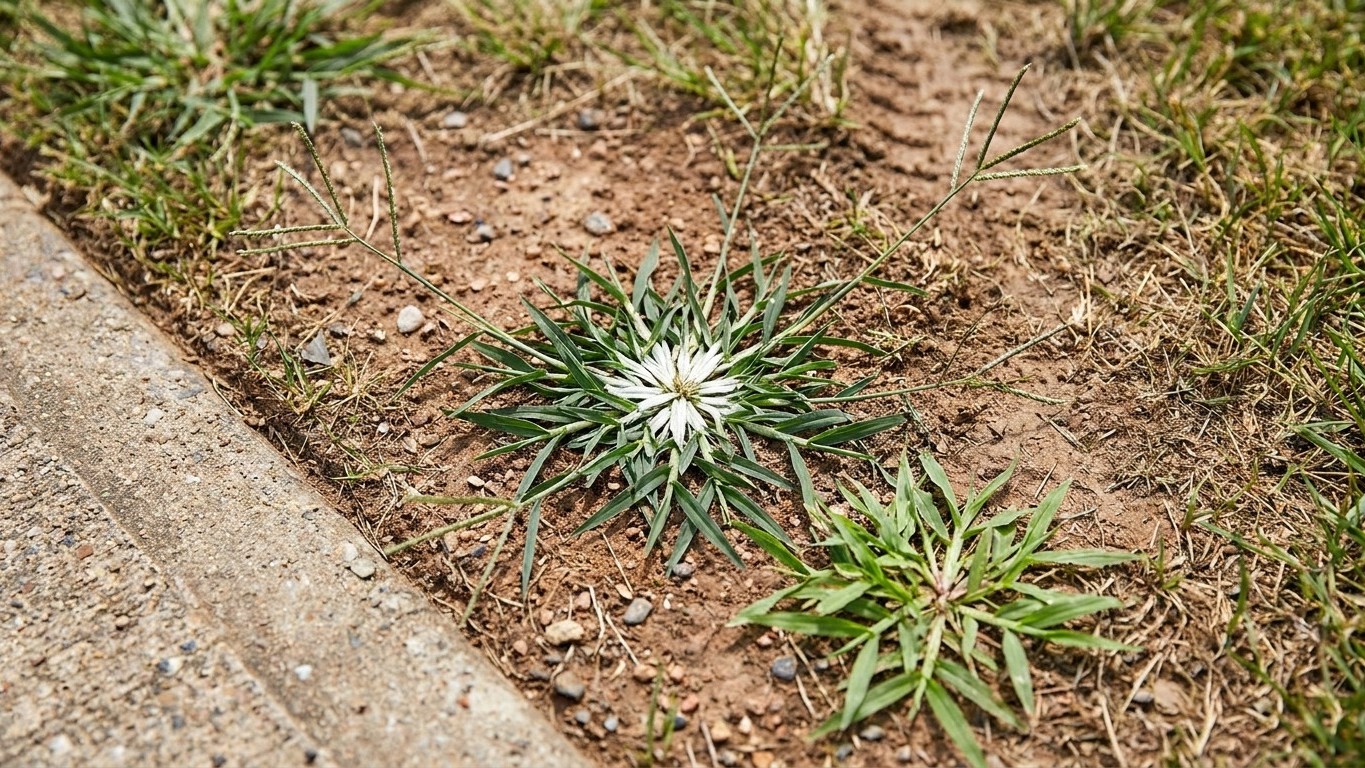

Most Ontario lawns don’t need dethatching. Cut a wedge of turf and measure the brown, spongy layer: if it’s thicker than 0.75 inch, dethatch, and do it in late summer to early fall while cool-season grass is growing hard. Spring is the backup window. Toronto-area records put the average first fall frost at October 16, so the seed that follows dethatching needs to be down well before then.
Do you need to dethatch at all?
Thatch is a layer of dead and living stems, roots and runners that builds up between the green blades and the soil. It is not mostly grass clippings, which is the old myth, and clippings break down quickly on their own. A thin layer is useful. It cushions foot traffic and insulates the crown of the plant. A thick one acts like a sponge mat, holding water at the surface and keeping roots shallow.
Measuring takes two minutes. Push a spade in, cut a wedge about 3 inches deep, and lift it out. Look at the brown, fibrous band sitting between the green growth and the dark soil, and put a ruler against it. Under 0.5 inch is healthy, and you should leave the lawn alone. Between 0.5 and 0.75 inch is a watch-and-wait zone. Above 0.75 inch is where you act. Check a few spots, because a shaded corner and a sunny slope can read very differently.
Why thatch builds up
Heavy nitrogen feeding, frequent shallow watering and compacted soil all slow the microbes that break thatch down. Grasses that spread by rhizomes and stolons, Kentucky bluegrass most of all, tend to build more of it than bunch-type grasses like tall fescue. If your measurement comes in low, the spongy feeling underfoot may be something else, like compaction or a poorly drained spot, and raking won’t fix it.
A lot of homeowners dethatch out of habit every spring, and a lot of those lawns would be better off left alone. Pulling out a layer that is already thin strips healthy crowns and opens bare soil for weeds. The wider Dethatching a Lawn guide covers the general method. What follows is the Ontario timing.
The season to do it in Ontario
Ontario lawns are cool-season lawns, and cool-season grass grows hardest in early fall and again in spring. Dethatching is a controlled injury, so you want it to recover fast. Late summer into early fall is the best window, because soil is still warm, the days are shortening but not cold, and weed seeds are mostly done germinating for the year. Any seed you spread afterwards has several weeks of growth ahead of it.
Spring comes second. Once the lawn is actively growing and the soil has dried enough to walk on without leaving prints, you can do it, but expect more weed pressure on the freshly opened ground, and you have less time to establish seedlings before summer heat arrives.
What the frost dates say, and what they don’t
The frost dates come from Environment and Climate Change Canada’s Canadian Climate Normals for the Toronto Lester B. Pearson International Airport station.
| Toronto Pearson, 1981-2010 normals | Average date |
|---|---|
| Last spring frost | April 30 |
| First fall frost | October 16 |
Read these as midpoints, not deadlines. They are means, so in one year out of two the frost arrives later than the date shown, and in the other half it arrives earlier. October 16 is the middle of a window, never a safe date. Count backward from it and leave yourself a generous margin for seed to establish.
Also keep in mind that this is one airport station near Lake Ontario, and a province is not one climate. Northern Ontario and upland districts run weeks off this pattern, with a shorter growing season and frost on the wrong side of these dates. Canadian normals cover 1981-2010, while the US figures cover 1991-2020, so the two aren’t a clean side-by-side. Your local conditions beat any average. For a colder-climate comparison, see When to Dethatch a Lawn in Maine, and for a place where the logic flips entirely, When to Dethatch a Lawn in Hawaii.
Rake, power rake, or core aeration
The tool should match the thatch thickness and the lawn size. Overshooting is the common error. A machine with blades set too aggressively can shred a lawn that only needed a rake.
Hand dethatching rake
A thatching rake has curved, sharp tines that pull through the mat. It is hard work, but it suits small lawns and thatch just over 0.75 inch. You’ll pull up a surprising amount of brown material, so have a tarp or wheelbarrow ready. Rake in two directions and stop when the lawn looks combed rather than scalped.
Power rake or vertical mower
For larger lawns with thick thatch, a power rake (also called a vertical mower) does the same job with spinning blades. Rental yards stock them, and the weight of the machine is the main thing to plan for. Run it only when the lawn is actively growing and the ground is moist but not soggy, since wet soil tears up in clumps. Make one pass in one direction, then judge the result before crossing over. Expect the lawn to look rough for a couple of weeks.
Core aeration
Core aeration pulls small plugs of soil out of the lawn. It does not strip thatch the way a rake does, but the plugs break down on the surface and mix soil into the thatch layer, which feeds the microbes that decompose it. It also relieves compaction. If your thatch measures in the 0.5 to 0.75 inch zone, or the lawn gets heavy foot traffic, aeration is usually the better move. Many people do it in the same early-fall window, and it pairs well with overseeding because the holes give seed a protected place to land.
If thatch is clearly over 0.75 inch, rake or power rake first. If the lawn is compacted as well, aerate after.
What the lawn needs afterwards
Dethatching leaves thin turf and exposed soil, so overseeding is the logical next step. Choose from the cool-season species that hold up in Ontario: fine fescues, Kentucky bluegrass, perennial ryegrass, rough bluegrass and tall fescue. Warm-season grasses are the wrong choice here. They grow well in long, hot summers but go dormant in cold weather, and they can’t be counted on to come through an Ontario winter.
Seed rates below are for a new lawn, in pounds per 1,000 square feet. For overseeding an existing lawn, use half. More seed isn’t insurance, because crowded seedlings compete and thin each other out.
| Grass | New lawn seed rate (lb per 1,000 sq ft) |
|---|---|
| Tall Fescue | 6 to 8 lb |
| Fine Fescues | 4 to 6 lb |
| Rough Bluegrass | 2 to 3 lb |
| Kentucky Bluegrass | 1 to 3 lb |
| Perennial Ryegrass | 4 to 10 lb |
Rake out the loosened debris before seeding so seed reaches the soil. Keep the surface evenly moist with light, frequent watering until seedlings come up, then shift to deeper, less frequent soaking. Hold off on heavy nitrogen, since piling it on is one of the ways thatch built up in the first place. Mow only once the new grass has real height, and keep the mower blade sharp.
For local recommendations, the Government of Ontario agriculture and food pages are a starting point, and a local garden centre can tell you which seed blends suit your soil and light.
Common questions
Can I dethatch in the middle of summer?
It’s a poor time. Heat and dry spells stress cool-season grass, and a lawn recovering from raking has little in reserve. Wait for late summer or early fall, when growth picks up again.
Is October 16 a safe cutoff for seeding?
No. It’s the average first fall frost at the Toronto Pearson station, so in half of years frost comes later and in the other half it comes earlier. Treat it as the middle of a window, and seed well ahead of it.
Do I need to dethatch every year?
No. Measure first. If the layer stays under 0.5 inch, leave it alone, and even a lawn that needed dethatching once may not need it again for years if you fix the cause.
Does the Toronto frost date apply across Ontario?
Not reliably. It comes from one station, and northern and upland districts run weeks off that pattern. The Canadian normals also cover 1981-2010, a different period from the 1991-2020 US figures, so check your own local conditions before you commit to a date.