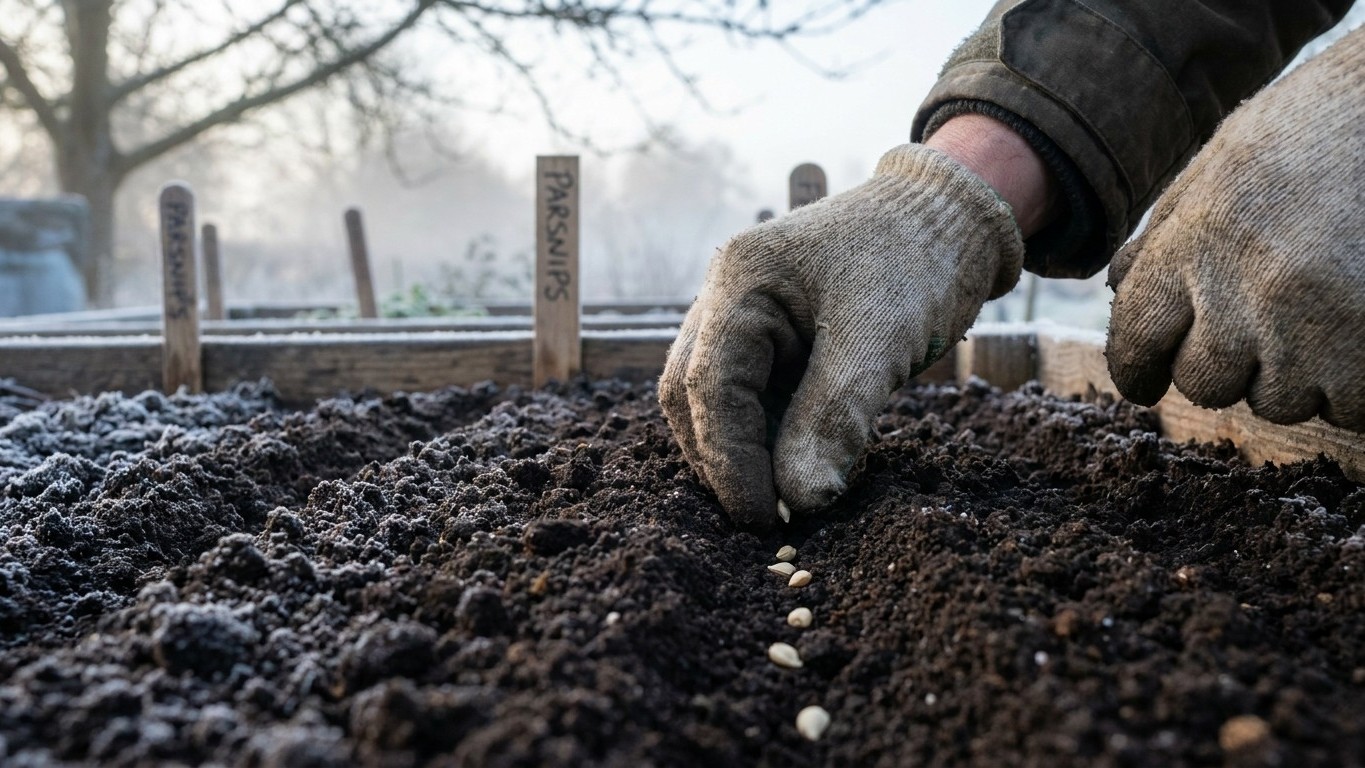

Sow parsnips in Ontario in early-to-mid April, about two to three weeks before the average last frost of April 30. That timing gives the crop its full 100 to 120 days to size up before the average first fall frost on October 16, and it leaves enough cold weather afterward for the roots to sweeten properly.
The short answer
Before picking a sowing date, ask the question that actually decides whether this crop is worth growing here: does the region deliver several weeks of hard frost, or does it stay mild enough that the roots never convert their starch to sugar? For the reference station at Toronto, the mean daily minimum of the coldest month sits at 13.6°F. That’s not a record low and not a seasonal average, it’s the typical overnight floor during the coldest stretch of winter, and it tells you this region gets real, sustained cold, not a token frost or two.
That figure matters more than any hardiness zone map. A hardiness zone tells you what survives the winter. It says nothing about whether a parsnip left in the ground develops flavor. Parsnip sweetening is a chemical reaction triggered by cold exposure: as the soil temperature drops and the plant senses frost, it breaks down stored starch into sugars as a kind of natural antifreeze. A region can sit in a perfectly comfortable zone and still fail to produce a sweet parsnip if it never gets enough consecutive frosty weeks. Toronto’s winter doesn’t have that problem. A mean minimum of 13.6°F in the coldest month means the ground and the roots sitting in it get repeated, sustained exposure to freezing conditions, not a one-off cold snap that passes in a night.
So the answer for Ontario, at least measured against the Toronto reference station, is straightforward: this climate does not just grow a parsnip, it sweetens one. Gardeners who leave their roots in the ground through the first few weeks of proper cold weather, rather than pulling them the moment they reach size, should see the classic parsnip transformation, that shift from a starchy, faintly bitter root to something noticeably sweeter and nuttier.
The caution worth repeating is that this is a regional average from one long-term climate record, not a guarantee for every yard in the province. Ontario stretches from the shoreline moderation near the Great Lakes to colder inland and northern districts, and a garden tucked against a warm south wall in a milder pocket will behave differently than open ground a few miles away. The 13.6°F figure is a strong signal that the province, broadly, has the cold this crop wants. It isn’t a promise for any one specific plot.
Does the season fit?
Parsnips are sown directly in place, never transplanted, and the clock starts the day the seed goes into the soil, not when a seedling appears. Working out whether the season fits means lining up three numbers: the average last frost, the germination lag, and the long maturity window this crop demands.
- Start from the average last frost. Environment and Climate Change Canada puts it at April 30 for the Toronto reference station. That’s a mean date, not a safe cutoff, meaning in roughly half of all years frost arrives later than that. Treat it as the midpoint of a window, not a guarantee.
- Sow two to three weeks ahead of that date. That places the sowing window around April 9 to April 16, once the soil has thawed and can be worked without turning to mud.
- Add germination time. Parsnip seed is notoriously slow, typically taking 14 to 21 days to emerge. Sown in mid-April, seedlings won’t reliably show above ground until late April or early May. Anyone who digs up the row before that, assuming the seed failed, ends up re-sowing a bed that was already working fine.
- Add the 100 to 120 day maturity window from the seeding date. Counting forward from a mid-April sowing, that puts the earliest harvest-ready roots around mid-to-late July, with the full 120-day mark landing in mid-August.
- Compare that to the average first fall frost of October 16. Even at the slower end of the maturity range, the roots are sized up roughly nine to thirteen weeks before that average frost date arrives.
That gap is the part worth paying attention to. It isn’t wasted time, it’s exactly the cushion this crop needs to sweeten, because the roots can sit in the ground through the first frosty weeks of autumn rather than being pulled the moment they hit size. In Ontario, measured against this reference station, the season doesn’t just fit. It fits with room to spare on both ends.
What goes wrong here
- Forked or twisted roots in heavy or stony ground. Parsnips push a single taproot straight down, and anything that deflects it, a stone, a clod of clay, compacted subsoil, splits the root into two or three legs. Utah State University Extension recommends deep, sandy soil for this reason, and says heavy ground needs to be double dug before sowing so the root has a clear, loose path down.
- Forked roots from overwatering, a separate cause entirely. Even in loose, well-prepared soil, inconsistent or excessive watering can cause the same forking. The remedy is even, moderate moisture rather than heavy soaking followed by dry spells, since the root reacts to shifting conditions by branching instead of running straight.
- Sowing too late and running the clock down to the wire. Given how wide Ontario’s window is between an April sowing and the mid-October frost, this is avoidable, but a sowing pushed into late May or June, whether from a slow spring or a forgotten seed packet, eats into that cushion fast. The fix is simple: sow within the two-to-three-week pre-frost window rather than waiting for warmer soil.
- Digging roots too early and losing the sweetening. With a coldest-month mean minimum of 13.6°F, Ontario’s winter has more than enough sustained cold to trigger the starch-to-sugar conversion. The mistake isn’t the climate, it’s the gardener pulling roots the moment they reach size instead of leaving them through the first real frosty weeks. Mulch the row once the top growth dies back and lift roots gradually through autumn and into the start of winter for the best flavor.
Common questions
Can parsnips be sown any earlier than two to three weeks before the last frost in Ontario?
The 100 to 120 day window is built around that two-to-three-week head start. Sowing much earlier risks seed sitting in cold, wet soil that can rot before the slow 14-to-21-day germination completes, so the standard window is the safer bet rather than an arbitrary rule.
Does a mild winter ever prevent parsnips from sweetening in Ontario?
Based on the Toronto reference station’s coldest-month mean minimum of 13.6°F, a winter too mild to trigger sweetening isn’t the typical risk here. Milder microclimates near the Great Lakes shoreline could see less consistent cold than that regional figure, so it’s worth watching local conditions rather than assuming every yard behaves identically.
Should parsnip seed be started indoors and transplanted?
No. Parsnips are sown directly in the ground where they’ll grow. Their taproot doesn’t tolerate the disturbance of transplanting well, and any damage to that single root during a move tends to produce the same forking problem caused by heavy soil or stones.
How long can parsnip roots stay in the ground after the first fall frost?
That figure isn’t published in the sources behind this page, so no specific end date can be given here. What is established is that the roots benefit from several weeks of frost exposure after the average October 16 first frost before they’re dug, since that’s the period when the starch-to-sugar conversion happens.