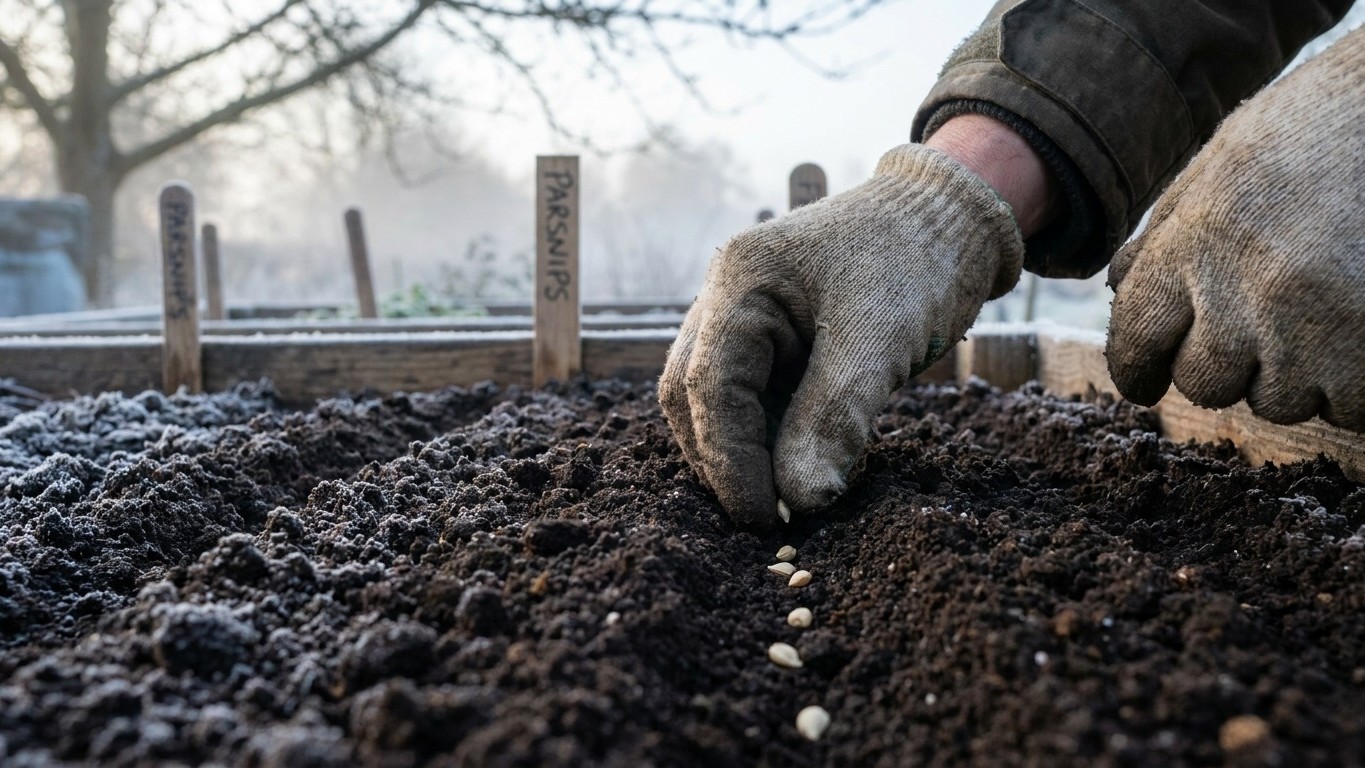

Sow Parsnips in South Carolina by counting backward from the season’s mild, uneven cold rather than from a fixed calendar date. Because the coldest month here averages a nightly minimum of 38.9°F, the classic spring-sown, frost-sweetened parsnip is a gamble on the coast and a much safer bet inland. Timing has to work around that gap, not ignore it.
The short answer
Start with the number that actually decides this crop: 38.9°F. That’s the mean daily minimum for the coldest month at the Charleston reference station, drawn from NOAA NCEI’s 1991-2020 Climate Normals. It sits above freezing. That single fact tells you the Lowcountry doesn’t reliably deliver the long run of frosty nights parsnips need to convert their stored starch into sugar. Some nights will dip below 32°F, since the region does record a first fall freeze and a last spring freeze most years, but the average night in the coldest month doesn’t get there. That’s a climate of occasional frost, not sustained frost.
This matters more than the state’s hardiness zone ever will. A hardiness zone tells you what a perennial can survive over winter. It says nothing about whether a biennial root vegetable sitting in the ground gets enough cold exposure to sweeten before you dig it. Parsnips are grown as an annual crop for the root, and the flavor payoff depends entirely on repeated exposure to frost, not on the zone number printed on a seed packet. Confusing the two leads a lot of Carolina gardeners to expect a candy-sweet parsnip that a mild coastal winter simply can’t deliver.
So the honest short answer splits by geography. Along the coast and through the Midlands, where winter minimums hover close to 39°F, parsnips will grow into a perfectly usable root, but the sweetening will be inconsistent, better in a cold snap year, flatter in a mild one. In the Upstate, where NOAA data shows the frost window running several weeks tighter at both ends, meaning colder minimums arrive earlier and linger later, the odds of getting several genuinely frosty weeks go up considerably. If you garden in the Upstate, treat this crop the way growers farther north do: sow for a fall maturity and let winter do the sweetening. If you garden near the coast, sow for a fall maturity too, but manage your expectations about how sweet the harvest gets, and consider harvesting right after the coldest stretch you get rather than waiting for a sustained cold snap that may not come.
Either way, the sowing decision itself doesn’t change with geography nearly as much as the sweetening outcome does. What changes the actual sow date is the arithmetic in the next section.
Does the season fit?
- Start with germination, not seeding. Parsnip seed is notoriously slow, taking 14 to 21 days just to break the soil surface, according to Utah State University Extension. That lag has to be added on top of the 100 to 120 days to maturity, or the true timeline runs three weeks short.
- Anchor to the standard spring formula. The conventional guidance is to direct-sow 2 to 3 weeks before the last spring frost. For the Charleston reference station, NOAA NCEI’s 1991-2020 normals put the last spring frost between February 28 and March 17, which places a spring sowing somewhere in mid-February.
- Run the maturity date forward. Add 100 to 120 days of growth, plus the 14- to 21-day germination lag already baked into that window, to a mid-February sowing, and the roots reach maturity sometime in June, well into South Carolina’s summer heat.
- Compare that to the frost calendar. The first fall frost at the same reference station falls between November 20 and December 5. A June harvest date sits nowhere near that window, which means a spring-sown crop matures five months before any frost exposure even becomes possible.
- Conclude on fit, not just on length. The raw season length here is generous. Charleston’s frost-free window runs roughly 260 to 280 days, far more than the 100 to 120 a parsnip needs. But a spring sowing wastes that length on the wrong end of the calendar, growing the root during the hottest months and skipping the cold months that give it flavor.
- Count backward from fall frost instead. Subtract 100 to 120 days, plus the germination lag, from the November 20 to December 5 window, and the sowing date lands in late July to early August for most of the state, earlier in the Upstate where the fall frost arrives sooner.
- Verdict. The season fits comfortably by total length, but only a late-summer sowing aimed at a fall or early-winter harvest actually uses that length correctly. A strict spring sowing fits the calendar but misses the point of growing parsnips at all.
What goes wrong here
- Forked roots from heavy or stony ground. South Carolina soils range from Lowcountry sand to Piedmont clay, and clay-heavy or rocky Upstate ground splits a taproot the way a rock splits a river. Utah State University Extension recommends deep sandy soil and, where that’s not available, double digging the bed well before sowing so the root has a clear, loosened path straight down.
- Forked roots from overwatering. This is a separate cause from soil texture, not a variation on it. Inconsistent or excessive watering pushes the root to branch as it hunts for a stable moisture level, even in soil that’s loose enough to grow straight. Water on a steady, moderate schedule instead of soaking heavily after a dry spell.
- A season that runs out before maturity. Sowing too late in summer, or losing the first three weeks to slow germination without accounting for it, pushes maturity past the first frost window and into a hard freeze the crop wasn’t ready for. Count the 14- to 21-day germination lag into the sowing date, not just the 100 to 120 days of growth.
- A winter too mild to sweeten. With the coldest month’s average minimum sitting at 38.9°F along the coast, some years simply won’t deliver the sustained frosty stretch that converts starch to sugar. Leave the roots in the ground through whatever cold does arrive rather than harvesting on a fixed date, and treat an unusually sweet crop as a good winter rather than the norm.
Common questions
Can parsnips be transplanted instead of sown directly?
No. Parsnips are grown in place from seed because the long taproot doesn’t recover from transplant shock. Any attempt to start them indoors and move them outside tends to produce the same forking problems as heavy soil.
How long can parsnips stay in the ground after they mature?
Utah State University Extension notes the flavor improves with continued cold exposure, so leaving mature roots in place through additional frosty weeks is the point of the fall sowing strategy, rather than a risk to manage.
Does the mild coastal winter mean parsnips shouldn’t be grown there at all?
No. They’ll grow into a fully usable root along the coast; the mean minimum of 38.9°F for the coldest month simply means the sweetening effect will be less consistent than in the Upstate, not that the crop fails.
Why does Upstate South Carolina get a different sowing window than the coast?
NOAA NCEI’s data shows the Upstate’s frost dates run several weeks tighter at both ends than the Charleston reference station, meaning frost arrives earlier in fall and lingers later in spring, which shifts both the safe sowing date and the harvest window several weeks in each direction.