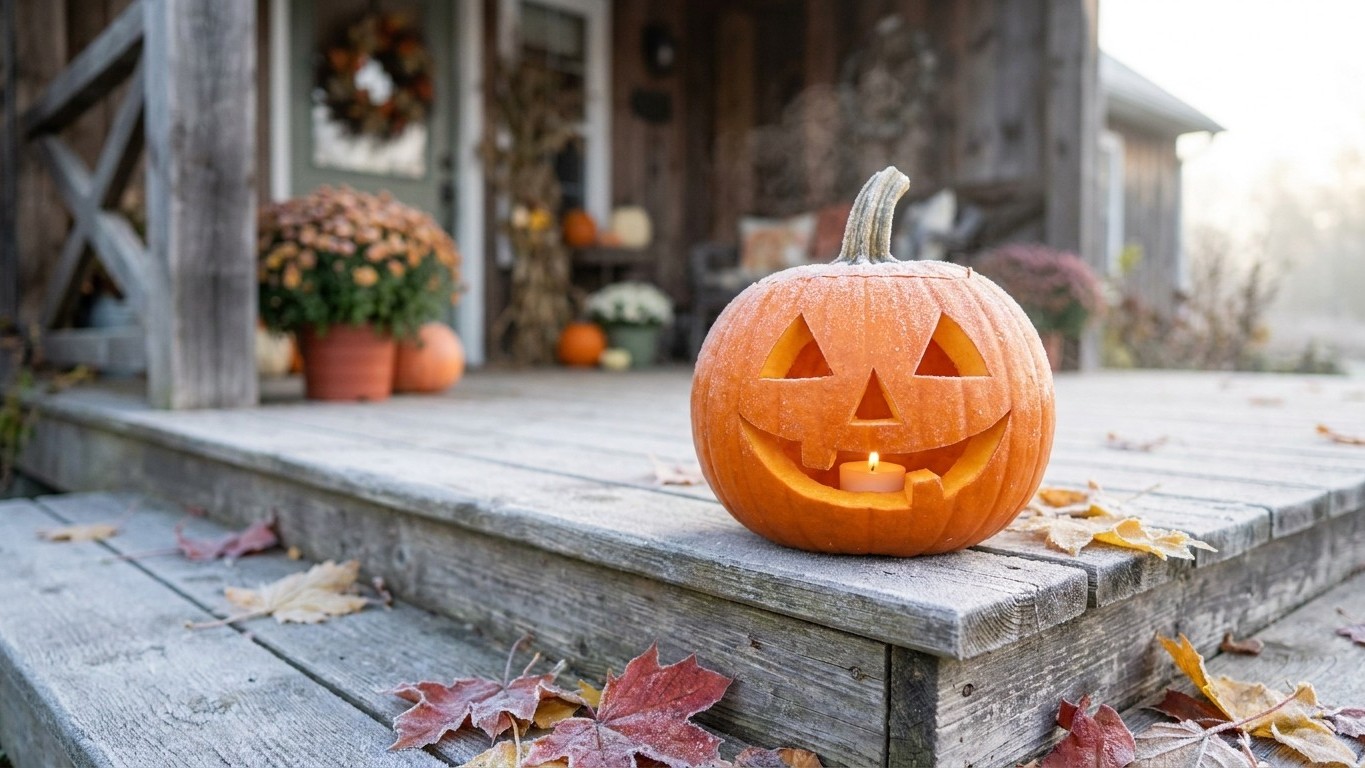

In the Toronto area, the average first fall frost lands around October 16, roughly two weeks before Halloween. That gap matters more than most people think. A pumpkin bought too early and left outside can meet freezing air well before October 31 even arrives, so the real question in Ontario isn’t just when to carve, it’s how to keep the pumpkin intact until you do.
The short answer

Around October 16 is the mean date of the first fall frost at Toronto Lester B. Pearson, based on Environment and Climate Change Canada’s 1981-2010 climate normals. That’s an average, not a schedule: in roughly half the years on record, frost showed up later than that, and in the other half it came earlier. Treat it as the midpoint of a window, not a date you can circle on the calendar and trust completely.
What this means for a porch pumpkin is straightforward once you sit with the numbers. Halloween falls a full two weeks after the average frost date. That’s a long stretch of cold-risk time for a pumpkin sitting exposed on a step or a railing, especially once nights start dropping toward freezing in the back half of October. The pumpkin itself doesn’t need protection from frost the way a tender plant does, but a hard freeze followed by a thaw can turn firm flesh soft and eventually collapse the rind from the inside. That’s the actual threat here, not the frost label itself.
So the practical window is this: buy your pumpkin whenever you like, but hold off on carving and hold off on constant outdoor exposure until you’re within a few days of Halloween. Keep it whole and stored cool until then, and bring it out for its final display close to October 31, ideally carving no more than a handful of days ahead. The whole-pumpkin storage research is clear that an uncut pumpkin can hold for three to six months in the right conditions, but nobody, not University of Illinois Extension, not Utah State University Extension, publishes a shelf life for a carved one. Once you cut into it, the countdown is real but undocumented, so the safest strategy is to carve close to the day you plan to display it and skip a long stretch of exposed time outdoors.
None of this changes if you’re in Ottawa, London, or Sudbury instead of the Toronto area. The Pearson station reading is a reference point, not a promise for every backyard in the province. Northern and upland parts of Ontario see frost weeks earlier than this figure, which only shortens the safe display window further.
Frost or heat: which one gets it here
The cold end
A whole pumpkin keeps best in a cool, dark spot between 45 and 50 degrees Fahrenheit, according to University of Illinois Extension. Ontario’s late-October nights push well past that lower boundary on a regular basis. The coldest month at the Toronto reference station averages a daily minimum of 13.6 degrees Fahrenheit, and while that figure describes deep winter rather than October itself, it tells you plainly what kind of climate this is: a firmly cold-winter one, where the seasonal turn toward freezing starts early and doesn’t reverse. By the back half of October, overnight temperatures in most of the province are already flirting with or beating that 45-degree floor, sometimes by a wide margin. That’s the risk here, and it’s a freezing risk, not a warmth one.
The warm end
In parts of the continent with milder autumns, the concern runs the other direction: temperatures that stay above 50 degrees for weeks accelerate softening and mold before the pumpkin ever gets carved. That scenario doesn’t really apply in Ontario. Between the mid-October frost average and a coldest month sitting at 13.6 degrees, this province simply doesn’t hold onto warm air long enough for heat to be the main threat to a stored pumpkin. Cold is the variable to manage here, and it starts earlier than Halloween itself.
Where to keep it until you carve
- An unheated garage or a detached shed works well in most of Ontario through mid-to-late October, staying close to that 45-50 degree band without dipping into a hard freeze on all but the coldest nights.
- A basement or cellar, especially an older one without forced-air heating running constantly, tends to sit in a similar cool-but-not-freezing range and adds the darkness that slows softening.
- An enclosed, unheated porch can work early in the season, but check it against the forecast as October progresses. Once overnight lows start regularly threatening freezing, move the pumpkin somewhere with a bit more buffer.
- Keep it away from the kitchen counter, a sunny windowsill, or anywhere near a heat vent. Indoor warmth above 50 degrees speeds up the very softening you’re trying to delay.
- Keep it away from apples, potatoes, and tomatoes, or any other ripening produce. These give off a gas that ages a pumpkin faster, which makes a shared porch crate or a mixed produce bin one of the worst storage choices you can make.
- Check the stem before you commit to a storage spot. Look for one to two inches of stem still attached. Once it breaks off, that section of the pumpkin is exposed and spoils sooner, so handle it by the base or the sides, never by lifting it with the stem.
Checking this against your own county
The Toronto Pearson reading is one weather station, and Ontario is not one climate. If you’re gardening or planning around frost timing rather than just pumpkin storage, it’s worth checking local conditions through the Ontario Ministry of Agriculture, Food and Rural Affairs. Their agriculture and food resources cover regional growing conditions across the province, which run weeks apart between the south and the north.
Reach them here: ontario.ca/page/agriculture-and-food. If you’re farther north or in a higher-elevation pocket of the province, plan on frost arriving earlier than the Toronto-area average, and shift your carving window a bit closer to that adjusted date.
Common questions
Does frost ruin a carved pumpkin faster than an uncarved one?
Neither University of Illinois Extension nor Utah State University Extension publishes a shelf life for a carved pumpkin, so there’s no verified answer on the exact rate. What’s documented is that a whole, uncut pumpkin can hold three to six months in the right cool, dark conditions, which is why keeping it intact until close to Halloween is the safer strategy.
Can I carve my pumpkin in early October and just refrigerate it?
There’s no published protocol for extending a carved pumpkin’s life, refrigeration included. The documented approach is choosing a pumpkin with a firm stem and no soft spots, storing it whole between 45 and 50 degrees, and carving close to when you plan to display it.
Is a hardiness zone map useful for figuring out frost timing?
Not directly. A hardiness zone describes winter cold severity for plant survival, not the calendar date of first frost. The mean first fall frost figure from Environment and Climate Change Canada is the relevant number here, not a zone rating.
What’s the single most important thing to check when buying the pumpkin itself?
The stem. University of Illinois Extension recommends one to two inches of stem left on, since that section acts as a seal. Shape doesn’t matter and blemishes are a bad sign, but a broken or missing stem is the detail most likely to lead to early spoiling.