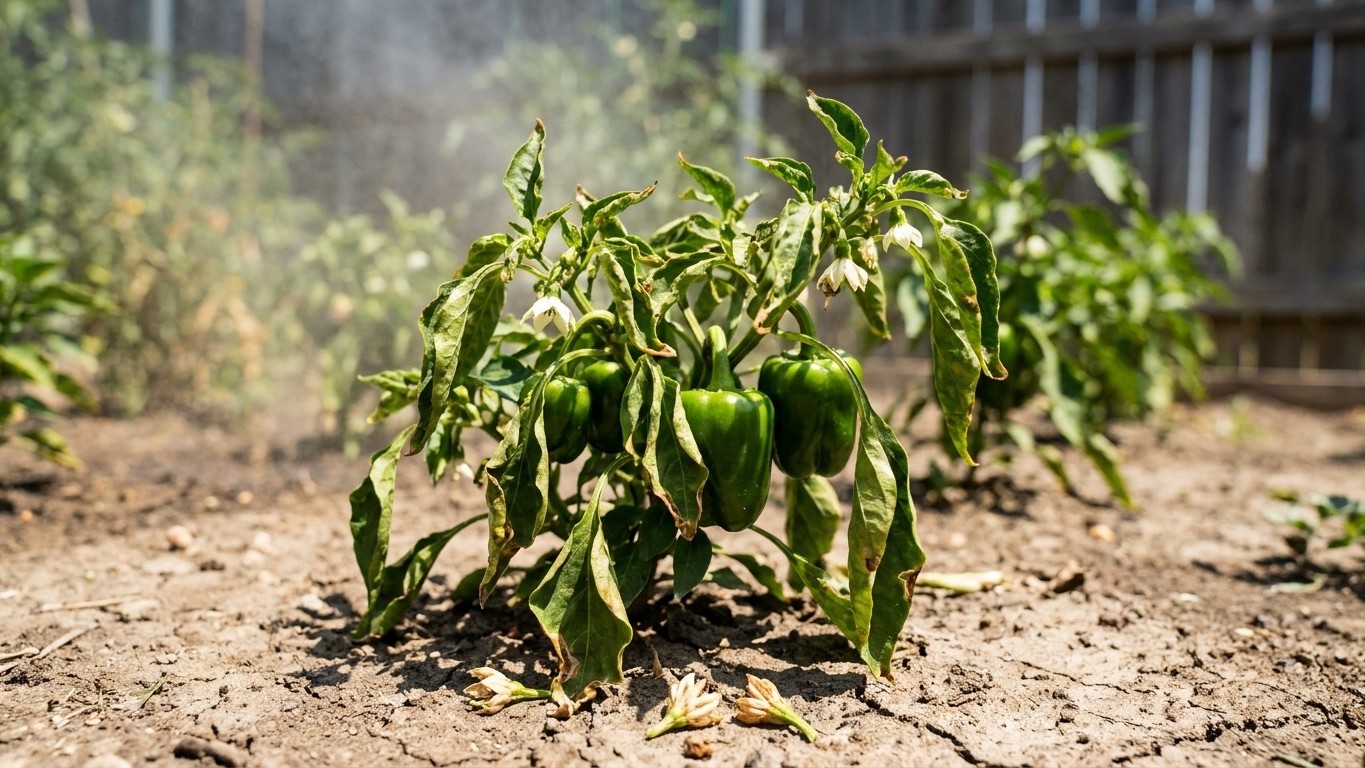

Weather does most of the damage to peppers in Ontario, and it comes from two directions: nights below 55 °F (about 13 °C) and days above 32 °C. Either one can make flowers drop before they turn into fruit. At Toronto Pearson, the reference station for this page, the hot end is rare. The cool end is the one this site cannot measure for you. Insects are not covered here; this page sticks to the weather and growing-calendar problems that eat into a pepper crop.
The short answer
The hot end is rare
Toronto Lester B. Pearson International Airport averages 6.08 days a year reaching 32 °C, the metric equivalent of 90 °F. That count comes from Environment and Climate Change Canada’s published climate normals. Utah State University Extension, the authority behind the fruit-set rule used on this site, says pepper fruit set fails when days climb above that mark. So roughly six days a year in the Pearson record are hot enough to put open flowers at risk.
Six days sounds like nothing, and for fruit set it mostly is. A pepper plant does not need every day of summer to cooperate. It needs enough flowering days in a workable range that some blossoms hold on and become fruit. One hot week in July can cost you a round of flowers, and the plant will usually flower again once the heat breaks.
Environment and Climate Change Canada also publishes a gentler count that Ontario gardeners tend to recognize more readily: 15.8 days a year above 30 °C at the same station. That figure describes summer warmth in general. It is not the pepper threshold, but it shows the season has real heat in it.
Please do not read the 6.08 as a verdict on whether peppers belong in an Ontario garden. It counts extreme days. It says nothing about the length of the frost-free period or the summer averages, and those decide whether a heat-loving plant ripens fruit. Gardeners across the province grow peppers successfully, and the Growing Peppers in Ontario page covers the wider picture.
One more caution on the number itself. An airport station sits outside the city and reads warmer or cooler than the neighborhoods around it. Your backyard in a dense part of town, or on a lakeshore, or on an upland farm, will not match Pearson day for day.
The cool end is yours to watch
The same Utah State University guidance names the other failure point: nights below 55 °F. Fruit set fails at both ends, and gardeners who only worry about heat tend to be caught off guard by a chilly week in early summer, right when the first flowers open.
This site does not carry summer night minimums for Ontario, so there is no number here to hand you. Guessing from latitude would be a mistake, and so would reading a cold-night risk off how harsh the winter is. Summer nights depend on your lot, your distance from the water, your elevation, and whether a clear, calm sky lets the heat drain away after sunset.
The practical fix costs a few dollars. Put a min-max thermometer near plant height, check it each morning once the first buds show, and note how often the low dips under 55 °F (about 13 °C). Two or three such mornings in a row, while flowers are opening, is your signal that fruit set may stall. The Why Peppers Fail to Set Fruit in Ontario page goes deeper on reading that pattern.
When to start seed here
Start from the transplant date and count backward. Utah State University Extension says transplants need 8 to 10 weeks indoors, and that they should go out when the soil reaches 60 °F (about 16 °C), after frost. Four steps get you to a sowing date for any county in the province.
- Find your last spring frost. At Toronto Pearson it falls on average on April 30, according to Environment and Climate Change Canada. That is a mean, not a safe date: in one year out of two, frost arrives later. Treat it as the middle of a window. Northern and upland districts run weeks behind Pearson, so look up the station closest to you. Note too that Canadian normals cover an older span of years than the US figures used elsewhere on this site, so the two are not a perfect match.
- Wait for the soil. Use a soil thermometer and look for 60 °F (about 16 °C). Soil can reach that mark later than the last frost, so your transplant day is whichever of the two arrives later. A warm afternoon in late April tells you very little about what the root zone is doing.
- Subtract 8 to 10 weeks. That is 56 to 70 days. If you plan to transplant on June 1 (an example date, not a recommendation), ten weeks back lands on March 23 and eight weeks back lands on April 6. So the sowing window runs from March 23 to April 6. As a floor, if you transplanted on the April 30 average frost date, the same math points to about February 19 through March 5. You would almost certainly be rushing the soil by then, so do not plan around it.
- Check the other end. Clemson Cooperative Extension says peppers should be ready for harvest about 70 to 85 days after transplanting. Add that to your transplant date: June 1 plus 70 days is August 10, and plus 85 days is August 25. If that window runs into the first fall frost for your county, look at faster options in Pepper Varieties That Ripen in a Ontario Season.
Notice what drives the whole calculation: a transplant date you can only confirm in spring. Sowing earlier does not buy you earlier peppers. Seedlings that outgrow their pots before the soil warms go out stressed, and a root-bound transplant is a poor start. Redo the subtraction each year, with your own frost date and your own soil reading.
What goes wrong here
A few failures show up again and again in Ontario pepper beds. Each has a cause you can see and a fix you can apply before the season is lost.
- Blossom drop in a hot spell. Days above 32 °C can make flowers fall without setting fruit. At Pearson that happens about 6.08 days a year on average, so it is the less common cause, but a run of hot days during peak flowering can still cost you a round of blooms. Water steadily, mulch to keep roots cooler, and do not panic. The plant flowers again when the heat lifts, and fruit set resumes.
- Blossom drop on a cool night. Nights under 55 °F (about 13 °C) do the same damage from the other side. This site does not carry summer night lows, so check your own thermometer. When a cold night is forecast while plants are in bloom, cover them with row cover or a light blanket in the evening and remove it in the morning. A few covered nights cost less than a lost flush of flowers.
- Sunscald. Fruit that goes from shade to full sun, often after leaves are lost to disease or heavy pruning, develops pale, papery patches on the side facing the sun. Keep the foliage healthy, since leaves are the fruit’s shade, and use a light shade cloth on the hottest afternoons if the plants are exposed. Remove scalded fruit if it starts to rot, but the undamaged part is still usable.
- Blossom-end rot. A sunken, leathery dark patch on the bottom of the fruit usually points to uneven watering more than to a shortage of calcium in the soil. Keep moisture consistent with a deep weekly soak and a layer of mulch, rather than a shallow sprinkle every few days. A soil test is worth doing before you add anything.
- Pitting after harvest. Not a garden failure, but a common one. Clemson Extension puts the best storage conditions at 45 to 50 °F (about 7 to 10 °C) and 80 to 90 percent relative humidity, for two to three weeks at most. A household refrigerator runs colder than that, and below about 45 °F peppers pit and go soft from chilling injury. A cool pantry or basement does better, and two to three weeks is a ceiling, not a promise.
Common questions
How many very hot days does Toronto get each year?
At Toronto Lester B. Pearson International Airport, the average is 6.08 days a year reaching 32 °C, and 15.8 days a year above 30 °C. Both come from Environment and Climate Change Canada. They describe one airport station, not the whole province, so your own lot may differ.
Is April 30 a safe day to put peppers outside?
No. It is the average last spring frost at the Pearson station, which means that in one year out of two the last frost comes later. Peppers also need soil at 60 °F (about 16 °C), which can arrive after the frost date. Use the later of the two, and expect a later date in northern or upland areas.
How do I know if cool nights are hurting my peppers?
Measure them. This site does not publish summer night minimums, and you cannot infer them from latitude or from how cold the winter is. A min-max thermometer near plant height will show you how often nights fall below 55 °F (about 13 °C) while the plants are flowering. Flowers dropping during that stretch point to cold rather than heat.
Can I keep harvested peppers in the fridge?
Only as a last resort. The best storage conditions are 45 to 50 °F with 80 to 90 percent relative humidity, which is warmer than a typical refrigerator. Below about 45 °F, peppers pit and soften. Even in ideal conditions, two to three weeks is the most you should expect, so plan to eat them well before that.