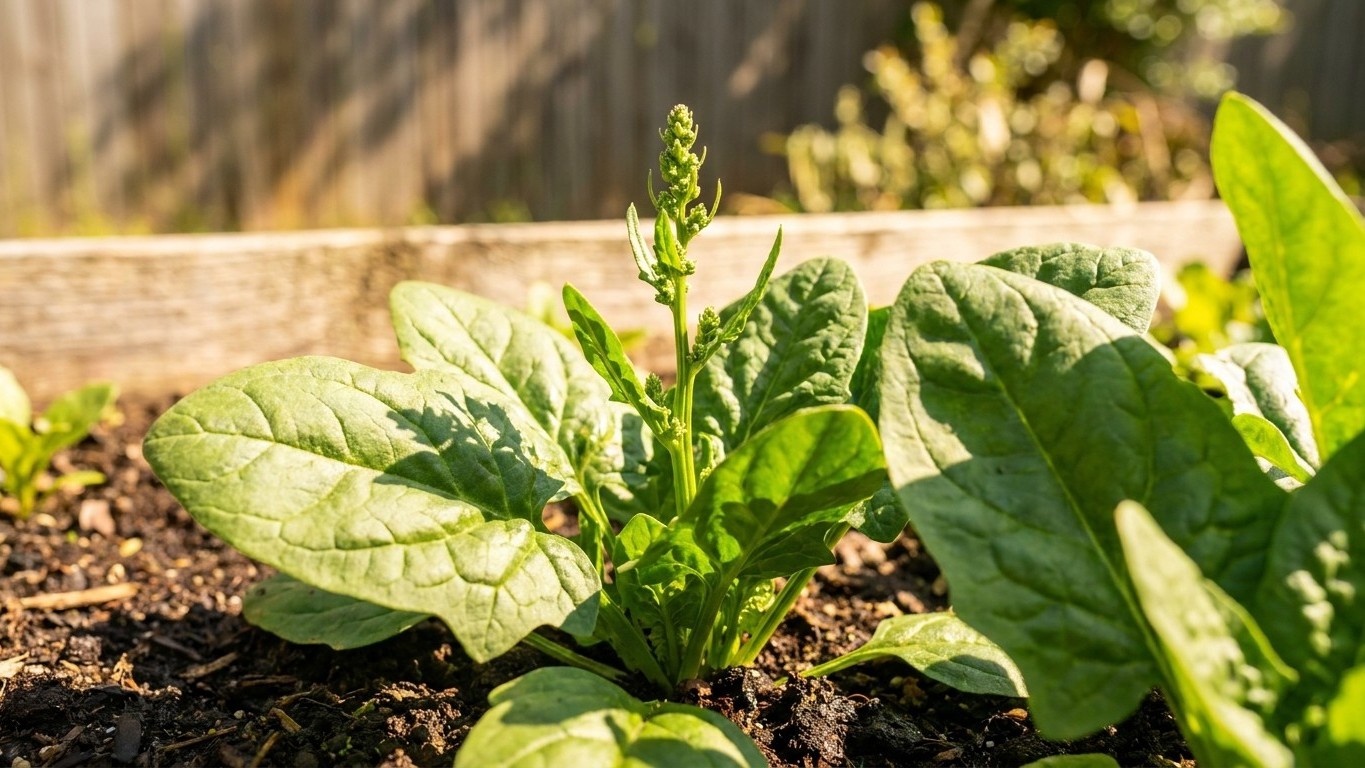

In Ontario, spinach gets two short cutting windows: a few weeks in spring from an early-to-mid April sowing, and a fall crop sown 50 to 75 days before the date you want to harvest. Heat and long days push the plant to flower, and the leaves turn bitter. Cut leaves keep two weeks at the very most, and only at 32°F. The calendar below is built on Toronto Pearson figures, so adjust it for your own district. For the full growing picture, start with Growing Spinach in Ontario.
The short answer
On the longest day of the year, Toronto Pearson gets 15 h 17 of daylight, or 15 hours and 17 minutes. That figure is calculated from the station’s latitude with a geometric horizon, so the roughly seven extra minutes that atmospheric refraction adds are not counted. It is a long day by any standard, and for spinach it is a problem.
Spinach bolts during long days and warm temperatures. Long days alone are enough to start the flowering process, even when the weather stays mild. A cool summer therefore does not buy you extra weeks. A gardener on the shore of Lake Huron with a breezy, 68°F July is still handing the plant 15-plus hours of light, and the plant reads the light.
So is the limit here the day length or the heat? Both. Day length is a clock that no weather can slow down. Heat is the second limit: spinach grows best where temperatures do not exceed 75 F (about 24 °C), and that same number is where bitterness sets in. The heat is easy to underestimate. Pearson averages 15.8 days a year above 30 °C and 6.08 days above 32 °C, but those count only the extreme days. Spinach starts to struggle long before the thermometer gets there, at ordinary warm afternoons that nobody calls a heat wave.
For cutting, the practical rule follows from this. Harvest while the plants are still making flat, tender leaves in cool weather, and do not wait for a bigger crop that the calendar will not allow. When a central stalk starts to rise, cut the whole plant, because the leaves will not improve. How early that happens is covered in Will Spinach Bolt Early in Ontario?. Leaf-eating insects can also strip the same tender growth you are waiting on, and What Eats Spinach in Ontario, and When explains who shows up and when.
The other half of the question is how long the harvest keeps. UC Davis Postharvest states that the optimum is 32°F at 95 to 98 percent relative humidity, and that spinach “will not maintain good quality for more than 2 weeks.” Wilting, yellowing and decay become more likely after 10 to 14 days, and faster still at 41 to 50°F, which is about what a refrigerator door actually holds. That makes two weeks a ceiling, not a plan. The coldest spot in most home fridges is the back of the bottom shelf, away from the door, so that is where cut spinach belongs. Plan to eat it within days.
How long the spring window really is
The spring window is short, and most of it is decided before the first leaf appears. Here is the count for the Pearson reference station.
- Start from the average last frost. At Pearson it falls on April 30, on average. Spinach goes in the ground 2 to 3 weeks before that date, which puts sowing at roughly April 9 to April 16.
- Treat April 30 as the middle of a range, not a safe date. It is a mean, so in one year out of two the last frost comes later. The figure also comes from an airport station. Northern and upland parts of Ontario, and anywhere well away from the lake, run weeks behind it. If you garden in cottage country or north of the Greater Toronto Area, shift your sowing later to match your own frost date.
- Add the growing time, which nobody publishes. The source behind this page gives no days-to-maturity for spinach, and I will not borrow a number from another crop. What you can do is watch the plants and start cutting leaves once they are big enough to eat, then keep cutting.
- Stop counting when the thermometer says so. Growth stops being good above 75 F, and that figure is a temperature, never a calendar date. In some springs the first afternoons above it arrive early. In others a cold May stretches the window. The days keep lengthening the whole time toward the 15 h 17 peak, so the plant is moving toward flowering even in cool weather.
Put those steps together and the usable spring is a matter of weeks, not months. It opens at a sowing in early to mid April, and it closes when warm afternoons and lengthening days outrun the plant. Anyone expecting spinach all the way to July from a single sowing will be disappointed.
Two small habits stretch the window. First, sow as soon as the soil can be worked, since the first sowing gets the longest stretch of cool weather. Second, harvest steadily instead of waiting for a single big cutting. Leaves you cut in week three are leaves the plant cannot bolt away from you in week seven. Choosing a variety could help too, and the source names four (Bloomsdale, Melody, Teton and Olympia), but it publishes no data on any of them, so there is no sound basis for ranking them here.
The autumn crop, and when the soil lets you sow
Fall is the better season for spinach, because days are shortening and temperatures are falling instead of the reverse. Getting a crop in is harder than it sounds, though, because two obstacles stand between you and a good September.
Warm soil blocks the sowing
The block is heat, not cold. Seed germination is reduced when the soil is above 80 F (about 27 °C). In Ontario, that is a real problem in the stretch from late July into August, when garden beds hold their warmth long after dark. A seed that goes into hot soil may come up poorly or not at all.
The window therefore opens when the soil falls below that line, and a soil thermometer settles the argument faster than the calendar. Pearson sees 15.8 days a year above 30 °C, which tells you the hot spells are real but not constant, so there are usually workable days. A shaded bed and steady moisture are the common-sense ways to help the seed along, though the source publishes no specific numbers on either.
The frost that ends the season
At Pearson the first fall frost arrives on October 16, on average. As with the spring date, that is the middle of a range. In some years the frost comes earlier, and in colder districts it comes earlier still. Use your own local date if you have a better one.
The source’s rule is to plant 50 to 75 days before the date you want to harvest. Counting back from October 16 gives a sowing window from about August 2 to August 27. The early end of that range lands in the stretch when soil is most likely to be too warm, so in practice many gardeners will do better at the later end, when the soil has cooled enough for good germination. Since half the years bring frost before October 16, aim for a harvest target a little earlier than the average date, which pulls the sowing window earlier as well. You are balancing two limits, with warm soil pushing you later and frost pushing you earlier. The 50 to 75 day span is the only guidance the source offers for a fall crop, so the exact choice within it is yours.
Common questions
When should I start cutting spinach in Ontario?
Cut when the leaves are big enough to eat, after sowing in early to mid April. The source publishes no days-to-maturity for spinach, so judge by the plants instead of a number. Start taking leaves early and keep cutting, because the spring window is short.
Will a cool summer let me keep cutting into July?
No. Long days alone trigger flowering, and Toronto Pearson reaches 15 h 17 of daylight on the longest day. Cool weather slows the heat problem but does nothing about the day length.
How long does cut spinach keep in the fridge?
Two weeks is the ceiling, and it applies only at 32°F with 95 to 98 percent humidity. At the 41 to 50°F of a typical fridge door it yellows faster. Store it at the back of the bottom shelf and eat it within days.
Which variety should I grow?
The source names Bloomsdale, Melody, Teton and Olympia, but it publishes no data on any of them, so there is nothing reliable to say about bolting, flavor or days to harvest. Sowing date and soil temperature matter more than the name on the seed packet.