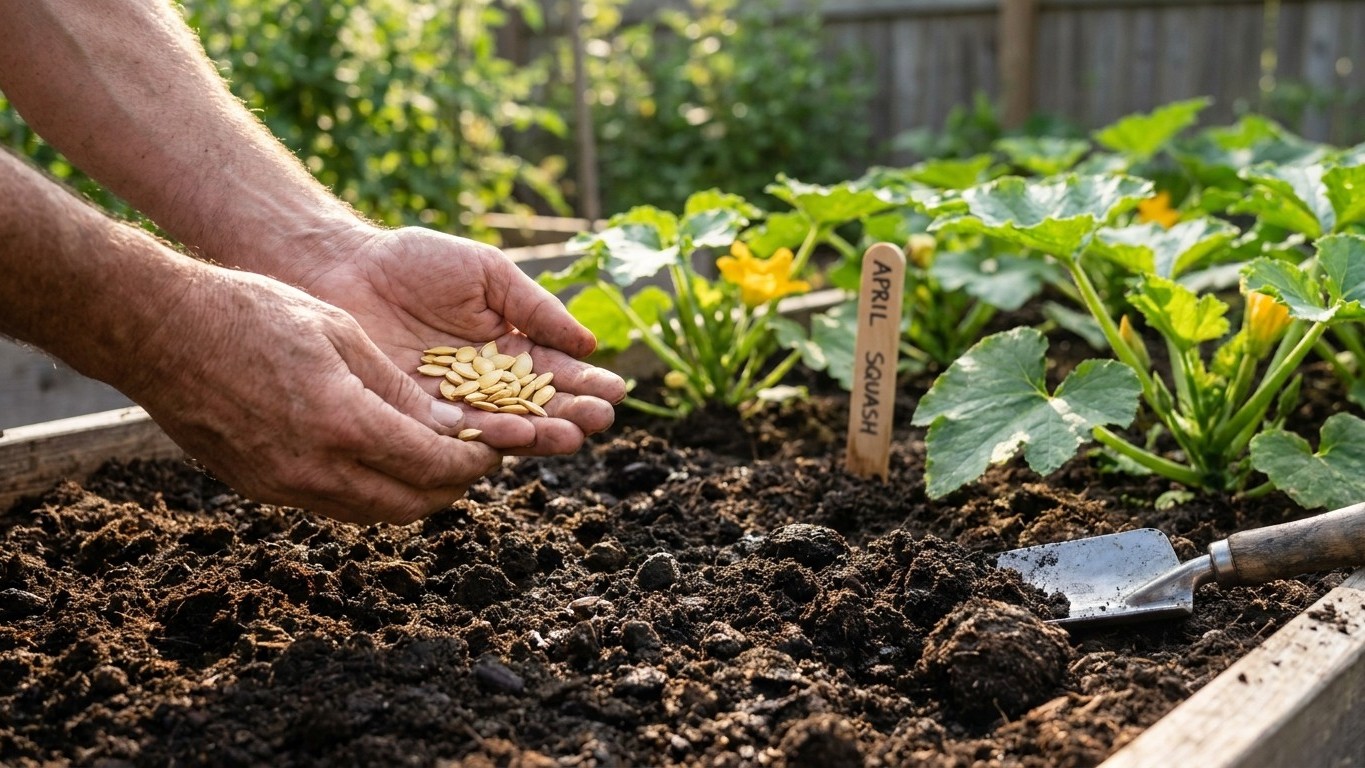

Sow summer squash outdoors in Ontario once the soil has warmed and the frost risk has genuinely passed, typically from mid-May through early June, with succession sowings continuing into early July for a longer harvest. The April 30 average last frost date matters less than what it actually measures: a midpoint, not a guarantee.
The short answer for Ontario
Environment and Climate Change Canada puts the mean last spring frost at Toronto Pearson at April 30, and the mean first fall frost at October 16. That’s a mean date, calculated from three decades of records, which means in roughly half of those years frost showed up after April 30, sometimes well after. Treat it as the center of a window, not a green light to plant.
Because summer squash is frost-tender and germinates poorly in cold soil, the practical sowing window opens two to three weeks after that mean date, once nighttime lows are reliably staying above 50°F and the soil itself feels warm several inches down. For most of southern Ontario that lands the direct-seeding start somewhere in mid-to-late May. Gardeners who want a head start can raise transplants indoors three to four weeks earlier and move them out once the frost risk has clearly passed, rather than gambling on the calendar date alone.
The other end of the season is generous. With a mean first fall frost of October 16, the region offers about 169 days between the two mean dates, far more than the 45 to 60 days most summer squash varieties need to reach harvest. That gives real room for succession sowing: a second or third planting in June or even early July still has time to mature well before the mean fall frost, as long as it’s planted with enough buffer given how variable that October date can be in practice.
One more number worth folding in here: the reference station recorded zero days a year averaging 90°F or above. Summer squash doesn’t need blistering heat to thrive, it just needs warm, consistent soil and steady moisture, so this isn’t a limiting factor the way it would be in a hotter zone. It does mean the plants won’t race ahead the way they might further south, so patience with the calendar matters more than urgency.
What will not work here
Sowing directly into the ground right on or before April 30 is the most common misstep, and it comes from treating a mean date as a safe one. Squash seed sitting in soil still cold from a slow Ontario spring is prone to rot before it ever germinates, and a late frost arriving in the second half of that “average” window can wipe out young seedlings entirely. The fix isn’t complicated: wait until the soil itself gives the signal, not the calendar page.
Watering on a fixed weekly schedule
June is the driest of the summer months here, averaging 2.81 inches, compared with 2.98 in July and 3.07 in August. That’s not a drought by most measures, but it’s uneven, and summer squash has shallow roots and heavy water needs right when flowers and fruit are forming. A gardener who waters once a week on autopilot, assuming the season’s roughly 8.9 inches of summer rain will average out, can still end up with a dry stretch in June that stalls fruit set or triggers blossom drop. The total is fine on paper; the distribution is what actually matters to the plant.
Planting too tight
With zero days above 90°F, this isn’t a punishing dry heat climate, and that cuts both ways. Ontario summers close to the Great Lakes carry real humidity, and dense spacing that might be forgiven in a drier region here invites powdery mildew on squash leaves fast. Crowded plants trap moisture around the foliage and slow airflow, and once mildew takes hold on summer squash it rarely reverses. Wider spacing than the seed packet’s minimum, and morning watering aimed at the soil rather than the leaves, does more to prevent this than any spray applied after the fact.
None of this is about the season being too short, it isn’t, given nearly six months between the mean frost dates. The failures here come from timing the start too early against a frost date that’s really a coin flip, and from managing water and spacing as if the climate were hotter and drier than the numbers actually show.
What changes across Ontario
The 7a hardiness zone cited for this page belongs specifically to the Toronto Pearson reference station, and it’s worth repeating that this is the Canadian hardiness system, built from seven climate variables rather than the single minimum-temperature measure the USDA uses. It cannot be converted into a USDA zone, and Natural Resources Canada says so directly: a single Canadian zone can overlap nine different USDA zones depending on the region. So this number describes one station’s climate, not the province’s.
Ontario itself stretches from the Niagara Peninsula and the shores of Lake Erie, some of the mildest, longest-season ground in the country, up through the Canadian Shield and into the far north near James Bay, where the growing season shrinks dramatically and frost can linger into June and return by early September. There is no single frost-date answer for a province that spans that range, and a gardener working from Toronto’s April 30 and October 16 figures while gardening two hundred miles north is likely working from numbers that don’t apply.
Lake-moderated areas in the south often get a modest buffer against both spring and fall frost, since large bodies of water release stored heat slowly, while inland and northern areas lose that cushion and see sharper temperature swings. Anyone gardening outside the immediate Toronto area should treat this page’s dates as a reference point, not a local forecast, and check their own position on the hardiness zone map rather than assuming the 7a figure applies to their yard. Natural Resources Canada’s Plant Hardiness Site lets you look up the zone by municipality rather than guessing from a provincial average.
Where to check this for your own county
Ontario’s own agriculture ministry publishes regional guidance that goes well beyond what a single weather station can tell you, and it’s the right next stop for anyone trying to nail down a planting date more precise than a provincial mean. Start at the Ontario government’s agriculture and food portal at ontario.ca/page/agriculture-and-food.
Two things are worth looking for once there. First, any local or regional planting calendar that reflects the growing conditions of your specific county rather than the Toronto Pearson averages used on this page, since frost timing in Essex County and frost timing near Thunder Bay are not remotely the same conversation. Second, look for variety trial results or recommendations tied to your area. Ontario’s agricultural research has tested summer squash and other crops across multiple growing zones within the province, and a variety that performs well in a trial near your county carries more weight than a general recommendation aimed at the whole province.
This distinction matters more than it sounds. A provincial page, this one included, is built to be true across a huge and climatically varied territory, which means it has to speak in averages and ranges. A county-level recommendation is built from actual local trial data and local frost records, and it will almost always beat a provincial figure for accuracy. Treat this page as the starting framework, and treat whatever your local extension or ministry resource says as the correction layer on top of it.
If you follow the almanac, here is when to plant zucchini by the moon. It is a tradition, not a proven method.
Checking this against your own garden
Every date on this page is an average pulled from decades of records at one weather station. Your own garden, with its own soil, sun exposure and drainage, will tell you something more specific if you know what to look for.
Start with the soil itself. Push a finger a few inches down before sowing. If it feels cool and damp rather than warm and dry, summer squash seed is likely to sit and rot rather than germinate, regardless of what the calendar says. Warm, crumbly soil is the real green light, not a date.
Watch for the first flush of flowers once plants are established. Summer squash typically opens male flowers before female ones, so an early burst of blooms with no fruit forming isn’t a problem, it’s a normal sequence. What it does tell you is how your particular microclimate is pacing the plant compared with a neighbor’s garden a few streets over, which can run warmer or cooler depending on wind exposure and how much sun the bed gets.
Finally, note how quickly true leaves appear after the first seed leaves. A fast emergence of true leaves points to soil that’s genuinely warm and active; a long delay suggests the ground is still cooler than it feels, and that later plantings might do better waiting another week. These three signals, taken together, will tell you more about your own timing than any frost date ever will.