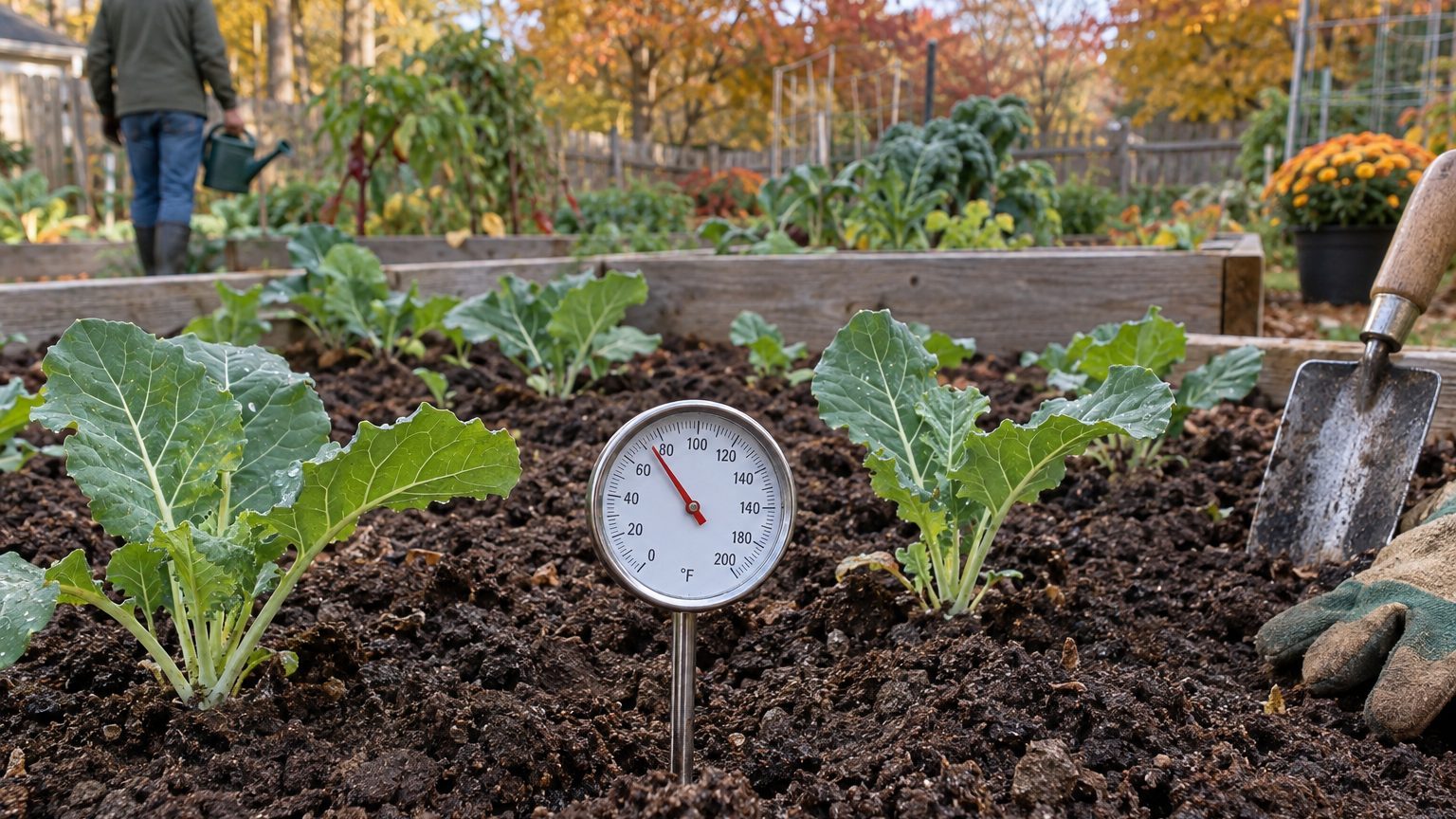

Collards go into Oregon soil once the last frost risk has passed and the ground itself has warmed, not the moment the calendar says spring arrived. In the Willamette Valley that means late March at the earliest, and the plant then settles into one of two very different lives depending on how cold the following winter actually gets where you garden.
When the soil is warm enough in Oregon

The question every Oregon gardener asks first is simple: what date is safe? NOAA’s Climate Normals for the Portland station (USW00024229, 1991-2020 data) put the last spring frost window at March 6 to March 21, based on the 30 to 70 percent freeze probability band. That’s a probability, not a promise, and it only covers the west side of the Cascades. Central and eastern Oregon sit in high desert country with a much shorter, colder season, and this window should not be stretched to cover them.
Frost dates are a proxy, and a rough one. What actually matters for collards is soil temperature, and soil warms after the air stops freezing, not on the same day. A patch of ground can sit cold and slow to wake up for a week or two after the last frost risk has technically cleared, especially in a wet spring, which is the normal spring in western Oregon. A few signs help judge readiness without needing a thermometer:
- Soil that crumbles in your hand instead of forming a cold, sticky clod
- Volunteer weeds already sprouting on their own in the same bed
- A run of nights without any frost warning in the local forecast, not just one mild evening
Collards belong to the same species as cabbage, kale, and mustard, and they share pest and disease pressure with both turnip and rutabaga, which are brassicas too despite the different root shape. Planting collards into a bed that grew any of those crops last season isn’t a rotation at all, it’s the same trouble waiting in the same soil. The full guide to spacing that out properly lives on the collards growing hub, and it’s worth reading before the bed goes in rather than after the first mildew shows up.
Because the frost window is a range and not a fixed line, the safest planting decision leans toward the later end of it, especially for a first-time bed where the soil hasn’t been tracked season to season yet.
How long the season lasts here
Stack the two frost windows against each other and the growing season in western Oregon runs from a last spring frost of March 6 to March 21 to a first fall frost of November 11 to November 27, again from the Portland station normals. Using the tighter, more conservative pairing (March 21 to November 11) gives a season of about 235 days. Using the looser pairing (March 6 to November 27) stretches that to roughly 266 days. Either way, that’s a long window by national standards, and it’s the reason western Oregon gardeners can treat collards as more than a one-shot crop.
| Estimate | Last spring frost used | First fall frost used | Approximate season length |
|---|---|---|---|
| Conservative | March 21 | November 11 | 235 days |
| Generous | March 6 | November 27 | 266 days |
A window that long allows a second sowing. A spring planting can feed you through summer while a mid-summer sowing sets up a fall and early-winter harvest, which is worth doing on purpose rather than leaving to chance. The general logic behind timing that second round, and deciding how much overlap to leave between the two plantings, is covered on the collards growing hub. Gardeners working the high desert side of the state, where the frost-free window is far shorter, don’t get that luxury, and the first sowing has to be treated as the only shot at a full-size harvest.
That difference in season length also changes whether transplanting from starts makes sense. In a long west-side season there’s room to recover from a slow transplant. In a short high-desert season, checking root health at transplant time (firm, pale roots, no soft or discolored patches) matters more, because there’s little slack left to grow a replacement crop if the first one stalls.
Heat and water in Oregon

Western Oregon doesn’t hand collards the kind of summer heat that stresses the crop in the Deep South. The Willamette Valley’s marine-influenced climate keeps extreme heat rare rather than routine, which is a very different starting point than a Southern garden bed. What the region does deliver reliably is a dry summer stretch, with most of the year’s rain falling between fall and spring rather than during the growing months, so a collard bed planted in May or June needs irrigation carried through July and August rather than relying on the sky.
The number that actually decides how this crop is managed here isn’t a summer figure at all. It’s the coldest month’s average daily minimum, which for the Portland reference station sits at 36.2°F (NOAA NCEI Climate Normals, 1991-2020). That’s mild enough that collards in much of western Oregon don’t die back with the first freeze the way they would somewhere colder. Where winters stay in that mild range, collards behave as a standing crop, picked leaf by leaf from November into March without the plant ever being pulled. Where winter dips harder, which describes higher elevations and the state’s eastern half, collards behave as an autumn crop instead, harvested in full before a hard freeze ends the season outright.
Oregon’s USDA hardiness range spans zone 4a to 9b across the state (USDA Plant Hardiness Zone Map, 2023, built on 1991-2020 normals), which is an unusually wide spread for one state and a reminder that the Portland-based numbers above describe the Willamette Valley, not Bend or Burns. A cool, damp Willamette summer brings its own trouble too: slower growth than a hot-climate garden, and a higher risk of mildew on crowded leaves that don’t dry out between rains. Spacing plants for airflow matters more here than shading them from heat.
Which collards suit Oregon
None of this points to a single named variety, and that’s deliberate. The right collard for a given Oregon garden depends on which side of the state that garden sits on, and the varieties actually trialled for local disease pressure and season length are tracked by Oregon State University Extension, not by a general growing guide like this one. Naming a specific cultivar here would be a guess dressed up as advice, and it’s the kind of error a gardener notices the first season it fails to perform as promised.
What can be said honestly is which traits matter, sorted by type rather than brand name:
- Early-maturing types suit the shorter, high-desert season in central and eastern Oregon, where there’s no room for a slow starter
- Open, upright types with good airflow around the leaves suit the humid Willamette Valley, where crowded foliage stays damp longer after rain
- Types bred for downy mildew and other foliar disease resistance are the safer bet anywhere west of the Cascades, where the wet season overlaps with the growing season more than it does further inland
Humidity, not heat, is the deciding factor for most of this state, which flips the usual Southern-garden priority list on its head. A gardener moving here from a hotter, drier climate should weigh disease resistance first and heat tolerance second, the reverse of what worked back home. It’s also worth checking how a comparably short-season territory handles the same tradeoff: the Idaho collards guide deals with a similar high-desert timing problem, while the Quebec collards guide shows what growing this crop looks like when winter, not summer, sets every rule. Reading a state’s own extension trial data before choosing seed is the one step that turns a guess into an actual plan.