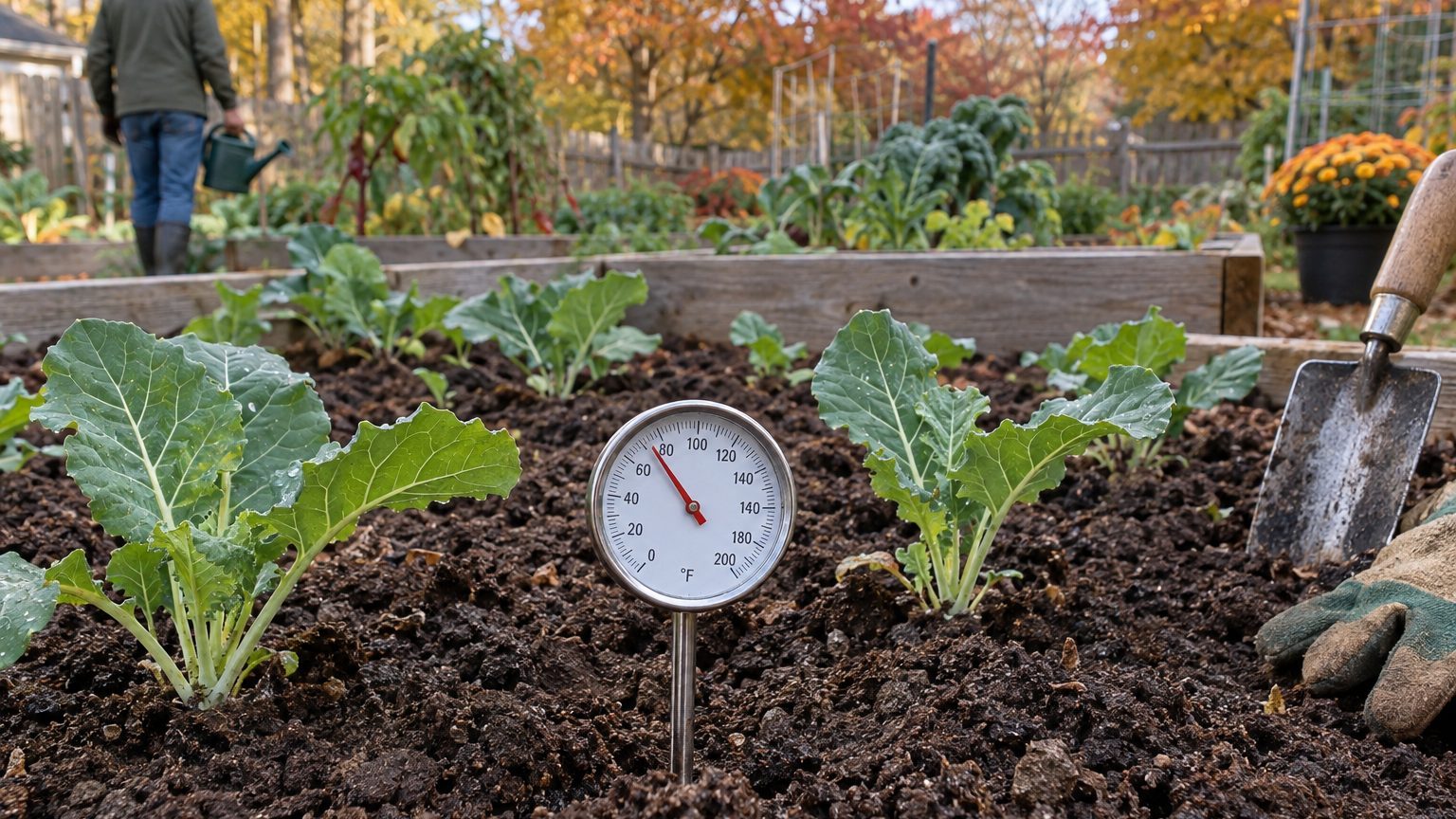

Collards grow well across most of settled Quebec, but the short frost-free window and hard winters mean timing and crop choice matter more here than in the American South. Direct sowing works once the ground has truly warmed, and the crop should reach maturity well before the average October frost. Season length, not summer heat, decides how a Quebec gardener plans this bed.
When the soil is warm enough in Quebec

Ask a Quebec gardener for a planting date and the number that comes back is May 6, the average last spring frost recorded at the MONTREAL/ST-HUBERT A station, based on Environment and Climate Change Canada’s 1981-2010 climate normals. It’s a useful anchor. It is not, on its own, the answer collards need.
That date is a mean, not a promise. In one year out of two, frost arrives after May 6, sometimes well after, and the figure comes from a single reference station in the Montreal area. Gardens north of the St. Lawrence lowlands, in the Laurentians, the Eastern Townships uplands, or anywhere north of Quebec City, should expect the real date to run days or weeks behind it.
Frost is also only a proxy for what collards actually need, which is warm soil. Air temperature can climb above freezing days before the ground a few inches down does the same, and a seed dropped into cold, wet soil sits and rots rather than germinating. The practical move is to let the average last frost pass, then wait for the soil itself to feel warm and workable before sowing or setting transplants, rather than sowing the moment the calendar clears the risk of frost.
Collards belong to the brassica family, alongside cabbage, kale, mustard, turnip, and rutabaga, and that matters from the first day in the ground. Every one of these crops shares the same soil-borne diseases and the same insect pests, from cabbage root maggot to clubroot. A gardener who follows collards with cabbage, or plants them where turnips grew the year before, has not rotated anything at all. Working from a rotation plan that treats the whole brassica family as one group, rather than crop by crop, is the only version of rotation that actually reduces disease pressure over several seasons.
On pest and disease control, the useful habit is scouting the underside of leaves early and often, and removing affected leaves promptly, rather than reaching for a chemical fix by default. Where a treatment is genuinely needed, a Quebec extension agent through MAPAQ can point to what is registered and appropriate for the specific problem, which is a safer path than guessing at a product and a rate.
How long the season lasts here
Subtracting the two average frost dates from Environment and Climate Change Canada, May 6 for the last spring frost and October 5 for the first fall frost, both from the MONTREAL/ST-HUBERT A station, gives a frost-free window of roughly 152 days. That is a longer stretch than many Quebec gardeners assume, and it changes what’s worth attempting in a single season.
A window over five months is long enough to support more than one sowing of collards. A spring planting made once the soil has warmed can be harvested through summer, and a second sowing made in early-to-mid summer will still have time to reach usable size before the October frost closes the season. Collards also tolerate a light frost better than many greens, and a touch of cold near the end of the season tends to sweeten the leaves rather than ruin them, so pushing a second sowing close to the average fall frost date is not the gamble it would be with a more tender crop.
Where the calculation changes is for a gardener starting late, or gardening north of the reference station where the real frost-free window runs shorter than 152 days. In that case, the first sowing becomes the only realistic one, and the decision about whether to direct-sow or transplant matters more, since transplants buy back several weeks that a short window can’t otherwise spare. Checking transplants for healthy, undamaged roots before setting them out also avoids introducing a problem into a bed that won’t have time to recover from it.
For gardeners who want to plan a second sowing with any precision, working backward from the average fall frost date and counting back the maturity period of the type being grown is the standard approach, and the site’s succession sowing guide walks through that math step by step for a range of frost windows, including one this length.
Heat and water in Quebec

The number that actually shapes a Quebec collard bed isn’t a summer figure at all. It’s the mean daily minimum of the coldest month, which sits at -14.1 °C (6.7 °F) at the Montreal reference station, according to ECCC’s 1981-2010 normals. That places most of settled Quebec in Canadian plant hardiness zone 5b, a system built from seven climate variables and not directly comparable to a USDA zone, even where the numbers look similar.
A winter that cold rules out one of the two lives collards can lead. In parts of the American South, where the coldest month stays mild, collards become a standing crop, picked leaf by leaf from November into March without ever being pulled. That is not available here. With the coldest month averaging well below freezing on most nights, Quebec collards are an autumn crop, planted for a single harvest window that ends at the hard freeze, not a bed that carries a household through winter.
This site’s climate facts for Quebec don’t include a count of days above 90°F at a reference station, and that absence is itself informative: extreme summer heat is not the pressure this crop faces here. What Quebec summers bring instead is a shorter, cooler growing stretch and the humidity that tends to come with the St. Lawrence lowlands, conditions that favor slow, steady leaf growth over fast bolting, but that also favor fungal pressure. Downy mildew and other leaf diseases spread readily in a summer with regular rain and warm, damp air sitting on foliage overnight.
The practical response is spacing plants for airflow, watering at the base rather than overhead late in the day, and clearing affected leaves as soon as they show spotting, rather than waiting to see if the problem resolves on its own. None of that requires a fungicide as a first step, and reaching for a rotation plan that keeps this bed away from last year’s cabbage or turnip patch does more for disease pressure over time than any single spray would.
Which collards suit Quebec
Nothing on this page names a variety, and that’s a deliberate choice rather than an oversight. The types trialled and recommended for Quebec’s soils and season are published by MAPAQ, Quebec’s ministry of agriculture, and that local trial data is worth more than any general recommendation this page could offer.
What this page’s own facts do support is reasoning by type rather than by name. A frost-free window of about 152 days, ending at an average October frost, favors the earliest-maturing types available, since a slower-growing type risks being caught by frost before reaching a useful size, especially for anyone starting the second sowing described above. Quebec’s cooler summer stretch removes the pressure that pushes hot-climate gardeners toward types bred for heat tolerance and root shade; that’s a Southern concern, not one that applies here.
The humid, disease-prone summer described in the previous section makes disease resistance, particularly to downy mildew and black rot, the first real selection criterion for a Quebec gardener, ahead of leaf size or flavor. Since collards share their disease pressure with the rest of the brassica family, choosing a resistant type matters most in a garden that also grows cabbage, kale, or turnips nearby, where inoculum can carry over from one crop to the next within the same season.
A MAPAQ extension agent, or the seed suppliers who work directly with Quebec growers, can match a type to a specific region’s frost dates and soil, something a generic list of names never accounts for. Contacting MAPAQ before ordering seed is the one step that turns a general plan into one suited to a particular garden, whether that garden sits in the milder St. Lawrence lowlands or in a shorter-season district further north.