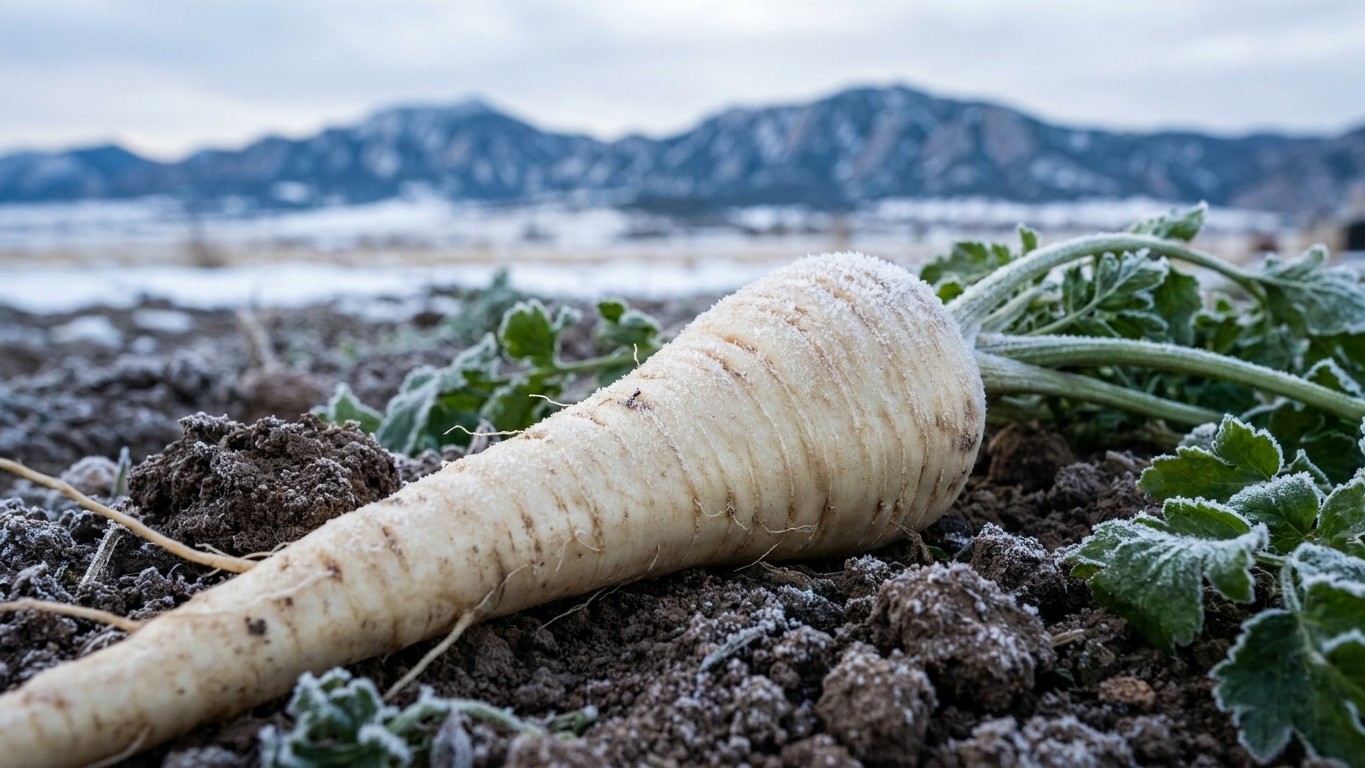

Oregon State University Extension documents eleven garden pests active on vegetable crops in this state, but only about half of them have any real reason to touch a parsnip bed. The rest target cabbage family plants, cucurbits, or fruit trees. The insects and mollusks that actually go after parsnip roots and foliage show up in stages tied to the state’s frost-free window, not to a fixed month.
Which pests attack parsnip in Oregon
Oregon State University Extension documents eleven pests active on garden vegetables in this state: Aphids, Brown garden snail, Brown marmorated stink bug, Cabbage maggot, Carrot rust fly, Cucumber beetles, European earwig, Imported cabbageworm, Slugs (the gray field slug, Deroceras reticulatum), and Symphylans.
Four of those have nothing to do with a parsnip bed. Imported cabbageworm feeds on cabbage-family leaves, not the fern-like foliage of a root crop in the carrot family. Cabbage maggot targets the roots of cabbage, radish, and turnip, a different plant family entirely from parsnip. Cucumber beetles are cucurbit feeders, drawn to squash and melon vines, and have no documented interest in parsnip. Brown marmorated stink bug feeds mainly on fruit and seed pods, tree fruit and beans in particular, not on root vegetables growing underground.
That leaves seven that do belong on this page. Aphids feed on parsnip foliage and can weaken young plants before roots ever size up. Carrot rust fly is the one to watch closest, since parsnip shares the carrot family and the fly’s larvae tunnel directly into the root. Slugs, including the gray field slug, and the brown garden snail both graze on seedlings and can strip a newly germinated row overnight. European earwig feeds on tender seedling growth and can also do genuine good in a garden by preying on aphids, which makes it a mixed case rather than a pure pest. Symphylans live in the soil and feed on roots and root hairs below the surface, doing damage a gardener rarely sees until the plant stalls out.
The decision that matters most here is timing the first inspection to germination, not to a date on the wall, because Utah State University Extension notes parsnip seeds take 14 to 21 days to sprout, and that slow, bare-soil window is exactly when slugs, symphylans, and earwigs do the most damage while a gardener sees nothing above ground.
Oregon State University Extension does not document a longer list for this state, and there is no reason to pad it. Seven pests, tracked at the right stage, cover what actually threatens a parsnip planting here.
When each one shows up, and what it does first
The whole sequence runs off the frost window, not the calendar. NOAA NCEI climate normals put the last spring frost west of the Cascades between March 6 and March 21, and parsnip seed goes into the ground two to three weeks before that date, meaning the seed is sitting in cold soil well before anything visible happens above ground. Central and eastern Oregon are high desert with a much shorter season, so this same sequence shifts later there.
The first stage to watch is germination itself. Symphylans feed on root hairs of seedlings still underground, and a gardener’s first clue is not a visible insect but a patchy, uneven stand where some seeds never seem to sprout at all. Slugs and the brown garden snail move in as soon as the first leaves break the surface, and their first sign is a seedling that simply vanishes overnight, leaving a stub or nothing at all.
Once true leaves form, European earwigs start rasping small, ragged holes into the tender foliage, usually at night, and aphids begin clustering on the undersides of leaves, where they show up first as a slightly sticky, curled leaf rather than an obvious insect swarm. Carrot rust fly follows as the foliage fills in, and because parsnip is in the same family as carrot, its larvae tunnel into the shoulder of the developing root well before harvest, so the first sign is often invisible until the root is pulled.
The germination window, 14 to 21 days of bare or barely-sprouted soil, is the single stretch where slug and symphylan damage does the most harm relative to how little a gardener notices it, since parsnip is sown directly in place and there is no transplant stage to inspect beforehand. Roots left in the ground toward the first fall frost, November 11 to 27 west of the Cascades, are also the stage where carrot rust fly larvae feeding becomes visible once the crop is finally dug.
Telling the damage apart from everything else
A parsnip bed can look damaged for reasons that have nothing to do with any of the seven pests above, and mixing them up leads to the wrong response.
| Symptom | Likely cause | What distinguishes it |
|---|---|---|
| Ragged holes in leaves, seedlings missing overnight | Slugs, brown garden snail, or European earwig | Slime trails or chewed stems at soil line, damage worst after rain or overnight |
| Sticky residue, curled or yellowing leaf tips | Aphids | Clusters of small soft-bodied insects visible on leaf undersides |
| Rusty tunnels or scars just under the root’s skin | Carrot rust fly larvae | Tunneling concentrated near the root’s shoulder, not scattered through the flesh |
| Patchy, uneven germination across the row | Symphylans feeding on root hairs underground | No insect visible above soil; stunted plants cluster in the same section of bed each season |
| Forked or misshapen root | Heavy or stony soil, or overwatering | No tunneling or chew marks when the root is cut open; this is a soil condition, not a pest |
| Overall pale or yellowing foliage, no chew marks | Nutrient deficiency or drought stress | No insects, slime, or tunnels present anywhere on the plant |
That forked-root row deserves its own mention, because it gets blamed on insects more often than it should. Utah State University Extension is clear that parsnip needs deep, sandy soil, and that heavy ground has to be double dug before sowing, or the root splits and forks as it grows around obstructions. Overwatering can cause the same forking independently of soil texture, so a forked root by itself does not point to one single cause, and a gardener should not assume a pest is involved unless a cut root actually shows tunneling or feeding marks.
When a symptom doesn’t clearly match anything in this table, the local extension office can look at an actual sample rather than a description, which matters more than it sounds like for anything underground.
What actually works here, and what is a waste of time
Because parsnip is sown directly in place and takes 100 to 120 days to mature, there is no transplant stage where a gardener can inspect roots before committing them to the bed, which makes prevention at seeding time more useful than any later response. A fine mesh or floating row cover laid over the row right at sowing, and left in place through the germination window, keeps adult carrot rust flies from laying eggs near the row and blocks earwigs and larger slugs from reaching seedlings during the two to three weeks before anything is up. Timing that cover to go down at seeding, not after seedlings appear, is the single detail that decides whether it works, since carrot rust fly adults target the soil around young plants early, not established roots later in the season.
Handpicking slugs and snails at night, when they’re active, does more than most home remedies people reach for first. Crop rotation helps against symphylans and carrot rust fly too, since both build up in soil that grows the same family of crops repeatedly, and moving root crops to a different bed each season interrupts that cycle.
What doesn’t hold up: scattering coarse material around the base of plants as a slug deterrent has weak and inconsistent results in practice, and there’s no registered treatment that a home gardener should apply without checking first, since what’s legal to use varies by state and by pest. Any material aimed at aphids, symphylans, or carrot rust fly needs to be confirmed as registered for use in Oregon through the local extension office rather than guessed at from a product label meant for a different state.
Where to check this for your own county
Everything above comes from Oregon State University Extension, and it describes what’s documented statewide, not what’s necessarily present in any one garden. A pest common in the Willamette Valley may be rare east of the Cascades, and the reverse is also true, since that region’s shorter, drier season changes which pests build up populations at all.
The county office is the level where this actually gets confirmed, because Oregon State University Extension maintains local offices that track pest pressure specific to their area and can identify a sample rather than a description. A photo or a bagged specimen brought to that office answers the question a general list never can: whether that particular symptom in that particular garden matches a known pest, or something else entirely.
Bringing an actual root or leaf sample, rather than just describing symptoms over the phone, gets a far more useful answer, particularly for anything underground like symphylans or carrot rust fly larvae, where the damage itself is the only real evidence.
Common questions
Does the gray field slug do more damage than other slugs in Oregon gardens?
Oregon State University Extension names the gray field slug specifically among the documented slug pests here, which suggests it’s common enough to call out by name, though the source doesn’t rank it against other slug species for parsnip specifically.
Can I skip the row cover if I plant parsnip late?
Parsnip is sown two to three weeks before the last frost and needs 100 to 120 days to mature, so pushing sowing later shortens the growing season without necessarily avoiding pest pressure, since carrot rust fly and slugs remain active across the growing period, not just at one point on the calendar.
Will earwigs in my parsnip bed also help control aphids?
European earwigs feed on tender seedling growth but also prey on aphids, so their presence in a bed isn’t purely negative; the balance depends on how many are present and how young the seedlings are at the time.
Why does my parsnip taste bland even though the plants looked pest-free?
Utah State University Extension notes that the sweetening in parsnip comes from several weeks of frosty exposure after the roots mature, not from surviving winter or from reaching a particular hardiness zone. A garden with no frost, or roots harvested before enough frosty weeks have passed, produces a fine but bland root regardless of pest control.