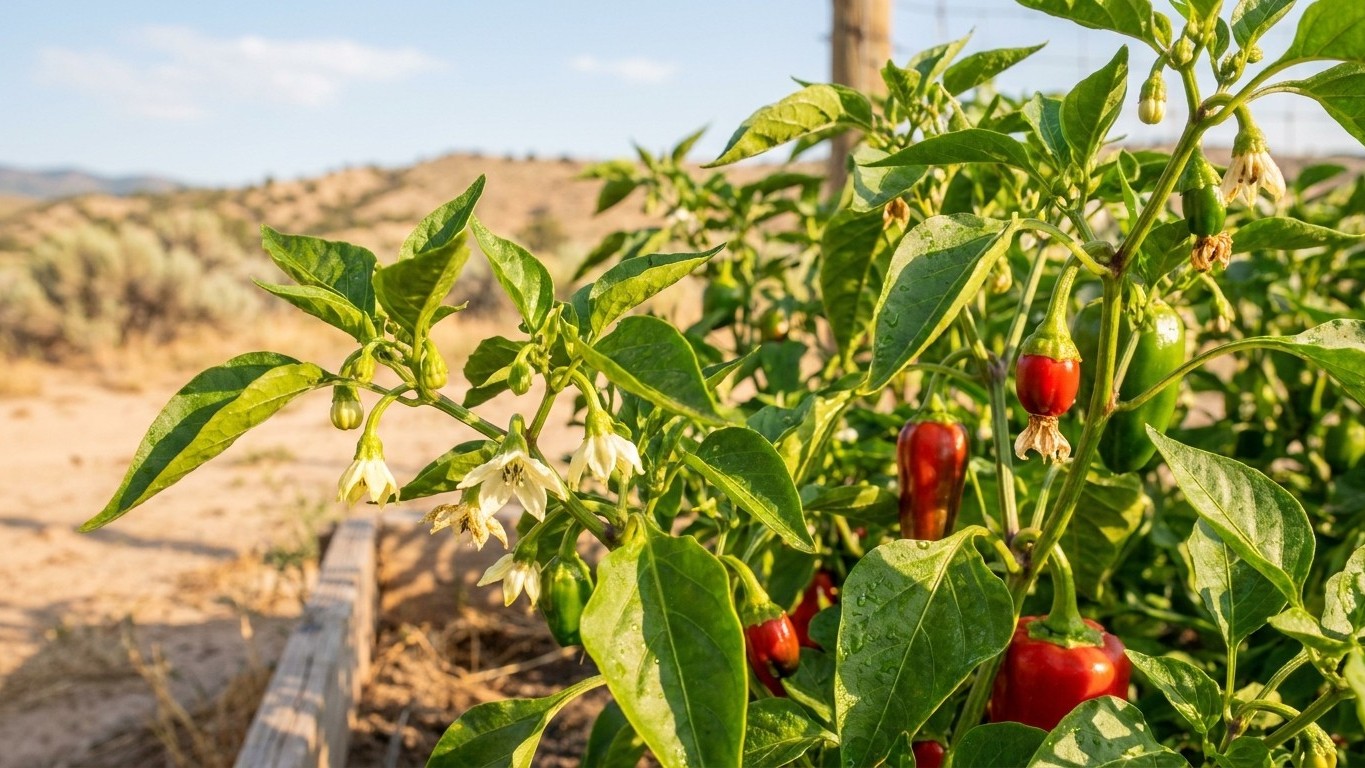

In Oregon, the biggest threat to a pepper crop is usually weather, not bugs. At the Portland reference station the thermometer reaches 90 F or higher on 11.9 days a year, and fruit set stalls at both ends: in heat above 90 F and on nights below 55 F. Insects and slugs take their share, but this page carries no pest calendar. It sticks to what the numbers support: heat, cool nights, start dates, and the physical failures that follow.
The short answer
The hot end: 11.9 days
NOAA NCEI Climate Normals put the mean number of days a year reaching 90 F or more at 11.9 for the Portland reference station. That figure measures summer heat load, meaning the stretches that drive water demand and heat stress. It is not an average summer temperature, and it says nothing about how warm a typical July afternoon feels.
For peppers, it means Portland-area gardens get fewer than two weeks of the heat that shuts down flowering. Utah State University Extension is plain about the rule: pepper fruit set fails when days climb above 90 F. So in a normal year, the hot-end problem is a few short windows rather than a whole season. It is also an average. A given summer can bring more of those days, or almost none, and a single run of three or four of them in a row during bloom is enough to drop a round of flowers.
The count belongs to a station west of the Cascades. Central and eastern Oregon are high desert, with a far shorter growing season and a different heat and cold pattern, so don’t carry 11.9 over to a garden in Bend or Pendleton. If you garden there, the number to trust is the one from your own thermometer, read in the shade at plant height.
The cool end: nights under 55 F
Here is the half of the rule that gets dropped most often. The same Utah State University Extension guidance says fruit set also fails when nights fall below 55 F. A garden can dodge the hot days and still lose its first flowers to a cold spell in June.
This site does not carry summer night minima, and nothing here should be read as a guess about them. Night lows swing with elevation, distance from the water, cold-air pooling in low spots, and how much pavement or fence sits near the bed. Latitude tells you little, and neither does the coldest month of the year. You have to watch your own nights. A cheap min/max thermometer placed at the bed, checked each morning through late spring and early summer, will tell you more than any regional average.
When the readings dip under 55 F while plants are in bloom, that is your cue to cover them at dusk or hold off fertilizing for a few days. The fuller diagnosis of flowers that open and fall without setting is in Why Peppers Fail to Set Fruit in Oregon. Which plants give you the best odds of ripening fruit before fall is covered in Pepper Varieties That Ripen in a Oregon Season. For the whole-season view, start at Growing Peppers in Oregon.
When to start seed here
The arithmetic, step by step
Peppers are slow, which is why the calendar works backward from the garden, not forward from the seed packet. Utah State University Extension says transplants need 8 to 10 weeks indoors, and that they go out when the soil reaches 60 F, after frost. Those three conditions give you a repeatable count.
- Find your last spring frost. For Portland, NOAA NCEI U.S. Climate Normals place it between March 6 and March 21, a band covering 30 to 70 percent probability of a 32 F freeze. That window is for the Portland side of the state only. Central and eastern Oregon have a much shorter season, so look up a date for your own county.
- Wait for the soil, not the date. After the last frost, push a soil thermometer a few inches into the bed and watch for 60 F. This site does not publish a soil-temperature date, so the thermometer is the authority. Write down the day it first holds at 60 F.
- Count back 8 to 10 weeks from that transplant day. Eight weeks is 56 days and ten weeks is 70 days. The earlier date gives slower, sturdier starts, and the later one gives younger plants that still make the cut.
- Sow seed at the result. Anything earlier leaves you holding leggy, root-bound plants with nowhere to go. Anything later means setting out plants that haven’t reached the age the guidance calls for.
A worked example
Say your soil holds at 60 F on May 10. That date is an illustration, not a forecast for Portland or anywhere else. Eight weeks back from May 10 is March 15, and ten weeks back is March 1. Your seed-starting window, then, runs from March 1 to March 15.
Now redo it with your own number. If your soil doesn’t reach 60 F until May 25, both ends of the window slide fifteen days later, to March 16 and March 30. A cold spring pushes the start date later, and a warm one pulls it earlier, which is why a fixed calendar date on a seed packet can mislead you.
One more gap worth knowing about: the last frost and the 60 F soil day are not the same day. In a cold spring, soil can lag the frost date by weeks. Starting seed by the frost date alone, then, can leave you holding ten-week-old plants with nowhere warm to put them.
What goes wrong here
Three failures and what to do about each
Most of what damages peppers in an Oregon garden traces back to the temperature band described above, or to uneven water. Pest damage does happen, but its timing is not carried on this site, so it is left out here rather than guessed at.
- Blossom drop. Flowers open, then fall without setting fruit, usually after a hot spell above 90 F or a night below 55 F. Since 11.9 days a year reach 90 F at the Portland reference station, the heat version is occasional, while the cold-night version depends entirely on your own microclimate. Remedy: shade cloth over the bed during a forecast heat run, row cover or a cloche at dusk when your thermometer says the night will be cold, and steady watering through both. Don’t panic-feed. Extra nitrogen pushes leaves, not fruit. Pinching off the first early flowers on a small transplant can also help the plant build frame before it carries a load.
- Sunscald. Pale, papery patches appear on the side of the fruit facing the sun, and they turn tan and sunken. It shows up most where the sun is strong and the plant has lost leaf cover, from pruning, disease, or a thin canopy. Remedy: leave the foliage alone so leaves shade the fruit, and avoid stripping leaves for looks. In a hot, open site, light shade cloth through the afternoon peak does the job. Sunscalded fruit is not harmful to eat once the damaged spot is cut away, but it rots quickly.
- Blossom-end rot. A dark, leathery, sunken patch forms at the bottom tip of the fruit, opposite the stem. It is tied to uneven watering more often than to a missing nutrient in the soil. Remedy: water deeply and on a schedule, mulch to hold moisture steady, and avoid letting the bed swing between dry and soaked. A soil test is a better next step than guessing at additives. Early fruit is hit hardest, and later fruit often comes out clean once watering evens out.
Reading the pattern matters. Drop during a hot week points to heat. Drop after a chilly night points to the cold end. Scald tracks sun exposure, and rot tracks watering. Keep a short log of the weather against what you see on the plants, and within a season you’ll have a map of your own garden’s weak points.
Common questions
Can I plant peppers right after the last frost in Portland?
Not automatically. NOAA NCEI places the last 32 F freeze between March 6 and March 21 (the 30 to 70 percent probability band), but the guidance calls for setting transplants out after frost and once the soil reaches 60 F. Check the soil with a thermometer before you plant. The frost window applies to the Portland side only, and central and eastern Oregon have a much shorter season.
How long until I can pick peppers?
Clemson Cooperative Extension says peppers should be ready for harvest in about 70 to 85 days after transplanting. That is one extension source’s figure, and your own garden’s timing depends on how many weeks of good flowering weather the plants get. Night chill or a hot spell during bloom can push fruit later.
Should I keep harvested peppers in the refrigerator?
The fridge is too cold for peppers, and it is the mistake nearly everyone makes. Clemson gives the optimal storage conditions as 45 to 50 °F with 80 to 90 percent relative humidity, for two to three weeks. A household refrigerator runs colder than that, and below about 45 °F peppers pit and soften from chilling injury. Treat the two to three weeks as a ceiling under ideal conditions, not a promise. A cool pantry or basement shelf is often a better bet. Source: Clemson Cooperative Extension, Home & Garden Information Center.
Does the 11.9-day heat count apply across Oregon?
No. It is the mean number of days a year at 90 F or higher for the Portland reference station, from NOAA NCEI Climate Normals. Gardens east of the Cascades sit in a different climate, and this site does not publish a figure for them here. Use your own thermometer to count hot days and cold nights through the season.