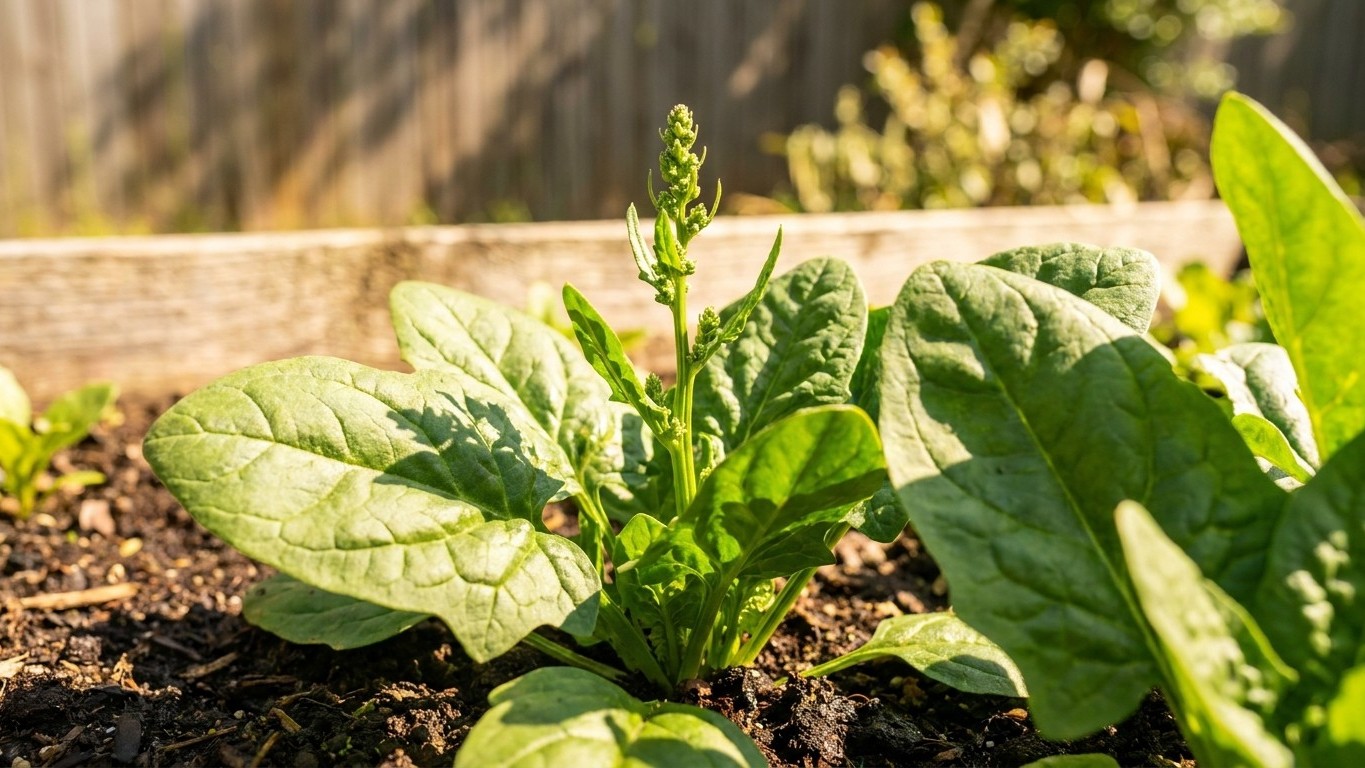

West of the Cascades, spinach bolts early no matter how mild the summer feels. Portland’s reference station logs 15 hours and 30 minutes of daylight on the longest day of the year, and that length alone pushes spinach toward flowering. Heat adds a secondary push, but with just 11.9 days a year reaching 90 F, day length, not heat, is the main reason spring and summer sowings run short here.
The short answer
Start with the number that matters most: 15 hours and 30 minutes of daylight at the summer solstice, measured at the Portland reference station. That is a long day by any garden standard, and for spinach a long day is not a bonus, it is the trigger. Flowering (bolting) in spinach comes from long days combined with warmth, so a cool, cloudy Willamette Valley summer does not buy extra weeks the way it might for a heat-sensitive crop that only fails once temperatures climb. The days themselves are doing the damage before the thermometer even gets involved.
That distinction matters because it flips the usual gardening instinct. A gardener moving from a hotter state might assume Oregon’s mild summers mean spinach can hang on longer here. It cannot, not for that reason. The plant reads day length the same way whether the air is 65 F or 95 F. Once the days stretch past whatever threshold triggers flowering in a given variety, the plant starts putting energy into a seed stalk instead of leaves, and the leaves that remain turn bitter.
Heat still plays a role, just a smaller one in this particular climate. Spinach grows best when temperatures stay under 75 F, and that ceiling is also the point where flavor starts to turn bitter. Portland’s climate normals show only 11.9 days a year averaging 90 F or above, which is a modest heat load compared to much of the country. So the region is not cooking its spinach into bolting the way a hotter climate would. It is the calendar, not the thermometer, doing most of the work.
Put plainly: in western Oregon, the limit on spinach is day length first, heat second. The plant bolts because the days get long, and any stretch of 90-degree weather during that window just accelerates a process that was already underway. Gardeners east of the Cascades, in the high desert of central and eastern Oregon, are working with a different climate entirely, shorter frost-free seasons and more extreme heat swings, so this particular balance of day length versus heat does not transfer statewide.
How long the spring window really is
Working out the spring window means lining up three things: when it is safe to sow, how fast the days lengthen after that, and where the 75 F growth ceiling sits along the way.
- The last spring frost at the Portland reference station falls somewhere between March 6 and March 21. Spinach seed goes in the ground 2 to 3 weeks before that date, which puts sowing in the window from mid-February to right around the start of March.
- From that sowing date, the days lengthen quickly. Portland is already gaining daylight fast through March and April, on the way to that 15-hour-30-minute peak at the solstice in late June. There is no plateau here, the day length keeps building the whole time the crop is in the ground.
- Heat is not the constraint in spring. With only 11.9 days a year reaching 90 F on average, and most of those falling in July and August, spring temperatures in the Willamette Valley rarely push spinach past its 75 F comfort zone before the days themselves become the problem.
- Because day length is doing the pushing, the practical harvest window runs roughly from sowing in late February or early March to sometime in the mid-spring stretch, before the lengthening days of late spring drive the crop toward bolting. That leaves something in the neighborhood of eight to ten weeks of usable growth, a shorter run than gardeners in a lower-latitude, shorter-day climate might expect.
None of the four named spinach varieties, Bloomsdale, Melody, Teton, and Olympia, come with published days-to-maturity or bolt-resistance figures from the source used here. Naming them is straightforward; claiming specific performance numbers for any of them is not, and none should be invented.
The autumn crop, and when the soil lets you sow
Fall spinach solves the day-length problem simply by sowing after the solstice, when days are shortening rather than lengthening. But autumn brings its own pair of obstacles, one at the start of the season and one at the end.
Soil too warm to germinate
Spinach seed germinates poorly once soil temperatures climb above 80 F, and late summer soil in the Willamette Valley holds onto heat well after the air itself has started to cool. Even though Portland averages just 11.9 days a year at 90 F or higher, those days tend to cluster in July and August, and the soil warmed by them does not cool instantly once September arrives. Gardeners sowing a fall crop need to wait until soil temperature has actually dropped, not just until the calendar flips to a cooler-sounding month.
The frost that ends the season
The first fall frost at the reference station arrives somewhere between November 11 and November 27. Working backward from a harvest target in the first half of November, using the 50-to-75-day sowing window that applies to a fall spinach crop, puts sowing somewhere between late August and roughly the third week of September. Aim for a harvest around November 10, ahead of the earliest likely frost date, and the math lands on sowing from about August 27 to September 21.
The two obstacles overlap in practice. The earliest end of that sowing window, late August, is also when soil is most likely still running warmer than the 80 F germination ceiling. The safer play in most years is to sow toward the later part of that window, mid-September, once soil has had more time to cool, accepting a slightly tighter run to harvest before frost rather than fighting warm soil that will not let the seed germinate reliably.
Common questions
Do the named spinach varieties (Bloomsdale, Melody, Teton, Olympia) bolt at different rates?
That is not published in the source used for this page. The four names are recognized garden varieties, but no days-to-maturity or bolt-resistance data for any of them is given here, so none should be assumed.
Can spinach be grown through the Oregon summer?
No, not reliably. Once the days lengthen past the point that triggers flowering, the plant bolts regardless of how mild the air temperature stays. Portland’s modest heat load, just 11.9 days a year at 90 F or above, does not offset that day-length trigger.
What is the safest sowing date for spring spinach in the Portland area?
Sowing 2 to 3 weeks ahead of the last spring frost, which falls between March 6 and March 21 at the reference station, puts seed in the ground from about mid-February through the first days of March.
Does this window apply to all of Oregon?
No. Portland sits west of the Cascades. Central and eastern Oregon are high desert with a shorter frost-free season and a different heat and cold profile, so the frost dates and sowing windows described here do not carry over statewide.