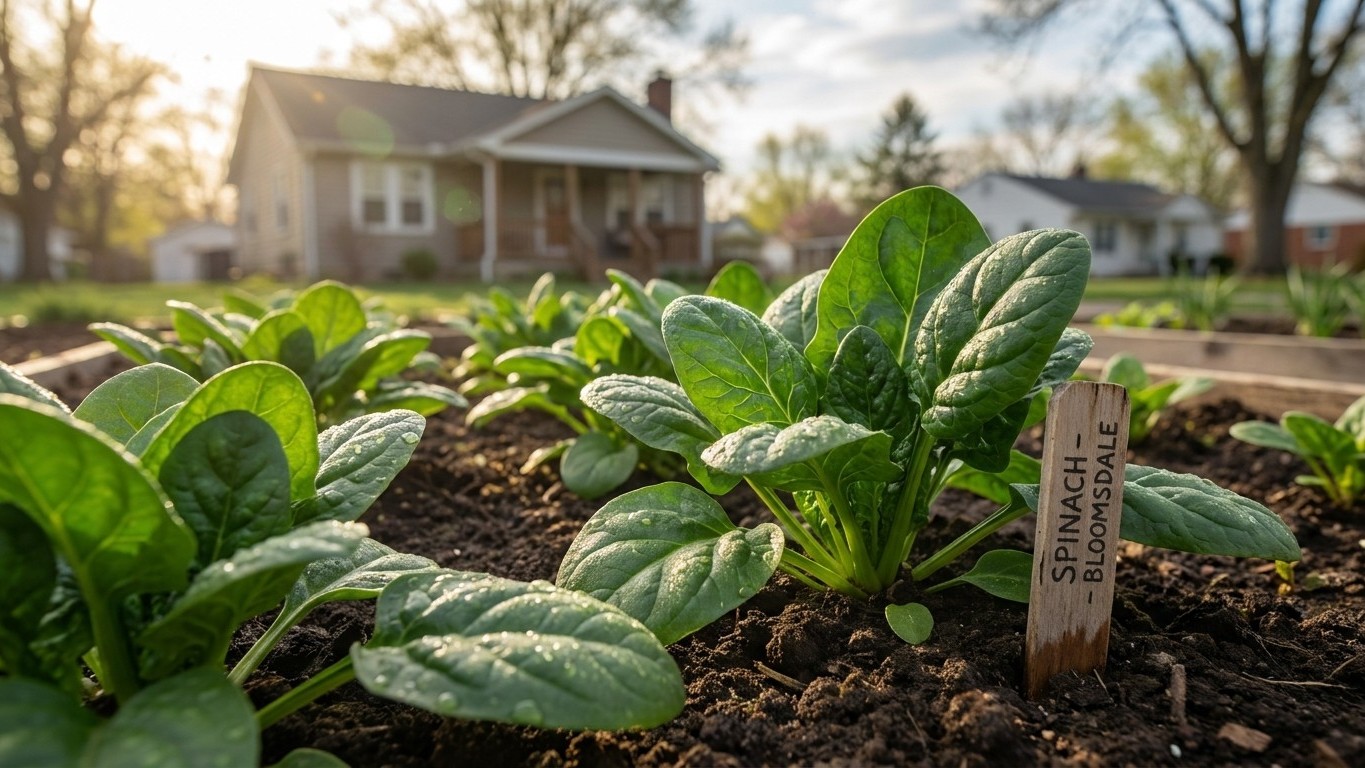

Spring spinach in the Willamette Valley bolts as the days close in on the 15-hour, 30-minute mark reached at the June solstice, which usually means the harvest window shuts by late May or very early June. A fall crop has to be sown roughly 50 to 75 days before the first frost, so seed goes in the ground sometime between mid-August and mid-September west of the Cascades, a timing question covered in depth in When to Sow Autumn Spinach in Oregon. Two different triggers, two different calendars.
The short answer
Portland sits at a latitude where the longest day of the year runs 15 hours and 30 minutes of daylight. That number matters more than most gardeners realize, because spinach flowers in response to long days as well as to warm temperatures. It does not wait for heat to show up before it starts putting energy into a seed stalk instead of leaves. As the days lengthen through April and May, spinach is already reading the calendar, and by the time daylight gets close to that 15-hour-30-minute ceiling, bolting is underway whether or not the thermometer has cooperated. This is the exact question many gardeners ask when they wonder Will Spinach Bolt Early in Oregon?
This is the part that trips people up who move to Oregon from a hotter, shorter-summer-day state and expect the mild coastal-influenced climate to buy them extra weeks. It doesn’t, because the trigger isn’t really about how hot it gets. A cool, drizzly Portland June does nothing to stop bolting if the days are long enough on their own. Heat piles on top of that mechanism rather than replacing it: spinach grows best where temperatures stay under 75 degrees Fahrenheit, and that ceiling is also where the leaves start turning bitter. Willamette Valley summers aren’t brutal by national standards. The station behind these numbers averages just 11.9 days a year at 90 degrees or hotter, so this isn’t a place where spinach gets baked out of existence the way it might in the Sacramento Valley or the Texas Panhandle.
So which limit actually governs Oregon’s spinach season, the day length or the heat? Both, but they arrive in a specific order. Day length is the first hand on the clock, pushing plants toward flowering as spring progresses no matter the weather. Heat is the second hand, and in a place with a modest 11.9 annual days above 90 degrees, it tends to arrive a little later and finish the job the long days already started. West of the Cascades, day length sets the outer edge of the window, and rising temperatures usually confirm the closing rather than causing it early. That’s different from a hot interior climate where heat alone can end things before the days ever get that long.
How long the spring window really is
- Start from the last frost. At the reference station, the last spring freeze falls somewhere between March 6 and March 21. Spinach seed goes in the ground 2 to 3 weeks before that date, which puts a realistic sowing window from roughly late February through the first days of March for most Willamette Valley gardens.
- Give it several weeks of cool growth. Spinach germinates and grows well in cool soil, and March and April in western Oregon rarely push temperatures anywhere near the 75-degree growth ceiling, so this stretch is close to ideal for leaf production.
- Watch the days lengthen through April and May. Daylight is climbing steadily toward that June peak of 15 hours 30 minutes, and spinach is responding to that lengthening the entire time, not just on the solstice itself.
- Expect bolting to begin as days approach the seasonal maximum. By the back half of May, most plantings are showing seed stalks, and any run of warm weather on top of that (even short of the mean 11.9 annual days above 90) speeds things along and adds the bitterness that comes with the same 75-degree threshold.
- Total usable spring window. Counting from a late-February or early-March sowing to a late-May finish, Willamette Valley gardeners get roughly 10 to 12 weeks of good spinach growth before the crop turns to seed.
The autumn crop, and when the soil lets you sow
Fall spinach dodges the long-day problem almost entirely, since daylight is shrinking rather than building through late summer and into autumn. That removes one trigger from the equation. What’s left is a narrower, more practical set of obstacles tied to soil temperature on one end of the calendar and frost on the other.
Soil too warm to germinate
Spinach seed struggles when soil temperatures climb above 80 degrees Fahrenheit, and germination drops off noticeably at that point. Late July and August in the Willamette Valley routinely run warm enough at the soil surface to slow or stall a direct sowing, even in a region that averages only 11.9 days a year above 90 degrees in the air. Ground temperature lags air temperature, but it still climbs high enough in mid-to-late summer to matter for a seed that prefers things cool. Gardeners sowing a fall crop typically need to wait until the hottest stretch of summer has passed, watching for soil that has started to cool rather than working off a fixed date, since exact soil-cooling timing for this region isn’t published in the source data behind this figure.
Frost sets the finish line
The first fall frost at the reference station arrives between November 11 and November 27. Utah State University Extension advises sowing a fall spinach crop 50 to 75 days before the date you want to harvest, since no specific days-to-maturity figure is published for the crop. Counting back from a harvest target of roughly early November, that math lands sowing somewhere between mid-August and mid-September for most Willamette Valley gardens, which lines up with the point in the season when soil temperatures are finally coming down out of that germination-limiting range. Four varieties commonly discussed for garden use, Bloomsdale, Melody, Teton, and Olympia, are named in Utah State’s guidance, though the source publishes no comparative data on how any of them perform, so there’s no verified basis here for recommending one over another.
Checking this against your own county
Every figure above comes from a single reference station representing the Portland area, west of the Cascades. Central and eastern Oregon sit in high desert country with a much shorter frost-free season, colder winters, and different soil-warming patterns, so none of these dates should be applied statewide without adjustment. A gardener in Bend or Pendleton working off Portland’s frost dates is likely to sow too early in spring and too late in fall.
The most reliable next step is Oregon State University Extension Service (https://extension.oregonstate.edu/), which maintains county-level guidance and can point to local frost data for whichever part of the state a garden actually sits in. That’s a better foundation for fine-tuning sowing dates than assuming Willamette Valley numbers apply everywhere.
Common questions
Does shade delay bolting in an Oregon garden?
Shade can lower the temperature around the plants, which helps with the heat side of the equation and the 75-degree bitterness threshold. It does nothing about day length, though, since spinach responds to how long the sun is up, not how bright it feels at soil level.
Can I sow spinach in an Oregon summer?
It’s a difficult window. Long days through June and July keep pushing existing plants toward bolting, and soil temperatures above 80 degrees reduce germination for any new seed going in, so summer sowing in the Willamette Valley works against both mechanisms at once.
Why does my Oregon spinach bolt even in a cool June?
Because the trigger is day length as well as heat. A mild, overcast June in western Oregon still delivers daylight close to the 15-hour-30-minute summer maximum, and that alone is enough to push spinach toward flowering regardless of the temperature.
Is fall spinach easier to grow than spring spinach in Oregon?
It avoids the long-day trigger, which removes one major cause of bolting. The tradeoff is the germination challenge from warm late-summer soil above 80 degrees, so fall growing swaps one obstacle for a different one rather than eliminating difficulty altogether.