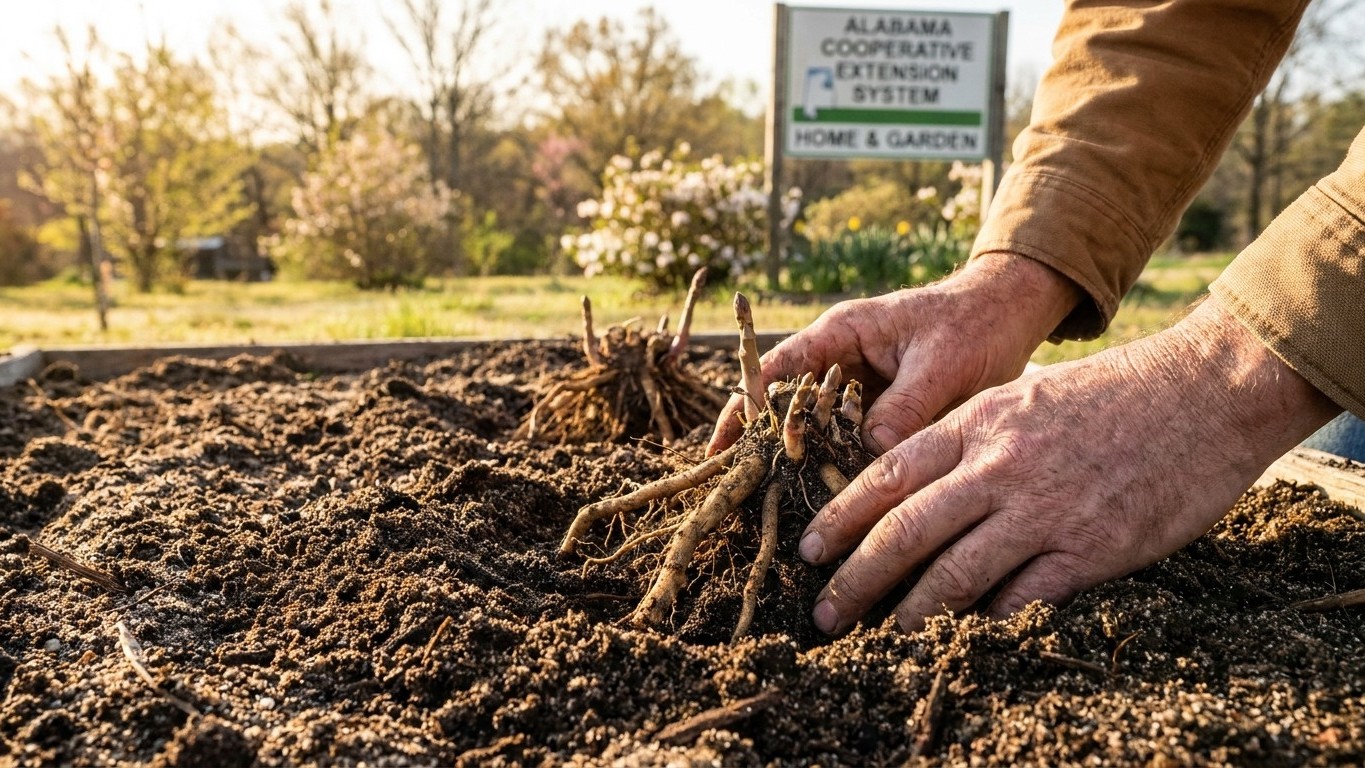

Plant asparagus crowns in early spring, timed to this region’s frost window: around March 29 to April 6 in the Philadelphia area, running two to four weeks later once you move into the northern tier and the Alleghenies. The soil under your feet matters more than the calendar here, because this is a bed that stays put for a decade or more.
The short answer
An asparagus bed is not a crop you rotate next season. Plant it right and it produces for 10 to 15 years in the same spot, which makes the choice of ground a bigger decision than almost anything else in a home garden. The only real requirement, according to Utah State University Extension, is that the soil drains. Most soils will grow asparagus fine as long as water doesn’t sit on the roots.
Pennsylvania’s representative soil, the Hazleton series (an Inceptisol, a young soil that hasn’t built strong layers yet) runs 46 percent sand, 12 percent clay and 42 percent silt at the surface, with organic matter around 3.0 percent. That texture, sandy loam leaning toward silt loam, is built to shed water rather than hold it. If your garden sits on something close to this profile, drainage isn’t your problem.
That’s the state’s answer, not your garden’s. The Hazleton series is what USDA NRCS lists as representative of Pennsylvania soils broadly, mapped from hundreds of sampled components across the state. Your own bed might be river-bottom clay from a floodplain, or compacted fill left behind by a builder, both of which hold water far longer than the sandy loam this series describes. A simple test: dig a hole a foot deep, fill it with water, and see how long it takes to drain. If water is still standing after several hours, the ground under your asparagus needs help before the crowns go in.
If the ground doesn’t drain
Raised beds solve this without moving the whole garden. Building the planting area 8 to 12 inches above grade, and working in coarse organic matter, gets the roots out of standing water without changing your address. A gardener on heavy clay who skips this step is signing up for a decade of soggy crowns and thin spears.
Whatever the soil, the timeline stays the same once the bed is established: no harvest at all in year one or two. Year three brings a first cutting window of about four weeks, extending to six weeks the following year and eight weeks after that. The rule for when to stop cutting each season is not a date on a calendar. It’s a size: once most of the spears coming up are thinner than a pencil, the plant needs to stop producing spears and start building next year’s root reserves. Cut past that point and you’re weakening the bed for years to come.
Will the summer here water it for you?
Pennsylvania’s summer normals run about 12.7 inches of rain across June, July and August, with June the driest month at 4.04 inches, July at 4.38, and August at 4.29. That’s a decent amount of rain by national standards, but asparagus beds have their own schedule, and the two don’t automatically line up.
- Years one and two: the bed wants 1 to 2 inches of water every other week while roots establish. Spread across a two-week window, the region’s summer normals come close to covering the low end of that range on paper, but rain rarely falls in neat, evenly spaced installments. A dry stretch in late June, common in the driest of the three summer months, can leave a young bed short even in a normal-rainfall year.
- Established beds, year three onward: the watering need drops to 1 to 2 inches every three weeks. Here the region’s summer rainfall has more room to cover the requirement on its own, especially in July and August when normals run slightly higher than June.
- The catch with any rainfall normal: these are 1991-2020 averages for a single reference station, not a forecast and not a measurement of your backyard. A thunderstorm that dumps an inch in twenty minutes mostly runs off a sloped or compacted bed rather than soaking into the root zone, so the same “inch of rain” on paper can mean very different amounts of usable water depending on your soil and your yard’s grade.
- What to actually do: put a rain gauge on the bed itself. If a two-week stretch comes up short of 1 to 2 inches during establishment, or a three-week stretch falls short once the bed matures, add water directly rather than trusting the regional average to have covered it.
When to put the crowns in
Crowns go into the ground in early spring, planted into furrows about 8 inches deep. In the Philadelphia area, that lines up around the region’s last spring frost window of March 29 to April 6. Further north and into the Alleghenies, where spring arrives two to four weeks later, the planting window shifts back accordingly. A mean frost date is an average built from three decades of records, not a guarantee for any single spring, so treat it as a target to plan around rather than a hard line to plant on.
The furrow itself isn’t filled in all at once. Crowns are set in the trench and covered with just a couple inches of soil at first, then backfilled gradually as the season progresses, roughly 2 inches every other month, until the furrow is level with the surrounding bed by year’s end. Filling it in one shot buries the emerging shoots too deep and slows the whole planting down.
The seed alternative
Starting from seed is the other route, though it adds a full year to an already long timeline: seedlings need a season in a nursery bed before they’re transplanted out as year-old crowns, pushing the eventual first harvest back accordingly. For most home gardens, buying crowns and planting them directly in early spring is the more practical path, since it skips that extra year of nursery growing before the bed even goes into its permanent spot.
Variety selection is worth a mention here, though the published information on it is thin. Utah State University Extension names four varieties by their flower type alone: Jersey Giant and Jersey Knight are all-male, while UC 157 F1 and Purple Passion are male/female types. No flavor comparison, yield figure, or reason to prefer one over another is published by that source, so treat variety choice as a matter of what’s available locally rather than a decision with documented performance differences behind it.
Common questions
Does soil pH matter for planting asparagus in Pennsylvania?
The surface pH of the state’s representative Hazleton soil runs around 4.6, which is strongly acid. That figure describes the mapped soil series, not a proven requirement for asparagus, and the source used for the bed’s planting and care guidance is silent on what pH the plant actually prefers. A soil test of your own bed is the only way to know where you stand, since acidity varies enormously between a sandy hillside and a cultivated garden plot even within the same county.
How long before I get a real harvest?
None in year one, none in year two. Year three brings the first cutting window, about four weeks long, followed by six weeks in year four and eight weeks in year five and beyond. Cutting earlier or longer than that weakens the crowns before they’ve had a chance to build up reserves.
Can I plant crowns later in spring if I miss the early window?
Crowns can go in later, but the plant loses growing time before summer heat arrives, and a late planting into warming, drying soil puts more pressure on the watering schedule during that critical first year. Early spring, close to this region’s frost window, remains the better target.
Do I need a winter chilling period for asparagus in Pennsylvania?
That figure isn’t published in the sources behind this guidance, and the state’s hardiness zone shouldn’t be treated as a stand-in for a chilling requirement. Asparagus is grown across a wide range of Pennsylvania’s climate without a documented chill-hour threshold attached to it.