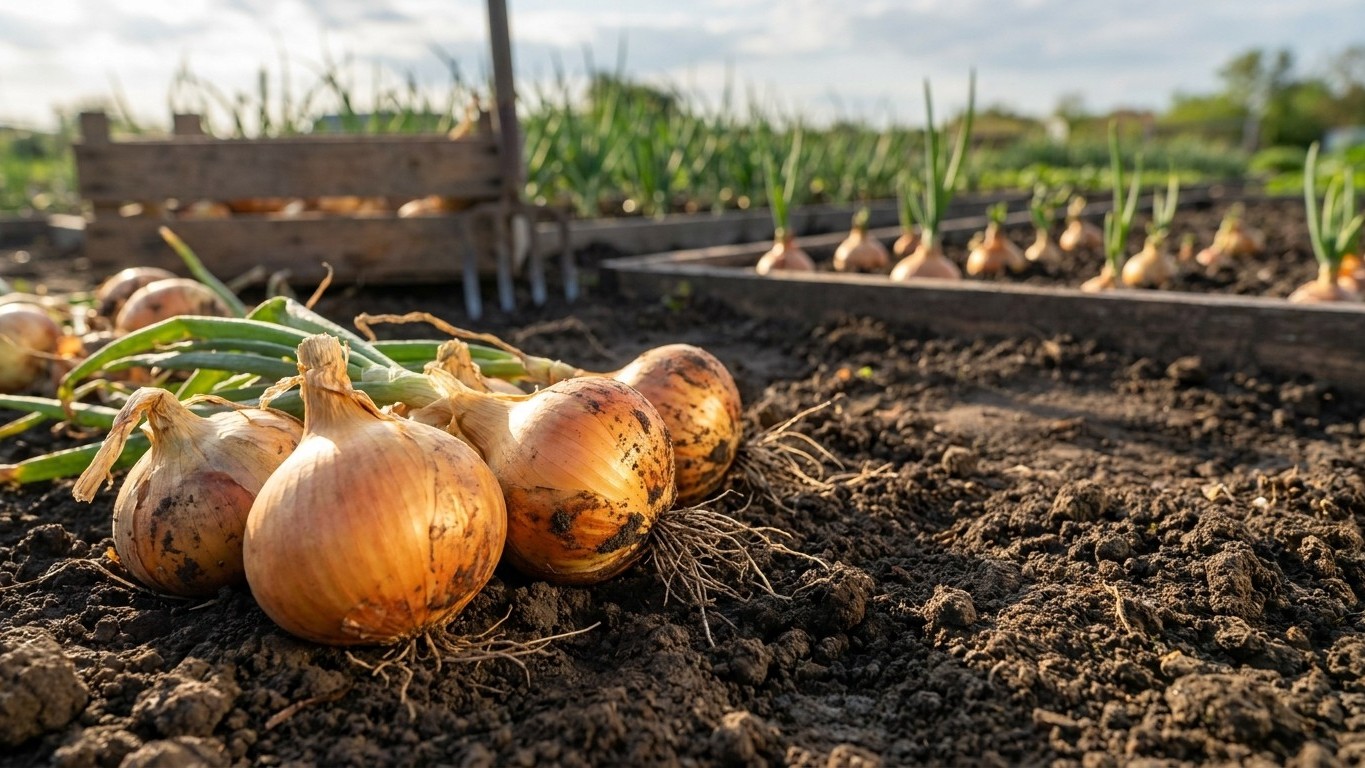

Lift onions once most of the tops have flopped over and begun to yellow. That usually happens between midsummer and early fall, depending on planting date and variety. Pull them on a dry day and cure them before they go anywhere near storage. Curing is finished when the necks are tight and the skins are papery. After that, a cool, dry spot keeps pungent varieties into late winter, while sweet ones give out much sooner. For the full growing season, start with Onions in Pennsylvania.
Keeping them, and for how long
What do cured onions need to last?
Clemson Cooperative Extension’s Home & Garden Information Center gives the target in one line: “Ideal conditions are between 45 °F and 55 °F, and 50 to 60 percent humidity.” Write those numbers down. The Clemson factsheet on onions, leeks, shallots and garlic is the source.
The humidity figure surprises people who store carrots, beets and potatoes, because those roots want damp air. Onions want dry air. A single cellar cannot hold both well, so if you grow both crops, they usually need two different spots. And none of this applies to bulbs fresh from the ground. They go into storage only after curing, once the necks are tight and the skins are papery.
Why do sweet onions not keep as long?
University of Missouri Extension (publication G6355) says it plainly: “As a rule, ‘sweet’ onions do not store as well as the more pungent types.” The reason is chemical. The bite of an onion comes from volatile sulfur compounds, and those same compounds help protect the bulb through months in storage. A sweet variety carries fewer of them. It tastes better raw and will not last the winter. If you want a sweet onion that stores, you are asking for something that does not exist, so eat the sweet ones first and save the pungent ones for later. Variety choice is covered in The Best Onion Varieties for Pennsylvania.
Day length lines up with this. Clemson notes that short-day varieties start bulbing at about 12 hours of daylight, and they tend to run sweeter. Long-day varieties wait for 14 to 16 hours and tend to keep longer. The reference point here is Philadelphia, at 39.87 degrees north, where the longest day of the year has 14 h 50 of daylight. That figure is calculated from the latitude with the standard sunset formula, and it leaves out the roughly seven extra minutes that atmospheric refraction adds. It sits inside the long-day range, so long-day onions bulb there. Short-day types bulb early and stay small. If you garden in the far northern counties or along the southern border, look up your own latitude, because it shifts the picture.
How long will stored onions last?
A long-day, pungent onion cured well and held at those conditions can feed a northern household into March. Treat that as a ceiling under ideal conditions, not a promise. A warm spell, a damp corner or one bruised bulb will shorten it. Check the pile every couple of weeks and use any onion that feels soft at the neck right away. Bulbs scarred by maggots or thrips are the first to rot, so cook those first. What Eats Onion in Pennsylvania, and When explains which damage to look for.
Where in the house that actually is
Which room comes closest to 45 to 55 °F and dry?
A refrigerator is set well below 45 °F. A heated living space is too warm, and a kitchen counter is warmer still. An attached garage swings with the weather.
The best choice in a typical Pennsylvania house is a cool interior spot that stays dry. Good options are an unheated back bedroom, a pantry closet on an inside wall, or a basement corner well away from the furnace and the water heater. Many basements here run damp, and that moisture invites mold on the skins. A basement that is both cool and dry in fall and winter works well. One that sweats in August needs a dehumidifier or a different spot.
What should you check with a thermometer?
Put a thermometer with a humidity readout where the onions will sit, and read it for a week before you move them in. Skip that step and you can lose a whole bin to a spot that looked fine. Check it regularly, and read it again after the first hard cold snap. Aim for readings between 45 °F and 55 °F with humidity between 50 and 60 percent.
Store the bulbs so air moves around each one. A sealed plastic tub traps moisture.
How do you tell when onions are ready to lift, and how do you cure them?
When are onions ready to lift?
Watch the tops. When the leaves fall over and the neck at the base of the tops goes soft, the bulb has stopped growing and is ready to pull. Day length triggered that bulb in the first place, so the timing follows the variety. Early-bulbing short-day types finish sooner than long-day ones, which hold their leaves longer. Lift on a dry day and handle the bulbs gently. Leave the tops on.
How do you cure onions?
Spread the bulbs in a single layer somewhere dry, shaded and airy. Keep them out of rain and direct sun. The tops dry, the neck shrinks and tightens, and the outer skins turn papery. Test it by squeezing the neck: it should feel firm and dry. Only then trim the tops to a short stub and move them to storage.
Common questions
Can I keep sweet onions through winter?
Not for long. Sweet onions carry fewer of the sulfur compounds that protect a bulb in storage, so plan to eat them first, in the weeks after curing. Save pungent varieties for the long haul.
Is the refrigerator a good place to store whole onions?
No. It runs colder than the 45 °F floor Clemson gives, and the humidity is too high. A cool, dry room does better.
Should I wash onions before curing them?
Don’t. Water on the skins and necks invites rot, and curing exists to dry those parts out. Let the soil dry on the bulbs and brush it off afterward.
What if the necks stay thick and green?
Those bulbs are not ready for storage. A thick, green neck holds moisture. Give them more time curing in dry, airy shade, and use them first because they will not last as long as bulbs with tight, dry necks.