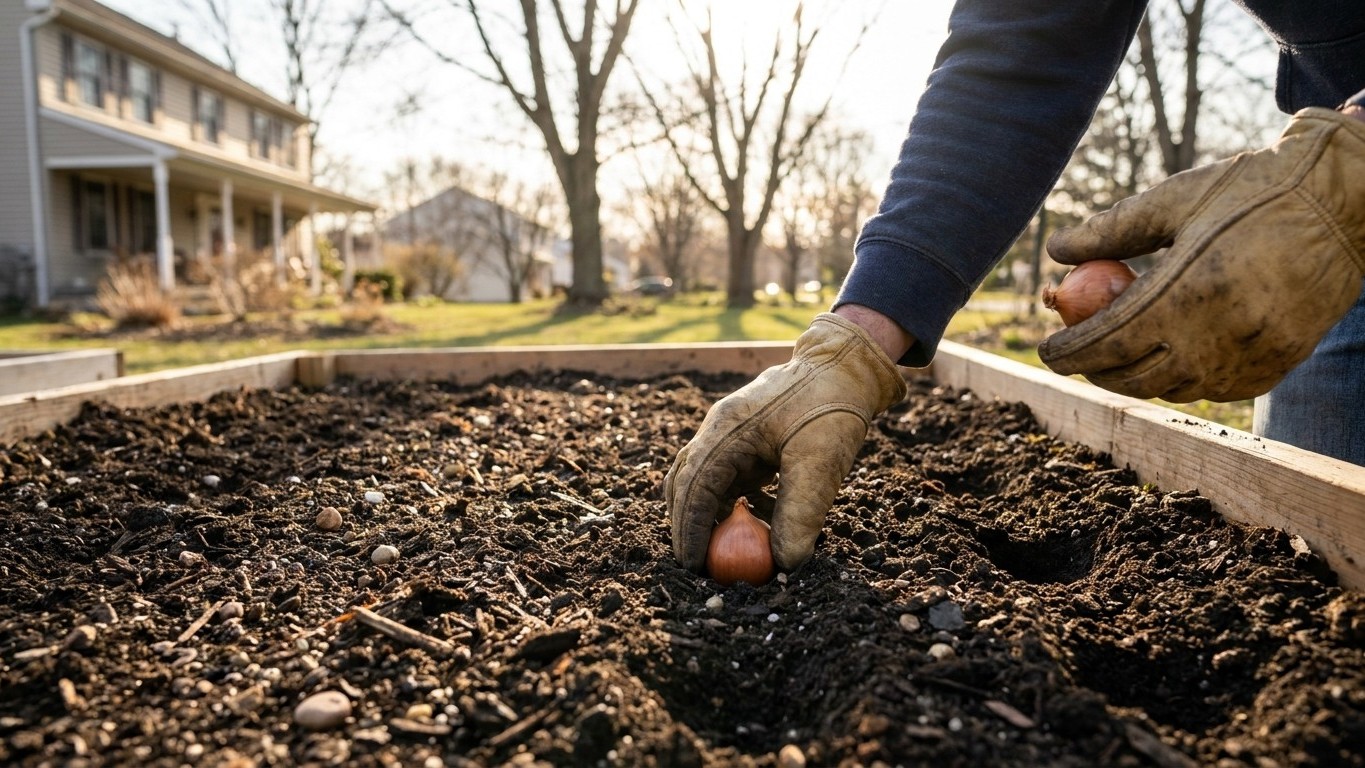

Pennsylvania onions go into the ground in late winter to early spring, not autumn, because winters here are too cold for the fall-planting approach that works in mild-winter states. Philadelphia sits at 39.87 degrees north, where the longest day of the year delivers 14 hours and 50 minutes of daylight. That single number decides which onion varieties will bulb here at all, and it decides the planting window too.
The short answer for Pennsylvania

Onions don’t respond to temperature the way tomatoes or peppers do. They respond to day length. Once daylight reaches a variety’s bulbing threshold, the plant stops making leaves and starts making a bulb, whatever size it happens to be at that moment. At Philadelphia’s latitude, the longest day tops out at 14 hours and 50 minutes, which places Pennsylvania squarely in long-day and intermediate-day territory rather than short-day territory.
That’s the reason fall planting doesn’t work here the way it does in Georgia or Texas. In mild-winter states, gardeners plant short-day onions in autumn, let them overwinter as small plants, and let the naturally short days of early spring trigger bulbing on schedule. Pennsylvania winters kill that plan outright. The onions freeze, or they survive but the short-day trigger point (around 12 hours) arrives too early in the season for the plant to have made any real growth.
Instead, Pennsylvania gardeners start onion seed indoors in January or February, or buy sets and transplants, and get them into the ground as soon as the soil can be worked, typically some point in March. That gives the plant several months to build leaf mass before the June solstice pushes day length toward its 14 h 50 peak and triggers bulbing in long-day and intermediate-day types.
Eighteen of the varieties tracked on this site have published latitude ranges that cover 39.87N, meaning they’re a documented fit for Philadelphia’s day length: Ailsa Craig, Barolo, Blush, Bridger, Cabernet, Calibra, Candy, Elsye, Expression, Monastrell, New York Early, Patterson, Red Long of Florence, Red Long of Tropea, Rossa di Milano, Scout, Sierra Blanca, and Walla Walla Sweet. A gardener choosing among these isn’t guessing. The catalog data lines up with the daylight math.
What will not work here
Planting the wrong day-length group doesn’t produce a disappointing onion. It produces no onion, or an onion the size of a golf ball, and the two failures happen for opposite reasons.
Short-day varieties fail because Pennsylvania’s daylight passes their 12-hour bulbing trigger while the plants are still young. The bulb starts forming on schedule, but the plant hasn’t had time to grow enough leaf mass to feed a full-size bulb, so the harvest is small onions rather than no onions:
- Gabriella (short-day, 20-35N), bulbs too early here, giving an undersized onion
- Madalyn (short-day, 20-35N), same failure, triggers well before the plant is grown
- Red Rock (short-day, 30-36N), bulbs before adequate leaf growth
- Red Sensation (short-day, 25-35N), same day-length mismatch
- Texas Grano 1015Y (short-day, 25-35N), built for southern latitudes, not this one
- Vidora (short-day, 25-35N), bulbs too soon at 39.87N
- White Castle (short-day, 30-38N), just south of Pennsylvania’s range, same problem
The other failure runs in the opposite direction. Some long-day varieties need more daylight than Pennsylvania’s summer ever provides:
- Powell (long-day, 43-47N), the trigger threshold is never reached here
- Redwing (long-day, 43-65N), needs daylight well beyond 14 h 50
- Safrane (long-day, 42-50N), day length here falls just short of the requirement
- Talon (long-day, 42-50N), same shortfall
These four don’t give a small bulb. They never get the signal to bulb at all, so the plant keeps producing leaves all season, then rots in the ground or in storage with nothing underneath. That’s a different failure than the short-day mistake, and it’s worth knowing which one you’re risking before you order seed.
There’s also a timing trap that has nothing to do with variety choice. Planting late does not push the harvest date back. It shrinks the harvest. The bulbing trigger fires on the calendar, tied to day length, regardless of when you got the plant in the ground. An onion transplanted three weeks late has three fewer weeks of leaf growth when that trigger arrives, so it bulbs on schedule anyway, just smaller.
What changes across Pennsylvania
Pennsylvania isn’t one latitude. The state runs from roughly the Mason-Dixon line near 39.7N up to the New York border above 42N, a spread of more than two degrees. The figures above belong to Philadelphia specifically, at 39.87N, which sits near the state’s southern edge.
A gardener in Erie or Scranton, closer to 42N, gets a longer summer day than Philadelphia does. That extra daylight is modest, just a few minutes more on the solstice, but it’s enough to matter for the two varieties sitting in the blurred zone of their published ranges: Frontier (long-day, 40-50N) and Red Carpet (long-day, 40-45N). At Philadelphia’s latitude these are borderline and may or may not bulb reliably. Further north in the state, they’re closer to the middle of their documented range rather than the edge of it.
| Location | Latitude | Longest-day daylight | What it changes |
|---|---|---|---|
| Philadelphia (reference city) | 39.87N | 14 h 50 | Baseline for the varieties listed above; borderline varieties are at the edge of their range |
| Northern tier PA (Erie, Scranton area) | ~42N | Slightly more than 14 h 50 | Blurred-zone long-day varieties sit closer to mid-range; spring soil-working and transplanting typically run about two weeks later than in the southeast |
The two-week spring lag in the north matters as much as the daylight difference. Colder soil and a later last frost mean northern Pennsylvania gardeners are usually transplanting into the ground closer to early April than mid-March, which shifts the whole planting calendar even though the day-length math stays close to what southeastern growers see.
Sweet now, or onions that last
Pennsylvania’s position in long-day and intermediate-day territory comes with a trade-off that has nothing to do with taste preference and everything to do with chemistry. The volatile sulfur compounds responsible for an onion’s bite are the same compounds that protect the bulb in storage. More sulfur means more pungency and a longer shelf life. Less sulfur means a milder, sweeter onion that spoils faster.
University of Missouri Extension states the pattern plainly: sweet onions do not store as well as the more pungent types. That’s not a quirk of any particular variety. It’s the underlying mechanism, and it lines up with the day-length groups discussed above. Short-day varieties, the ones excluded from Pennsylvania gardens entirely, tend to run sweeter. Long-day and intermediate-day varieties, the ones that actually bulb here, tend to run sharper and keep longer.
From the list of 18 varieties suited to Philadelphia’s latitude, that split shows up directly. Walla Walla Sweet and Candy lean toward the sweeter, softer, use-it-soon end. Ailsa Craig, Patterson, and Cabernet lean toward the sharper end that holds up in a root cellar or pantry for months.
What that means for a Pennsylvania kitchen is a pantry that can still hold onions in March, provided the gardener planted toward the pungent end of the lineup. A southern grower working with sweet short-day onions is usually finishing off that harvest well before winter ends. A northern grower who chose a sharper long-day variety is often still pulling onions out of storage as the next season’s seedlings go in.
Checking this against your own garden
Everything above is built from Philadelphia’s coordinates. If your garden sits closer to the New York border or down near the Maryland line, the numbers shift enough to matter, and no state-wide figure should be treated as gospel for every yard in it.
- Look up your own latitude if you’re more than an hour’s drive from Philadelphia; a degree or two changes which borderline varieties will actually bulb
- Call your county extension office for local last-frost and first-frost dates rather than relying on a statewide average
- Check whether your chosen variety’s published range covers your latitude, not just Pennsylvania’s in general
- If you’re near 42N, ask your extension office whether the blurred-zone long-day varieties have performed reliably in your specific county
- Track your own solstice daylight hours for one season if you want a number more precise than the state-level estimate
Penn State Extension offices maintain county-level frost date records that are more useful for planting decisions than any statewide range, since a garden in the Poconos and a garden along the Delaware River can be weeks apart in soil workability even though both sit inside the same state line.